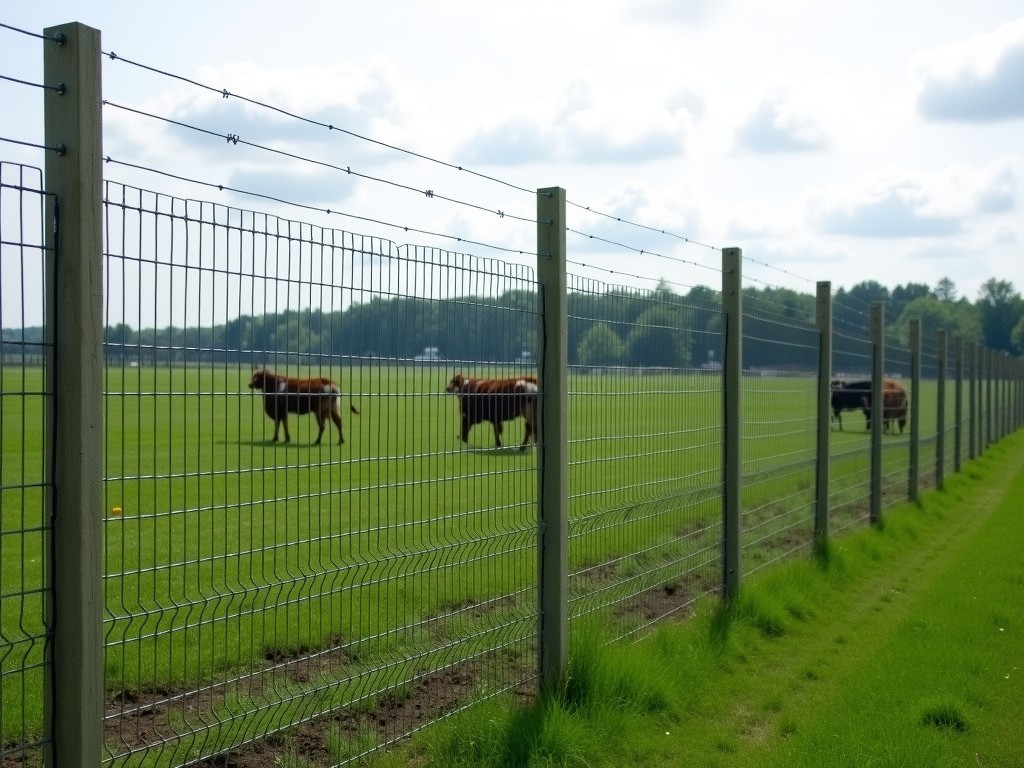
Wholesale Heavy Duty Cow Pasture Fencing Supplier
Heavy duty pasture fencing must contain livestock while resisting impact from cattle, environmental corrosion, and repeated tensioning cycles. The design focuses on high tensile steel, adequate
Request a QuoteWholesale Heavy Duty Cow Pasture Fencing
Heavy duty pasture fencing must contain livestock while resisting impact from cattle, environmental corrosion, and repeated tensioning cycles. The design focuses on high tensile steel, adequate coating thickness, and geometry that prevents animal entanglement while maintaining structural integrity under dynamic loads.
Material selection begins with low‑carbon steel wire meeting ASTM A641 for galvanized coating. Typical wire diameters range from 3.0 mm to 4.5 mm, providing a minimum tensile strength of 550 MPa. The zinc coating weight is specified at 275 g/m² (equivalent to G90) to achieve a service life exceeding 20 years in humid climates.
The fence fabric uses a square‑mesh pattern with opening sizes of 100 mm × 100 mm or 150 mm × 150 mm, chosen to deter hoof penetration while allowing visibility. Mesh wires are welded at each intersection, creating a rigid panel that distributes impact loads across multiple wires rather than concentrating them on a single strand.
Posts are typically hot‑dip galvanized C‑channel or tubular sections with a wall thickness of 2.5 mm and a nominal height of 2.1 m. Post spacing is set at 3.0 m intervals, which balances material economy with the required flexural rigidity to resist wind loads and animal pressure without excessive deflection.
Mechanical performance is validated through full‑scale pull‑out tests. A standard 2.1 m high panel with 3.0 mm wire and 100 mm mesh demonstrates an ultimate load capacity of approximately 12 kN per post before permanent deformation, well above the expected dynamic load from a herd of cattle (approximately 2–3 kN per impact event).
Corrosion resistance is evaluated via salt‑spray testing (ASTM B117). Panels with G90 coating show less than 5 % loss of coating thickness after 1000 hours, translating to a predicted rust‑free period of over two decades in typical pasture environments.
Typical Specifications
| Parameter | Typical Value |
|---|---|
| Wire Diameter | 3.0 mm – 4.5 mm |
| Tensile Strength (Wire) | ≥ 550 MPa |
| Coating Weight (Zn) | 275 g/m² (G90) |
| Mesh Opening | 100 mm × 100 mm or 150 mm × 150 mm |
| Post Spacing | 3.0 m |
| Panel Height | 1.5 m – 2.4 m (custom) |
| Expected Service Life | > 20 years (rural) |
Applications extend beyond simple containment. The open mesh design reduces wind loading, lowering the required post embedment depth. Visibility through the fence aids herd monitoring and reduces stress, while the smooth wire edges minimize injury risk during handling or when animals rub against the barrier.
Customization options are driven by site‑specific conditions. Clients may select increased wire diameter for high‑pressure areas, alternative coatings such as Zn‑Al‑Mg for salt‑laden environments, or varied mesh sizes to exclude smaller predators. Post types can be switched to timber or concrete where soil conditions dictate, and accessories like tensioners, gates, and barbed wire overlays are available upon request.
Quality control follows a sequential protocol. Raw wire is inspected for diameter and tensile strength before welding. Post‑weld panels undergo dimensional verification of mesh opening and wire protrusion. Coating thickness is measured via magnetic induction on random samples, and adhesive strength is assessed by pull‑off testing. Final audit includes a visual inspection for weld integrity and a functional load test on a sample panel per order.
Frequently Asked Questions
- Can the fence height be adjusted for specific livestock breeds?
- What information is needed to obtain a quotation?
Required details include desired height, length, wire gauge, coating type, post material, and any accessories such as gates or tensioners.
- How are panels packaged for transport?
Panels are stacked flat, protected with edge guards, and secured with steel straps. Standard pallet dimensions are 1.2 m × 1.0 m, facilitating container loading.
- What is the typical production lead time?
Lead time ranges from 2 to 4 weeks depending on order size and coating specifications, with expedited options available for critical projects.
Yes, panels are produced in standard increments of 150 mm, allowing heights from 1.0 m for calves up to 2.4 m for bulls or exotic species.
For technical data sheets, sample requests, or to discuss a custom fence solution for your operation, please contact our engineering team via the inquiry form.



