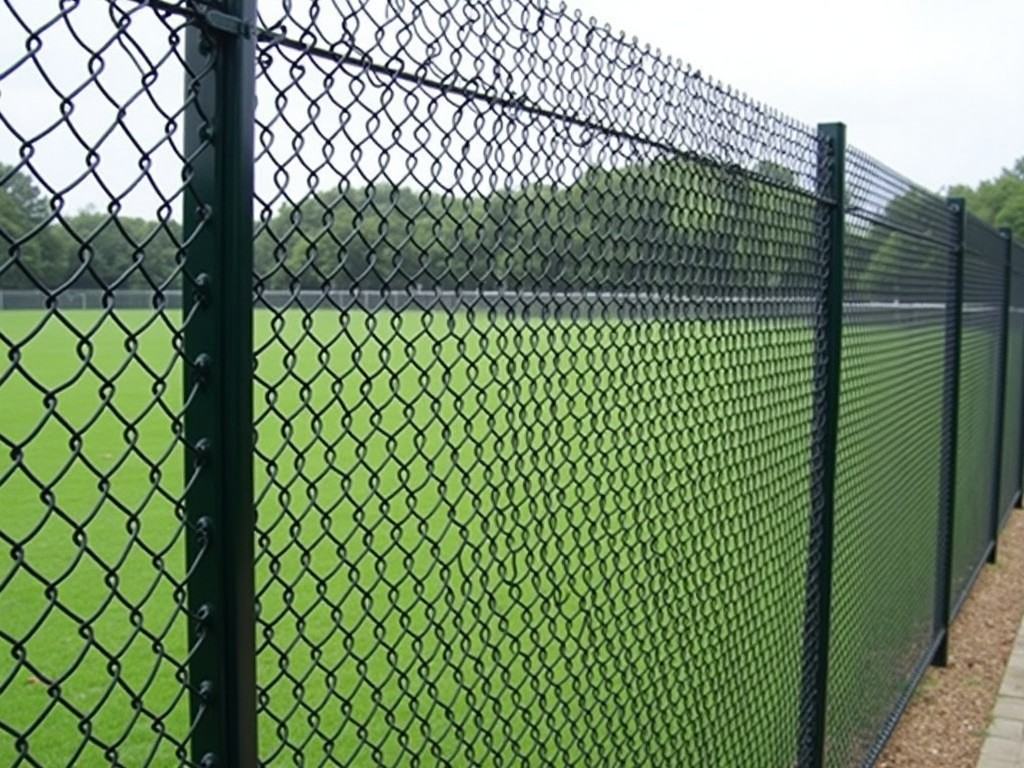
Low Price Price Of Black Chain Link Fence
Black chain link fencing provides a cost-effective barrier for industrial perimeters, storage yards, and temporary site enclosures. Manufacturers produce the fence by weaving galvanized steel wire
Request a QuoteLow Price Black Chain Link Fence
Black chain link fencing provides a cost-effective barrier for industrial perimeters, storage yards, and temporary site enclosures.
Manufacturers produce the fence by weaving galvanized steel wire into a uniform mesh and applying a black PVC or polymer coating for appearance and added corrosion resistance.
Material and Construction
Galvanized steel wire forms the tensile backbone, typically ranging from 2.0 mm to 3.5 mm diameter depending on required load capacity.
The wire undergoes a hot-dip zinc coating process that deposits a minimum of 55 g/m² zinc per side, providing sacrificial protection against rust.
After galvanizing, a black polyvinyl chloride (PVC) coating is extruded over the wire, achieving a thickness of 0.3 mm to 0.5 mm and delivering UV stability for outdoor exposure.
Dimensional Options
| Mesh Opening (mm) | Wire Diameter (mm) | Roll Height (m) | Typical Tensile Strength (kN/m) |
|---|---|---|---|
| 50 | 2.0 | 1.2 | 4.5 |
| 50 | 2.5 | 1.8 | 6.2 |
| 50 | 3.0 | 2.4 | 8.0 |
Applications and Benefits
Industrial facilities select black chain link fencing when a visible yet unobtrusive perimeter is needed to deter unauthorized access while maintaining sightlines for surveillance.
The black coating reduces glare under bright sunlight, which improves camera performance in outdoor security systems compared to traditional galvanized finishes.
Because the fence is lightweight yet strong, it can be installed quickly on uneven terrain using standard tension bars, brace bands, and tie wires, lowering labor costs for large‑scale projects.
Installation Considerations
Posts are typically set in concrete footings at 2.4 m intervals for heights up to 2.4 m, with deeper embedments required for wind‑loaded sites.
Tension wires run along the top and bottom of the mesh to prevent sagging; they are secured using ratchet tensioners that allow periodic retensioning over the fence’s service life.
Ground clearance of at least 50 mm is recommended to prevent moisture accumulation at the base, which helps preserve the coating integrity.
Quality Assurance
Each coil undergoes inline diameter measurement to ensure wire thickness stays within ±0.05 mm of the target specification.
Coating adhesion is verified by a cross‑hatch test per ASTM D3359, with a minimum rating of 4B required for acceptance.
Final inspection includes a visual check for uniform black color and a pull‑test on a sample mesh segment to confirm tensile strength matches the values in the specification table.
Pricing Factors
Unit cost varies primarily with wire diameter, coating thickness, and roll length; larger diameters and thicker PVC layers increase material expense but extend service life.
Order volume influences unit price through reduced setup and handling fees, making full‑truckload purchases more economical for large projects.
Delivery location affects final quote due to freight charges; specifying a nearby regional distributor can lower logistics costs.
Frequently Asked Questions
- Can the mesh opening be customized for specific security needs? – Yes, alternative openings such as 38 mm or 76 mm are available upon request.
- What information is required before a quotation? – Desired height, length, wire diameter, coating thickness, and any special post or accessory requirements.
- How is the black coating applied to ensure uniformity? – The PVC is extruded in a controlled line process, followed by cooling and curing to achieve consistent thickness.
- What packaging methods protect the fence during transit? – Rolls are wrapped in stretch film, placed on pallets, and secured with corner braces to prevent shifting.
Contact for Technical Support and Quotation
For detailed specifications, custom length options, or project‑specific advice, reach out to our engineering team.
Request a Quote


