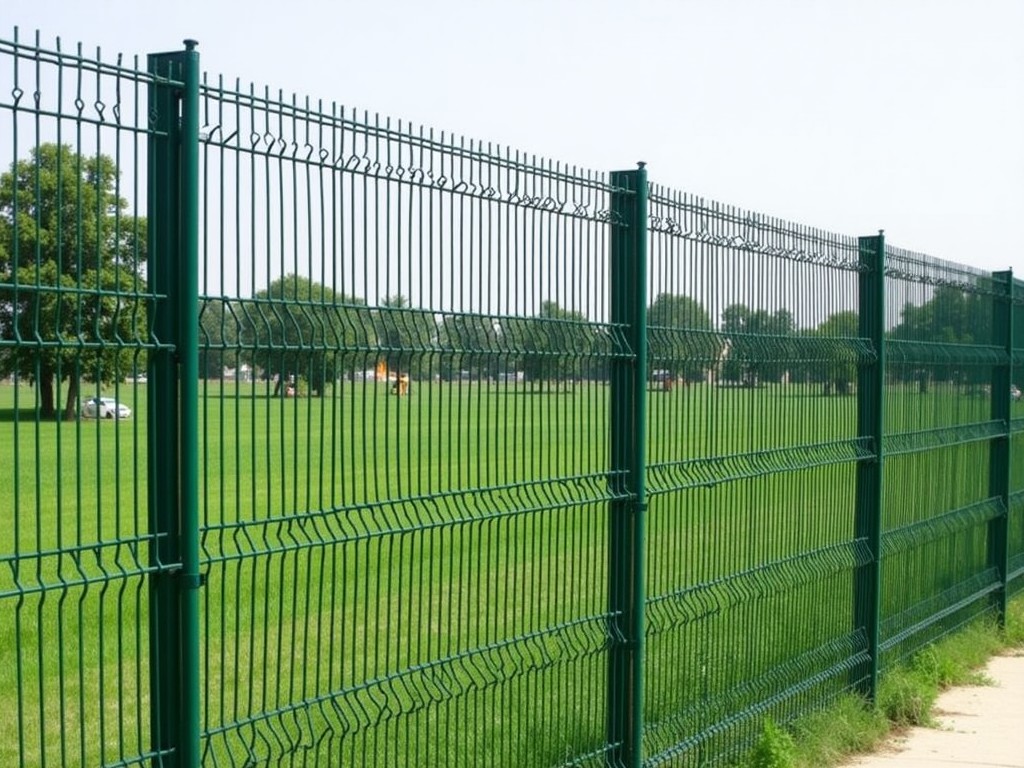
Factory Direct Twin Wire Mesh Fencing Panels Exporter
Twin wire mesh fencing panels consist of two parallel longitudinal wires that are resistance‑welded to a transverse wire at every intersection, creating a grid with enhanced shear stiffness compared
Request a QuoteFactory Direct Twin Wire Mesh Fencing Panels – Exporter
Twin wire mesh fencing panels consist of two parallel longitudinal wires that are resistance‑welded to a transverse wire at every intersection, creating a grid with enhanced shear stiffness compared to single‑wire mesh. The dual‑wire configuration distributes impact loads across both longitudinal members, reducing local deformation and improving long‑term dimensional stability under wind or impact loading.
Material and Construction
The longitudinal wires are typically cold‑drawn steel with diameters ranging from 3.0 mm to 5.0 mm, selected based on required tensile strength. The transverse wire, which forms the mesh openings, is usually the same diameter or slightly smaller to maintain a uniform weld profile. All wires undergo hot‑dip galvanization (Zn ≥ 55 g/m²) or optional PVC coating for corrosion resistance in aggressive environments.
Typical Specifications
| Parameter | Typical Value / Range |
|---|---|
| Longitudinal Wire Diameter | 3.0 mm – 5.0 mm |
| Transverse Wire Diameter | 2.5 mm – 4.5 mm |
| Mesh Opening (center‑to‑center) | 50 mm × 50 mm (standard); 75 mm × 75 mm or 100 mm × 100 mm available |
| Panel Height | 1200 mm – 3000 mm (custom lengths) |
| Panel Width | 2400 mm (standard); 1200 mm or 3000 mm options |
| Tensile Strength of Wire | ≥ 550 MPa (cold‑drawn steel) |
| Coating | Hot‑dip galvanized (Zn ≥ 55 g/m²) or PVC‑coated (thickness 80 µm – 120 µm) |
| Approximate Weight per Panel | 15 kg – 45 kg (depending on size and wire gauge) |
Values shown are typical for stock panels; exact dimensions and mechanical properties can be adjusted to meet project‑specific load criteria, such as wind pressure ratings up to 2.5 kPa or impact resistance classifications.
Applications and Performance Benefits
Industrial facilities select twin wire mesh for perimeter security where both visibility and resistance to climbing are required. The double‑longitudinal wire layout increases the panel’s flexural rigidity by roughly 30‑40 % compared with single‑wire equivalents of the same material weight, which translates to lower deflection under lateral loads and reduced maintenance over the service life. The open geometry also minimizes wind loading, allowing taller installations without excessive foundation reinforcement.
Customization Options
- Wire diameter (longitudinal and transverse) adjustable from 2.5 mm to 6.0 mm
- Mesh aperture sizes ranging from 30 mm × 30 mm to 150 mm × 150 mm
- Panel dimensions tailored to site‑specific height and width limits
- Surface treatment: hot‑dip galvanizing, galvan‑plus‑powder, or PVC coating in various colors
- Edge finishes: rolled top, barbed wire brackets, or anti‑climb extensions
- Compatibility with standard steel or concrete posts, including pre‑drilled mounting holes
Each option is priced according to material usage and processing time; quotations reflect the exact configuration requested.
Quality Control and Testing
Before leaving the factory, panels undergo a series of checks: weld shear strength is measured using a universal testing machine with a minimum acceptance of 2.5 kN per weld; coating thickness is verified with a magnetic‑induction gauge to meet the specified zinc or PVC layer; dimensional tolerances are checked on a calibrated fixture, accepting deviations of no more than ±2 mm on height and width. Random samples are subjected to accelerated corrosion testing (salt spray, 500 h) to confirm coating performance.
Packaging and Export Logistics
Panels are stacked face‑to‑face with protective cardboard corners on all vertical edges, then secured with steel or polyester strapping onto wooden pallets sized for 20‑ft or 40‑ft containers. Each pallet is labeled with part number, quantity, and weight, and a moisture‑barrier wrap is added for shipments to high‑humidity destinations. This method minimizes handling damage and allows quick unloading at the port of destination.
Frequently Asked Questions
Q: Can the panel dimensions be customized?
A: Yes. Height, width, wire gauge, and mesh opening are all adjustable to match project specifications. Provide the required clear opening and loading conditions for a precise quotation.
Q: What information is needed before a quotation can be issued?
A: We require the desired panel size (height × width), wire diameter or strength class, mesh aperture, coating type, and any special edge treatment. Quantities and delivery destination help determine freight costs.
Q: How is quality inspected before shipment?
A: Each batch undergoes weld tensile testing, coating thickness measurement, and dimensional verification per the internal QC protocol described above. Test reports are available upon request.



