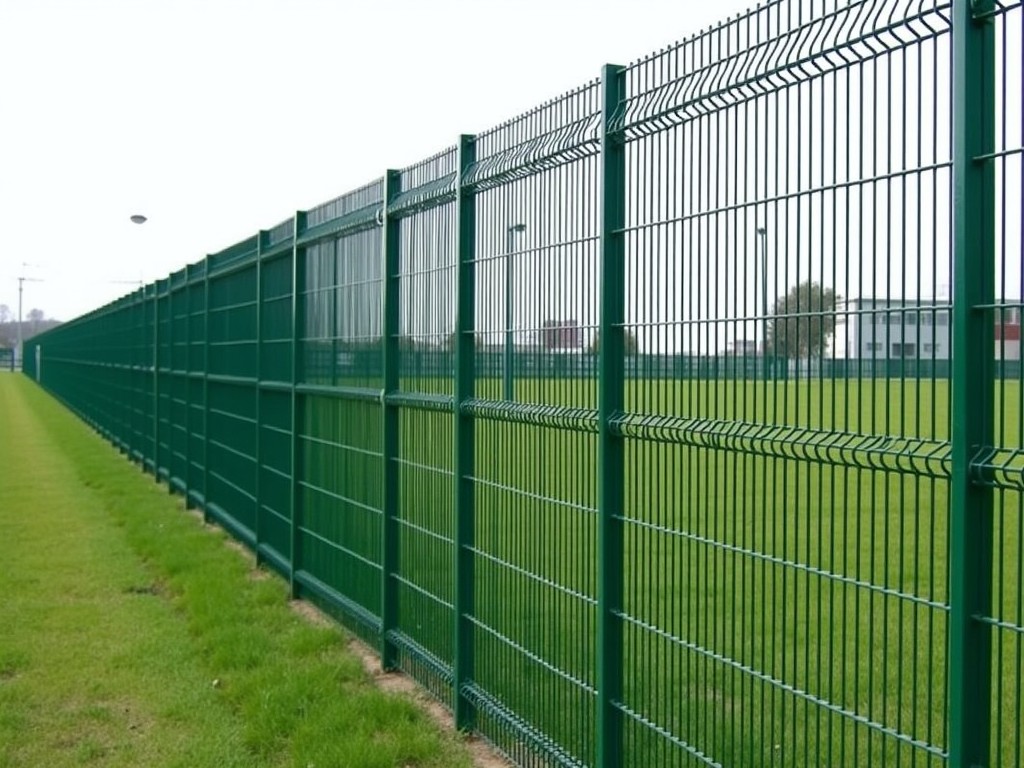
Factory Direct Security Wire Mesh Fence Manufacturer
Security wire mesh fences serve as a physical barrier that deters unauthorized entry while maintaining visibility for surveillance. The product is engineered from steel wire with specific tensile
Request a QuoteFactory Direct Security Wire Mesh Fence Manufacturer
Security wire mesh fences serve as a physical barrier that deters unauthorized entry while maintaining visibility for surveillance. The product is engineered from steel wire with specific tensile strength and coating thickness to resist cutting, climbing, and corrosion over extended service life. Manufacturers control wire diameter, mesh aperture, and panel dimensions to meet the performance requirements of high‑risk sites.
Material & Construction
Core wire is typically low‑carbon steel, cold‑drawn to achieve a uniform diameter ranging from 3.0 mm to 5.0 mm. After drawing, the wire undergoes hot‑dip galvanization or a PVC‑coating process; coating thickness is measured in microns, with galvanized layers commonly 55‑85 µm and PVC layers 150‑250 µm. The mesh is formed by welding intersecting wires at each junction, creating a rigid grid that resists deformation under impact.
Technical Specifications
| Parameter | Typical Value | Unit |
|---|---|---|
| Wire Diameter | 3.0 – 5.0 | mm |
| Mesh Opening (Square) | 50 × 50 | mm |
| Panel Height | 1.8 – 3.0 | m |
| Panel Width | 2.0 – 2.5 | m |
| Tensile Strength of Wire | ≥ 550 | MPa |
| Galvanized Coating Thickness | 55 – 85 | µm |
| PVC Coating Thickness | 150 – 250 | µm |
| Salt Spray Resistance (ASTM B117) | ≥ 500 | hours |
Applications
Facilities that require a clear line of sight combined with intrusion resistance benefit from welded mesh fences because the open geometry allows cameras and patrols to monitor the perimeter without visual obstruction. The small aperture prevents hand‑holds, reducing climbability, while the welded joints provide shear strength that defeats common cutting tools. These characteristics make the fence suitable for sites where both detection and delay are critical.
- Perimeter protection for manufacturing plants and warehouses
- Security barriers around correctional and detention centers
- Enclosure of utility substations and power generation sites
- Perimeter fencing for data centers and telecommunications hubs
- Border control and checkpoint areas
Quality Control & Testing
Each production lot undergoes mechanical testing of wire tensile strength using a calibrated universal testing machine, with results recorded against the specification limit. Coating adhesion is evaluated by a cross‑hatch test followed by tape removal, ensuring the coating remains intact after deformation. Dimensional verification of mesh opening and panel squareness is performed with laser‑based gauges to maintain tolerance within ±2 mm. Visual inspection checks for weld consistency, surface defects, and proper tensioning before packaging.
- Wire tensile strength test (ASTM A370)
- Coating adhesion (ASTM D3359)
- Mesh opening and squareness verification
- Weld integrity visual inspection
- Surface defect and burr check
Customization Options
Engineers can specify wire diameter to adjust rigidity and cut resistance, with larger diameters increasing tensile capacity but also weight. Mesh aperture can be reduced to 25 mm for higher anti‑climb performance or enlarged to 75 mm when greater visibility and airflow are required. Panel height and width are adjustable in increments of 100 mm to match site‑specific mounting constraints. Coating selection includes hot‑dip galvanization, PVC coating in various colors, or a duplex system that combines both for extended corrosion life. Post types, base plates, and fastening hardware are offered to suit concrete, steel, or timber foundations.
- Wire diameter: 3.0 mm – 5.0 mm
- Mesh opening: 25 mm – 75 mm (square)
- Panel height: 1.2 m – 4.0 m
- Panel width: 1.5 m – 3.0 m
- Coating: galvanized, PVC (custom colors), duplex
- Post options: round, square, C‑channel, with base plates
Packaging & Shipping
Finished panels are stacked flat on pallets, with protective corner guards applied to prevent edge deformation during handling. A corrosion‑inhibiting film is wrapped around the stack before stretch‑film securing, providing a barrier against moisture during transit. Standard pallet dimensions accommodate 20‑foot and 40‑foot container loading, optimizing space utilization and reducing freight costs. Each shipment includes a packing list, material test certificates, and installation drawings for easy receipt verification.
- Flat‑stacked panels on steel or wood pallets
- Corner protectors and edge guards
- Corrosion‑inhibiting wrap + stretch film
- Container‑optimized pallet configuration
- Documentation: test certs, packing list, installation guide
Frequently Asked Questions
- Can dimensions be customized? Yes, wire diameter, mesh opening, panel height and width are adjusted per project requirements.
- What information is needed for a quotation? Required details include desired height, length, wire gauge, coating type, post specifications, and delivery location.
- Which materials are available? Low‑carbon steel with hot‑dip galvanization, PVC coating, or a duplex galvanized‑PVC system.
- How is quality inspected? Each lot undergoes tensile testing, coating adhesion checks, dimensional verification, and visual weld inspection.
- What packaging methods are used? Panels are flat‑stacked on pallets with corner guards, protective film, and stretch‑film securing.
- How are export shipments protected? Corrosion‑inhibiting wrap and moisture‑resistant stretch film guard against sea‑air exposure.
- What is the typical lead time? Production usually begins within 10‑15 working days after receipt of approved drawings and deposit.
- How can I request a sample? Contact our sales team; samples are prepared according to the requested specification and shipped via express courier.
Get a Quote
To receive a detailed price and lead‑time estimate, provide the project specifications listed above. Our engineering team will review the requirements and return a formal quotation within one business day. Submit your inquiry to begin the process.



