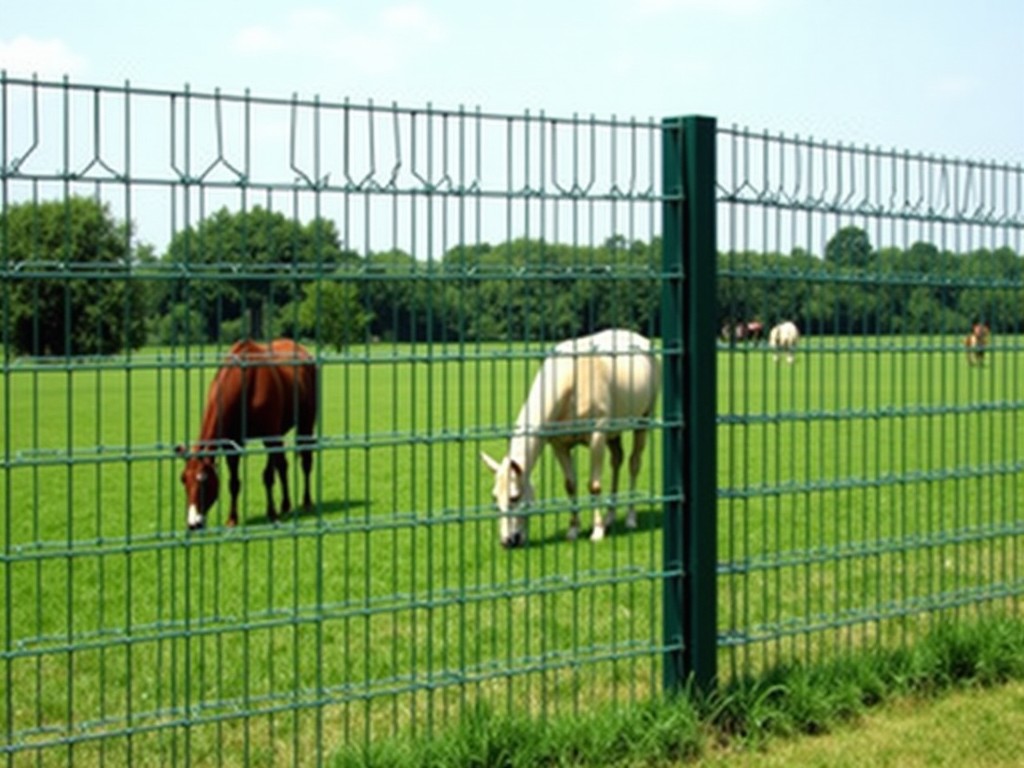
Factory Direct Galvanized Cattle Horse Sheep Woven Wire Fence Exporter
Woven wire fence creates a continuous barrier by interlocking steel wires in a uniform mesh, distributing impact loads across multiple strands and reducing point stress on any single wire. Typical
Request a QuoteFactory Direct Galvanized Woven Wire Fence for Cattle, Horse, and Sheep
Woven wire fence creates a continuous barrier by interlocking steel wires in a uniform mesh, distributing impact loads across multiple strands and reducing point stress on any single wire.
Typical wire diameters range from 2.0 mm to 3.5 mm, with zinc coating weights selected between 150 g/m² and 275 g/m² depending on exposure to moisture, urine, or salty conditions.
Roll widths are commonly supplied between 1.2 m and 2.4 m, and lengths can reach up to 100 m, allowing rapid installation with minimal splices in large pasture layouts.
Specifications
| Parameter | Typical Value | Unit |
|---|---|---|
| Wire Diameter | 2.0 – 3.5 | mm |
| Zinc Coating Weight | 150 – 275 | g/m² |
| Mesh Opening (H × V) | 50 × 100 | mm |
| Tensile Strength (Longitudinal) | ≥ 350 | MPa |
| Roll Width | 1.2 – 2.4 | m |
| Roll Length | 20 – 100 | m |
| Weight per Meter | 1.8 – 4.5 | kg/m |
Materials and Construction
The base wire is low‑carbon steel, cold‑drawn to the specified diameter before undergoing hot‑dip galvanizing per ISO 1461, which forms a zinc‑iron alloy layer providing both barrier and sacrificial protection.
Wires are woven in a plain weave pattern; at each intersection a knot is formed to prevent slippage under tension. An alternative welded mesh option spots‑welds intersections for increased rigidity.
Edge treatments include knuckled or twisted selvages to eliminate sharp protrusions; optional PVC capping can be added for abrasion resistance in high‑traffic zones.
Applications
- Cattle pastures – mesh size large enough to prevent hoof entrapment while resisting impact from pushing animals.
- Horse paddocks – smoother knuckled edges reduce risk of cuts; tensile strength withstands kicking and rubbing.
- Sheep enclosures – smaller openings (e.g., 25 × 25 mm) contain lambs while allowing adequate airflow.
- Wildlife exclusion – uniform mesh deter deer and hogs without creating gaps that could be exploited.
- Temporary penning – roll lengths enable quick deployment for rotational grazing or event fencing.
- Orchard and vineyard protection – corrosion‑resistant coating survives exposure to spray chemicals and moisture.
Quality Control
Incoming wire is checked for diameter tolerance (±0.05 mm) and coating weight via magnetic induction; each batch receives a mill test certificate.
During weaving, laser gauges verify mesh dimensions every 10 m; final rolls undergo tensile testing of longitudinal wires (minimum 350 MPa) and peel adhesion testing of the zinc coating (minimum 50 g/m²). Visual inspection ensures uniform coating and absence of defects.
Documentation accompanying each shipment includes coating thickness reports, roll length verification, and origin declaration.
Customization
Buyers may specify wire diameter, zinc coating weight, mesh opening dimensions, roll width and length, and edge finish to align with site conditions, livestock type, and installation equipment.
- Wire Diameter: 1.8 mm – 4.0 mm
- Zinc Coating: 100 g/m² – 350 g/m²
- Mesh Opening: 25 × 25 mm to 100 × 200 mm (horizontal × vertical)
- Roll Width: 0.8 m – 3.0 m
- Roll Length: 20 m – 150 m
- Edge Treatment: Knuckled, Twisted, PVC‑capped
Packaging and Export
Each roll is first wrapped in UV‑stabilized polyethylene film to block moisture, then placed on a wooden pallet with corner protectors. Polyester strapping secures the load, and pallets are labeled with part number, net weight, and destination.
For container shipment, pallets are stacked and braced to meet ISO 1496‑3 cargo‑securing standards. Export documentation includes fumigation‑treated pallet certificates, bill of lading, and origin declaration upon request.
Frequently Asked Questions
- Can the wire diameter and zinc coating be customized?
- Yes, both are selected per project requirements; typical ranges are 1.8‑4.0 mm for diameter and 100‑350 g/m² for coating weight.
- What information is needed to obtain a quotation?
- Required details include desired wire diameter, coating weight, mesh opening dimensions, roll width and length, edge finish, and destination port for freight calculation.
- How is the galvanized coating inspected?
- Coating thickness is measured using magnetic induction probes on at least five points per roll; results are reported in grams per square meter with a tolerance of ±10%.
- What packaging options are available for overseas shipment?
- Standard packaging consists of UV‑stabilized film wrap, palletizing with corner protectors, and polyester strapping; additional options include heat‑shrink sleeves or wooden crates for high‑value orders.
- What is the typical production lead time?
- Lead time varies with order size and customization, generally 15‑25 working days after receipt of confirmed technical specifications and deposit.
Request a Technical Quote
To discuss your specific fence specifications, request a detailed quotation, or obtain sample rolls, please contact our export team using the link below.
Contact Export Team


