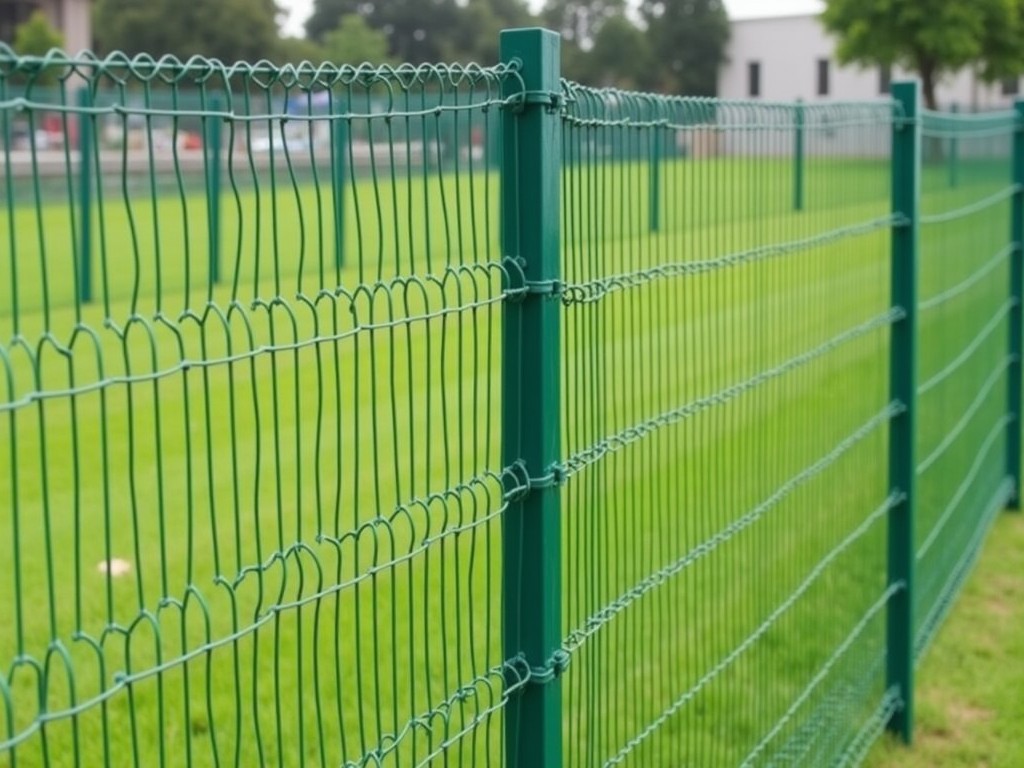
Custom Wire Mesh For Poultry Farm Fence Manufacturer
Poultry farms require fencing that balances containment, predator exclusion, and adequate airflow while resisting corrosion from litter, moisture, and cleaning agents. The mesh must maintain
Request a QuoteCustom Wire Mesh for Poultry Farm Fence
Poultry farms require fencing that balances containment, predator exclusion, and adequate airflow while resisting corrosion from litter, moisture, and cleaning agents. The mesh must maintain structural integrity over years of exposure to UV, temperature swings, and mechanical pressure from birds and equipment.
Material Composition and Properties
The base wire is typically low‑carbon steel drawn to precise diameters, then protected by a metallic or polymeric coating. The choice of coating determines resistance to rust, UV degradation, and chemical exposure from disinfectants.
Steel Core Characteristics
Wire diameters range from 1.2 mm to 3.0 mm, providing tensile strengths between 450 MPa and 650 MPa. Zinc‑galvanizing is applied at 180–270 g/m², offering a sacrificial barrier that retards rust formation in humid environments.
Coating Options
PVC over‑coating adds a UV‑stable layer 0.3–0.5 mm thick, available in green, black, or white to match farm aesthetics. For aggressive chemical cleaning, a polyester powder coat can be specified, delivering a hardness of 2H–3H on the pencil scale.
Mesh Geometry and Mechanical Performance
Aperture size influences both bird safety and predator exclusion. Smaller openings prevent chicks from escaping and deter rodents, while larger openings improve airflow and reduce material cost.
Load Capacity
Breaking load per linear meter scales with wire diameter and tensile strength; a 2 mm galvanized wire typically sustains 1.8–3.2 kN/m before yielding. These values are verified through tensile testing of full‑width mesh samples according to ISO 9044.
Customization Options
Every project demands a unique combination of aperture, wire size, roll dimensions, edge finish, and coating. Adjusting these parameters allows the mesh to meet specific flock densities, predator threats, and installation constraints.
- Aperture size: 15 mm × 15 mm to 75 mm × 75 mm
- Wire diameter: 1.2 mm, 1.6 mm, 2.0 mm, 2.5 mm, 3.0 mm
- Roll width: 0.5 m to 3.0 m (custom widths available)
- Roll length: 10 m to 100 m (standard lengths, splice‑free on request)
- Edge finish: selvage, knuckle, twisted, or welded border
- Coating: hot‑dip galvanized, galvanized + PVC, polyester powder coat
Applications in Poultry Farming
The mesh serves multiple functions beyond simple perimeter containment. Its open structure supports ventilation while preventing entry of foxes, raccoons, and birds of prey.
- Perimeter fencing for broiler and layer houses
- Internal pens to separate age groups or breeding stock
- Predator skirts buried 150 mm deep around free‑range ranges
- Aviary enclosures for ornamental or heritage breeds
- Partitioning of feeding and watering lines to reduce spillage
Manufacturing Process and Quality Control
Production begins with cold‑drawing of steel rod to the target diameter, followed by automated welding to form the mesh lattice. Coating is applied via dip‑galvanizing or extrusion, then cured under controlled temperature.
- Wire diameter tolerance ±0.02 mm
- Aperture uniformity measured by laser scanning (±0.5 mm)
- Coating adhesion tested per ASTM D4541 (minimum 2.5 MPa)
- Tensile strength verified on full‑width specimens (ISO 9044)
- Visual inspection for weld defects and coating continuity
Specification Overview
| Parameter | Typical Range | Customizable? |
|---|---|---|
| Wire diameter (mm) | 1.2 – 3.0 | Yes |
| Aperture size (mm) | 15 × 15 – 75 × 75 | Yes |
| Roll width (m) | 0.5 – 3.0 | Yes (custom widths) |
| Roll length (m) | 10 – 100 | Yes (splice‑free on request) |
| Coating type | Hot‑dip galvanized, galvanized + PVC, polyester powder | Yes |
| Tensile strength (MPa) | 450 – 650 | Dependent on wire |
Frequently Asked Questions
Can the aperture be tailored to specific bird sizes?
Yes. Aperture dimensions are selected based on the smallest bird that must be contained and the largest predator to be excluded. Typical ranges from 15 mm for chicks to 75 mm for adult turkeys are readily produced.
What information is required for a quotation?
We need the desired wire diameter, aperture size, roll width and length, edge finish, and coating type. If the installation involves burial or tensioning, please advise the expected load so we can verify mesh strength.
How is coating quality assured?
Coating thickness is measured with a magnetic‑induction gauge, adhesion is tested by pull‑off methods, and uniformity is verified visually and with UV‑exposure samples. All results are documented in the batch test report.
What packaging methods protect the mesh during transit?
Rolls are wrapped in polyethylene film, placed on pallets, and secured with strapping. For export, additional corner protection and moisture‑barrier sheets are added to prevent corrosion during sea freight.
Get a Quote
To discuss your poultry fencing requirements and receive a detailed technical proposal, contact our engineering team. Please provide the project specifications listed above, and we will return a quotation with lead‑time and packaging options within one business day.



