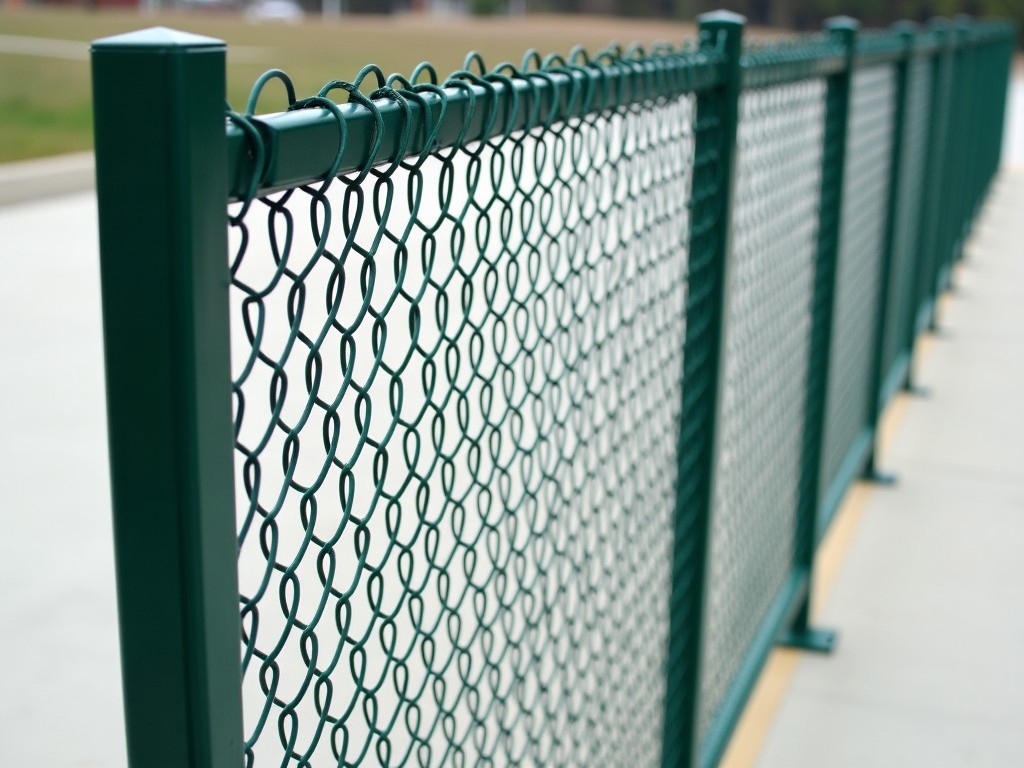
Custom Powder Coated Chain Link Fencing
This product consists of galvanized steel wire woven into a diamond mesh, then coated with a thermoset powder that is electrostatically applied and cured at 180–200 °C. The coating forms a
Request a QuoteCustom Powder Coated Chain Link Fencing
This product consists of galvanized steel wire woven into a diamond mesh, then coated with a thermoset powder that is electrostatically applied and cured at 180–200 °C. The coating forms a continuous, uniform film that bonds to the zinc‑coated substrate, providing a barrier against moisture, UV radiation, and chemical exposure.
Typical coating thickness ranges from 60 to 120 µm, delivering a salt‑spray resistance of 500 hours or more under ASTM B117 conditions, depending on the specific formulation and pretreatment.
Because the powder coating is applied after fabrication, all weld points and cut edges receive full coverage, eliminating the weak spots common with liquid‑painted finishes.
Technical Specifications
Key dimensions and material properties can be tailored to project requirements; the table below lists typical ranges and notes where customization is standard practice.
| Parameter | Typical Value / Customizable |
|---|---|
| Wire gauge (core diameter) | 2.0 mm to 4.0 mm (galvanized steel) |
| Mesh opening (clear) | 40 mm to 100 mm (square or diamond) |
| Fence height | 0.9 m to 3.0 m (standard panels; custom lengths available) |
| Coating thickness | 60 µm to 120 µm (epoxy‑polyester hybrid) |
| Color (RAL) | Standard: RAL 6005 (moss green), RAL 7016 (anthracite gray); custom colors on request |
| Selvage type | Knuckle (closed) or twist (open) – selected per safety and installation needs |
Typical Applications
Industrial facilities select this fencing for perimeter security where long‑term exposure to oils, solvents, or alkaline cleaning agents is expected; the powder coating resists chalking and maintains adhesion where liquid paints would delaminate.
Sports complexes and schools benefit from the high visibility of the open mesh combined with a smooth, non‑abrasive surface that reduces injury risk during contact.
Utility installations such as substations and water treatment plants use the product because the coating prevents rust‑induced weakening of the wire, preserving load‑bearing capacity over decades.
Customization Options
Engineers specify these variables to match structural load calculations, environmental corrosivity, and aesthetic requirements of the site.
- Height: 0.9 m – 3.0 m (custom lengths up to 6 m available)
- Wire gauge: 2.0 mm – 4.0 mm (affects tensile strength and wind load)
- Mesh opening: 40 mm – 100 mm (smaller openings increase climb resistance)
- Coating thickness: 60 µm – 120 µm (thicker films extend service life in aggressive atmospheres)
- Color: any RAL or custom match (UV‑stable pigments)
- Selvage: knuckle for safety‑critical zones, twist for cost‑sensitive runs
- Post options: round, square, or H‑section; galvanized or powder‑coated to match fabric
Manufacturing Considerations
The process begins with cold‑drawn steel wire that is hot‑dip galvanized to a minimum zinc coating of 55 g/m² before weaving. The woven mesh is then passed through a pretreatment tunnel where it is cleaned and phosphated to promote powder adhesion.
Electrostatic spray guns apply the powder uniformly; the parts are cured in a convection oven at 180–200 °C for 10–15 minutes, achieving full cross‑linkage. Inline dry‑film thickness gauges monitor each pass to maintain tolerance within ±10 µm.
After cooling, the fabric is inspected for holidays (pin‑holing) using a low‑voltage spark tester; any defects are re‑coated before final packaging.
Quality Assurance
Each production lot undergoes coating thickness measurement with a magnetic induction gauge (≥5 readings per square meter). Adhesion is evaluated by the cross‑cut tape test per ASTM D3359, requiring a rating of 5B or better.
Corrosion resistance is validated by salt‑spray exposure (ASTM B117) for 500 hours, followed by visual inspection for red rust; acceptance criteria allow no more than 5 % surface rust on the coated area.
Test certificates are available upon request; customers may also request third‑party verification for specific project specifications.
Frequently Asked Questions
Can the fence height and length be customized to site dimensions?
Yes. Panels are fabricated to any height within the 0.9 m–3.0 m range, and lengths can be cut to exact measurements; splicing is performed with matching couplers to maintain coating continuity.
What information is required to obtain a quotation?
Please provide the desired height, wire gauge, mesh opening, coating thickness, color (RAL or sample), selvage type, post specifications, and total linear meters. Including a site plan or sketch helps us confirm post spacing and gate requirements.
Which coating materials are available for aggressive environments?
We offer epoxy‑polyester hybrids as standard; for higher chemical resistance, a pure epoxy or fluoropolymer topcoat can be applied, increasing thickness to 150 µm if needed.
How is quality inspected before shipment?
Every batch receives thickness, adhesion, and holiday testing; visual inspection checks for uniform color and proper selvage formation. Documentation accompanies each shipment.
What packaging methods protect the finish during transit?
Panels are stacked on pallets with interleaving polyethylene sheets, then wrapped in stretch film. Corner guards prevent edge damage, and the entire load is secured with straps to avoid shifting.
Get a Technical Quote
Our engineering team will review your specifications, confirm load calculations, and return a detailed quotation including lead time and packaging options. To begin, please share your project details using the form below.
Contact our engineering team


