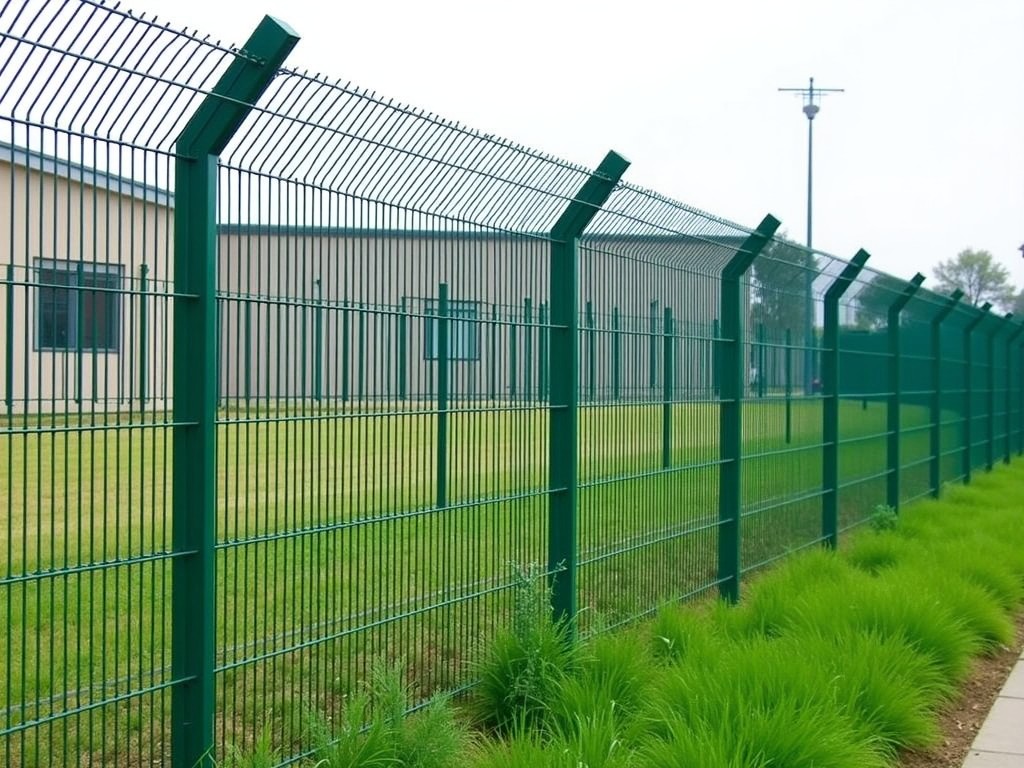
Custom Heavy Duty Hardware Cloth Fencing Supplier
Heavy duty hardware cloth fencing serves as a barrier solution where mechanical strength, corrosion resistance, and precise aperture control are required. Typical constructions use galvanized steel
Request a QuoteCustom Heavy Duty Hardware Cloth Fencing Supplier
Heavy duty hardware cloth fencing serves as a barrier solution where mechanical strength, corrosion resistance, and precise aperture control are required.
Typical constructions use galvanized steel wire, stainless steel alloys, or PVC‑coated variants.
Wire diameter, opening size, and roll width are the primary dimensional variables that determine load capacity and flow characteristics.
Material Composition and Mechanical Properties
Galvanized steel wire undergoes a hot‑dip zinc coating that typically provides a minimum coating weight of 270 g/m², offering protection against atmospheric corrosion for up to 20 years in moderate environments.
Stainless steel grades such as 304 and 316 deliver chromium content of 18‑20 % and nickel of 8‑12 %, yielding resistance to chloride‑induced pitting in marine or chemical‑processing settings.
PVC‑coated hardware cloth combines a steel core with a polyvinyl chloride layer of 0.4 mm thickness, raising the surface resistivity to >10¹² Ω·cm and enabling use in food‑grade or wash‑down areas.
Customization Parameters
Customers specify wire gauge ranging from 0.8 mm to 3.2 mm, which directly influences tensile strength from 350 MPa to over 2 000 MPa depending on material.
Opening sizes are available from 3 mm square mesh up to 100 mm rectangular apertures, allowing selection based on particle retention, ventilation, or visibility requirements.
Roll widths can be fabricated from 0.5 m to 2.5 m, and lengths are typically spooled to 25 m or 50 m, though custom lengths are accommodated upon request.
| Parameter | Range | Typical Increment | Notes |
|---|---|---|---|
| Wire gauge | 0.8 mm – 3.2 mm | 0.2 mm steps | Affects tensile strength and flexibility |
| Opening size | 3 mm – 100 mm | 1 mm increments (square) or custom rectangles | Determines flow rate and particle retention |
| Roll width | 0.5 m – 2.5 m | 0.1 m steps | Limited by handling equipment |
| Roll length | 25 m – 50 m (standard) | Custom lengths on request | Impacts shipping weight |
| Coating type | Hot‑dip galv., electro‑galv., powder coat, PVC | As specified | Select based on environment |
Coating selections include hot‑dip galvanization, electro‑galvanization, powder coating, and PVC extrusion, each offering distinct barrier properties and service life expectations.
Typical Industrial Applications
In mining operations, hardware cloth is used as screen media for ore classification, where the precise aperture controls product size distribution while resisting abrasive wear from quartz and basalt.
Water treatment facilities employ the fencing as debris screens in intake channels, relying on its open area ratio to maintain hydraulic capacity while preventing clogging by foliage or trash.
Agricultural installations utilize the cloth as pest exclusion barriers around greenhouses, benefiting from its UV‑stabilized coating that maintains tensile strength after prolonged sun exposure.
Quality Assurance and Testing
Dimensional verification is performed using laser micrometers with a resolution of 0.01 mm, ensuring that opening tolerances stay within ±0.2 mm for standard mesh.
Tensile testing follows ASTM A370, sampling one specimen per 100 m of roll to confirm that yield strength meets the specified minimum for the chosen wire grade.
Corrosion resistance is assessed via salt‑spray chambers (ASTM B117) for coated specimens, with acceptance criteria of less than 5 % red rust after 500 hours for galvanized finishes.
- Wire diameter measurement
- Opening size verification
- Coating thickness (via magnetic induction)
- Visual defect inspection
- Tensile strength sample test
Packaging and Logistics
Finished rolls are wrapped in UV‑stable polyethylene film, placed on corrugated cardboard cores, and secured with steel strapping to prevent telescoping during transit.
For export shipments, moisture‑absorbent desiccant packs are included inside the outer crate, and the package is marked with handling symbols per ISPM 15 for wood‑packaging compliance.
Palletized units typically accommodate 16 rolls per pallet, with a maximum gross weight of 1 200 kg, facilitating efficient forklift handling.
Frequently Asked Questions
Can dimensions be customized?
Yes, wire gauge, opening size, roll width, and length can be tailored to project specifications; provide detailed drawings or requirements for a quote.
What information is required before quotation?
Required data include material type, wire diameter, aperture dimensions, roll dimensions, coating preference, and any applicable standards (ASTM, ISO).
What materials are available?
Available materials are hot‑dip galvanized steel, stainless steel grades 304/316, and PVC‑coated steel; other alloys can be sourced upon request.
How is quality inspected?
Inspection includes dimensional checks, tensile testing, coating thickness measurement, and corrosion resistance testing per relevant ASTM standards.
What packaging methods are available?
Standard packaging uses UV‑stable film, cardboard cores, and steel strapping; export packaging adds desiccant and ISPM 15‑compliant crating.
Request a Quote
To discuss your specific fencing needs, contact our engineering team or download the specification sheet.
Request a Quote


