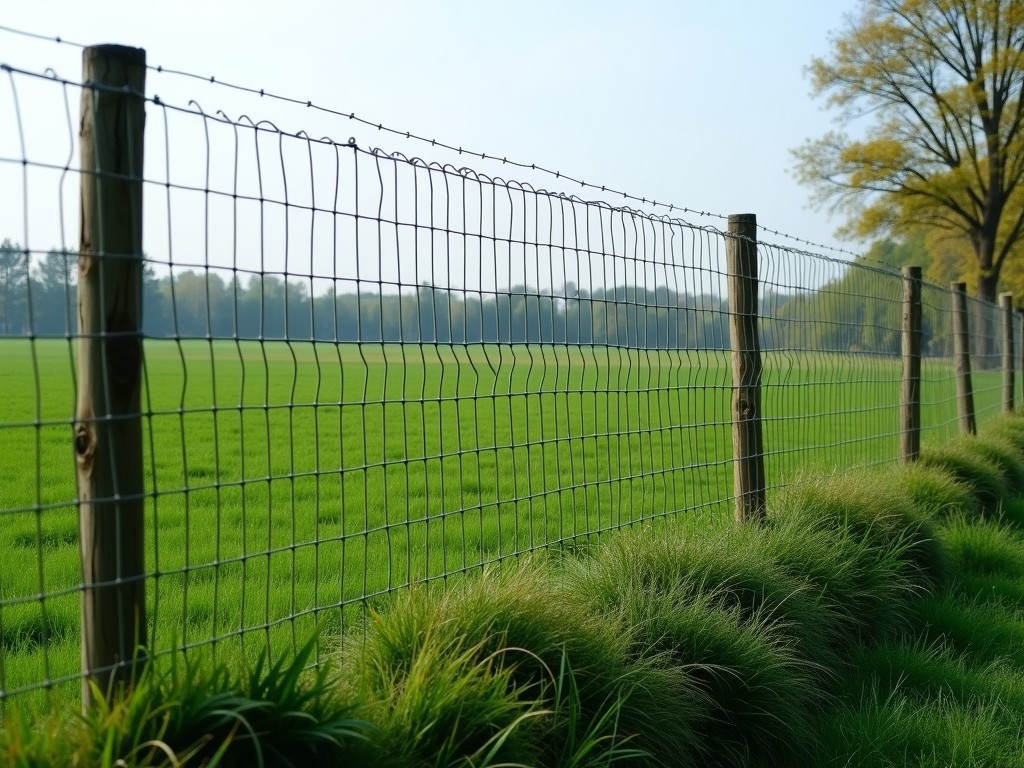
Custom Cattle Pasture Field Fence Factory
Designing a perimeter barrier for cattle pastures requires balancing animal containment, resistance to environmental loads, and long‑term maintenance costs. The fence must withstand repeated impact
Request a QuoteCustom Cattle Pasture Field Fence Factory
Designing a perimeter barrier for cattle pastures requires balancing animal containment, resistance to environmental loads, and long‑term maintenance costs. The fence must withstand repeated impact from livestock, resist corrosion from moisture and soil chemicals, and remain effective across varying terrain slopes.
Material Options
| Material | Typical Tensile Strength (MPa) | Coating / Finish | Expected Service Life (years) |
|---|---|---|---|
| Hot‑dip galvanized steel wire | 550–650 | Zn coating 55–85 µm | 20–25 |
| High‑tensile steel wire | 800–950 | Zn‑Al alloy coating | 25–30 |
| PVC‑coated steel wire | 500–600 | PVC layer 0.5–0.8 mm | 15–20 |
| Woven polypropylene mesh | 30–45 (MD) | UV‑stabilized PP | 10–12 |
Design and Engineering Considerations
Fence height for cattle typically ranges from 1.2 m to 1.5 m to prevent jumping, while the bottom wire is positioned 0.15 m above ground to deter digging. Post spacing is determined by wire tension and expected impact forces; common intervals are 3 m for high‑tensile wire and 2.5 m for lighter gauges.
Tensioning systems incorporate strain‑in‑line devices or ratchet tighteners to maintain optimal wire tension after settlement. Gate frames are fabricated from the same post material, reinforced with diagonal bracing to handle frequent operation loads.
Manufacturing Process
Wire is drawn to specified gauge, then passed through a continuous galvanizing line where molten zinc alloy adheres to the surface. For PVC‑coated variants, the galvanized wire undergoes extrusion coating before cooling and winding.
Post fabrication involves roll‑forming steel sections to C‑ or U‑shapes, punching holes for wire attachment, and applying the same corrosion protection as the wire. All components are inspected for dimensional tolerance (±2 mm) before assembly.
Customization Capabilities
- Height adjustment from 1.0 m to 2.0 m in 0.1 m increments
- Wire gauge selection: 12 ga to 6 ga (high‑tensile) or equivalent diameters
- Mesh opening sizes: 50 mm × 50 mm, 75 mm × 75 mm, or custom
- Coating options: hot‑dip galvanized, Zn‑Al alloy, PVC, powder‑coat
- Post shapes: round, square, or C‑section with variable wall thickness
- Gate configurations: single swing, double swing, sliding, with optional livestock guards
- Accessories: tensioners, barbed wire add‑ons, electric wire brackets, corrosion‑resistant fasteners
Quality Assurance Philosophy
Each production lot undergoes tensile testing on representative wire samples to verify minimum break load conforms to specification. Coating thickness is measured via magnetic induction or X‑ray fluorescence at five points per meter, ensuring uniform protection.
Visual inspection checks for surface defects, correct hole alignment, and proper tensioner installation. Finished fence rolls are labeled with batch codes, enabling traceability back to raw material certificates and process parameters.
Applications in Cattle Pasture Management
A well‑engineered fence supports rotational grazing systems by allowing rapid subdivision of paddocks without compromising animal safety. The barrier’s resistance to livestock rubbing reduces wear on posts, decreasing the frequency of repairs and labor costs.
In regions with high predator pressure, the fence can be integrated with buried wire aprons or electric strands to deter incursions while maintaining a visual boundary that cattle recognize. The durability of galvanized or coated wires ensures consistent performance across seasonal temperature swings and soil moisture variations.
Frequently Asked Questions
- Can dimensions be customized? Yes, height, wire gauge, mesh size, and post length are tailored to project drawings or site surveys.
- What information is required before quotation? We need a site plan indicating perimeter length, terrain slope, livestock type, and any specific gate or accessory requirements.
- What materials are available? Hot‑dip galvanized steel, high‑tensile Zn‑Al alloy steel, PVC‑coated steel, and UV‑stabilized polypropylene mesh.
- How is quality inspected? Each lot undergoes tensile testing, coating thickness measurement, and visual inspection per ISO 9001‑based procedures.
- What packaging methods are available? Fence rolls are wrapped in UV‑protected stretch film, placed on pallets with corner guards, and sealed for moisture resistance.
- How are export shipments protected? Pallets are fitted with heat‑treated wooden frames and desiccant packs, then loaded into containers with bracing to prevent shifting.
- What is the typical production lead time? Lead time ranges from 3 to 6 weeks depending on order complexity and current capacity; exact schedules are confirmed at quote.
- How are samples arranged? Sample sections of wire, post, and coating can be shipped via express courier upon request, with associated freight costs.
Next Steps
To begin a custom fence solution for your cattle pasture, provide your project specifications via our contact form. Our engineering team will review the details, return a detailed quotation, and outline the production timeline.



