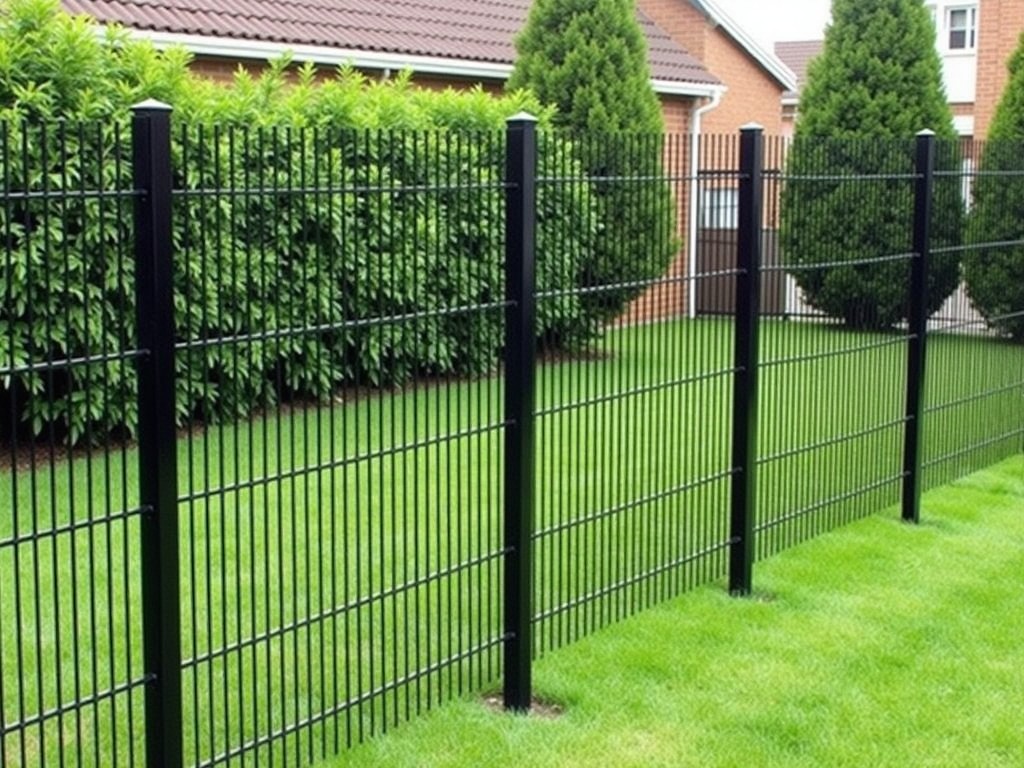
Custom Black Woven Wire Fence For Garden Supplier
A woven wire fence is produced by interlacing steel wires in a regular pattern to create a flexible mesh that distributes stress uniformly across the fabric. Unlike welded alternatives, the woven
Request a QuoteCustom Black Woven Wire Fence for Garden
A woven wire fence is produced by interlacing steel wires in a regular pattern to create a flexible mesh that distributes stress uniformly across the fabric. Unlike welded alternatives, the woven construction eliminates rigid joints that can crack under impact, providing a continuous load‑bearing surface suitable for garden enclosures, plant supports, and boundary demarcation.
Base wires are typically low‑carbon steel cold‑drawn to diameters ranging from 2.0 mm to 3.5 mm, delivering tensile strengths between 450 MPa and 600 MPa. After drawing, the wires receive a zinc coating of approximately 10‑15 µm followed by an extruded black PVC layer 0.3‑0.5 mm thick, which adds UV stability and corrosion resistance while presenting a non‑reflective finish.
Material and Construction
The core wire undergoes a continuous galvanizing line to ensure uniform zinc adhesion before PVC extrusion, which is performed at controlled temperatures to avoid micro‑voids in the coating. The weaving process uses a plain weave where each warp wire alternately passes over and under each weft wire, producing a stable opening size that can be tailored from 10 mm × 10 mm to 50 mm × 50 mm depending on the intended application.
Edge finishes are selected to prevent unraveling during handling and installation. Options include a knuckle edge where the terminal wires are looped back into the mesh, a selvage edge with a reinforced border wire, or a twisted lock that mechanically interlocks the perimeter wires for added tensile integrity.
| Parameter | Typical Value | Customizable According to Project Requirements |
|---|---|---|
| Wire Diameter | 2.0 mm – 3.5 mm | Yes – specific gauge per load case |
| Tensile Strength | 450 MPa – 600 MPa | Yes – higher grades available |
| Mesh Opening | 20 mm × 20 mm (standard) | Yes – 10 mm to 50 mm square or rectangular |
| Coating Thickness (PVC) | 0.3 mm – 0.5 mm | Yes – thicker for aggressive environments |
| Roll Height | 0.5 m – 2.0 m | Yes – custom lengths cut to suit posts |
| Roll Length | 10 m – 50 m | Yes – longer lengths on request |
Customization Options
Project engineers can specify multiple dimensions and finish characteristics to align the fence with site‑specific constraints such as post spacing, expected wind loads, and aesthetic preferences. The weaving machinery allows rapid changeover between mesh sizes without compromising wire tension, ensuring consistent opening uniformity across the entire roll.
- Height: selectable from 0.5 m to 2.5 m in 0.1 m increments
- Roll length: standard 20 m, extensible to 100 m for large‑scale installations
- Mesh aperture: square or rectangular, ranging from 8 mm × 8 mm to 60 mm × 60 mm
- Coating: black PVC, green PVC, or electrostatically applied powder coat in various RAL colors
- Edge treatment: knuckle, selvage, or twisted lock with optional stainless‑steel reinforcement
Performance Characteristics
The interlaced geometry provides a high shear‑area ratio, allowing the fence to resist lateral forces without significant deformation. For a 1.5 m tall panel fabricated with 2.8 mm wire and a 25 mm × 25 mm mesh, laboratory testing shows a permissible horizontal load of approximately 180 N/m before reaching 5 % strain, which accommodates typical garden wind pressures and occasional impact from gardening tools.
The black PVC coating exhibits a UV‑stabilized formulation that retains flexibility after 1,000 hours of accelerated weathering (ASTM G154). Salt‑spray exposure (ASTM B117) demonstrates less than 5 % loss in coating adhesion after 500 hours, confirming suitability for coastal or high‑humidity environments where untreated steel would corrode rapidly.
Applications in Garden Settings
Gardeners frequently choose woven wire for plant support structures because the open mesh permits light penetration and air circulation while still providing sufficient resistance to prevent vines from sagging. The material’s flexibility enables it to conform to uneven terrain without requiring extensive grading, reducing installation labor and material waste.
Beyond support, the fence serves as an effective barrier against small herbivores such as rabbits and rodents when the mesh size is kept below 20 mm. Its low visual profile complements both formal and informal landscaping designs, and the black finish minimizes glare, allowing the fence to recede visually behind foliage.
Quality Assurance and Testing
Incoming wire undergoes diameter verification with laser micrometers and tensile testing on a universal testing machine to confirm conformance to the ordered grade. During weaving, online sensors monitor pick density and wire tension, triggering automatic adjustments if deviations exceed ±2 % of the target specification.
Finished rolls are subjected to coating thickness measurements at multiple points using a magnetic induction gauge, with acceptance criteria of ±0.05 mm around the nominal value. Adhesion is evaluated via a cross‑hatch test per ASTM D3359, requiring a rating of 5B or better. Prior to shipment, each roll is inspected for length tolerance (±1 %) and width tolerance (±0.5 %) to ensure compatibility with ordered post spacing.
Packaging and Shipping
The fence is wound onto a sturdy cardboard core with an inner diameter of 150 mm, which prevents deformation of the mesh during handling. A layer of stretch film encases the roll to protect the coating from abrasion, followed by a corner‑protected pallet that secures the load with polyester strapping rated for 2,000 kg tensile strength.
Each pallet carries a weather‑resistant label displaying the product code, roll dimensions, batch number, and QC signature. For export shipments, the pallet is additionally wrapped in a UV‑stable polyethylene sleeve and fitted with moisture‑absorbent desiccant packs to mitigate condensation during transit.
Frequently Asked Questions
- Can the mesh size be customized to match specific plant support needs?
- Yes, the weaving equipment allows aperture selection from 8 mm × 8 mm up to 60 mm × 60 mm in both square and rectangular configurations, enabling precise tailoring to the growth habits of different species.
- What information is required to obtain a quotation?
- To generate an accurate quote we need the desired roll height, length, wire diameter, mesh opening, coating type, edge finish, and delivery destination. Optional details such as post spacing and load conditions help us recommend the optimal specification.
- How is the coating adhesion verified?
- Adhesion is assessed using the ASTM D3359 cross‑hatch method on representative samples from each production batch. A rating of 5B (no peeling or flaking) is required for release; lower ratings trigger process investigation and possible rework.
- What is the typical lead time for a custom order?
- Standard configurations ship within 10‑15 working days after receipt of purchase order. Custom mesh sizes or special coatings may extend the lead time to 20‑25 working days, which will be confirmed at quote stage.
Contact for Quote
To discuss your project requirements and receive a detailed specification sheet, please request a quotation. Our technical team will respond with available options, lead times, and pricing based on the parameters you provide.



