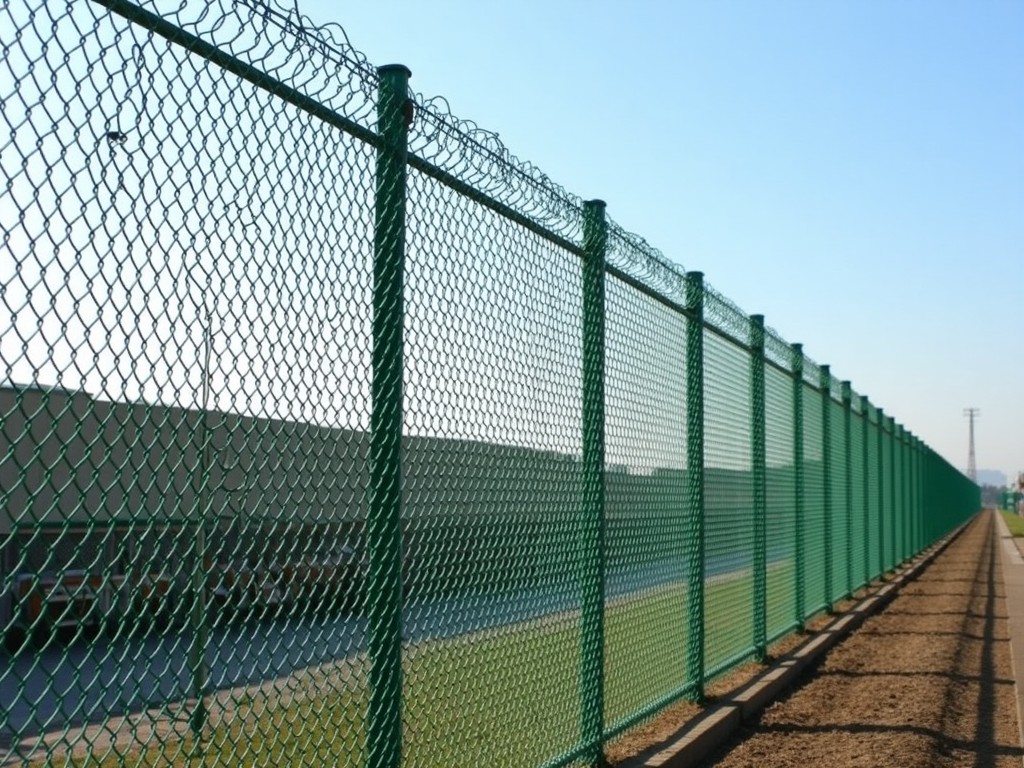
China Razor Wire Mesh Fence Manufacturer
Razor wire mesh fences combine high‑tensile steel wire with sharply profiled barbed tape to create a perimeter barrier that deters climbing and cutting attempts. The product is engineered for
Request a QuoteChina Razor Wire Mesh Fence Manufacturer
Razor wire mesh fences combine high‑tensile steel wire with sharply profiled barbed tape to create a perimeter barrier that deters climbing and cutting attempts. The product is engineered for installations where security, longevity, and low maintenance are primary concerns.
Product Overview
The core consists of a low‑carbon steel wire core (typically 2.5 mm diameter) that is cold‑drawn to achieve a tensile strength of 550 MPa or higher. Around this core, a helical strip of hot‑dip galvanized steel tape is formed into a razor‑profile with a blade angle of approximately 45° and a tooth height of 12 mm. The resulting mesh opening is usually 50 mm × 50 mm, providing visibility while maintaining a formidable physical obstacle.
Technical Specifications
| Parameter | Typical Value | Unit | Notes |
|---|---|---|---|
| Wire Core Diameter | 2.5 | mm | Cold‑drawn low‑carbon steel |
| Tensile Strength | ≥550 | MPa | Measured per ASTM A370 |
| Tape Thickness | 0.5 | mm | Hot‑dip galvanized (Zn≥55 g/m²) |
| Mesh Opening | 50 × 50 | mm | Square pitch, customizable |
| Coating Type | Hot‑dip Galvanized | – | Optional PVC or powder coat |
Material Options
- Core wire: low‑carbon steel (SAE 1008) or high‑tensile steel (SAE 1045) for increased load capacity.
- Barbed tape: hot‑dip galvanized steel, optionally coated with PVC (black or green) or powder‑coated for corrosion‑resistant finishes.
- Post and support brackets: rectangular steel tubing (60 × 40 mm, wall thickness 2 mm) with pre‑drilled mounting holes.
- Fasteners: stainless steel (A2) bolts and nuts to prevent galvanic corrosion when paired with galvanized components.
Manufacturing Process
Production begins with drawing the steel wire to the target diameter, followed by a continuous galvanizing line that applies a uniform zinc coating. The razor tape is formed by slit‑rolling the galvanized strip through a series of profiled rolls that create the helical blade geometry.
The wire core and tape are then helically intertwined on a high‑speed winding machine, maintaining a consistent pitch and tension. After winding, the mesh panels are cut to length, and the ends are crimped or welded to prevent unraveling.
Final inspection includes visual checks for coating uniformity, dimensional verification of opening size, and tensile testing of sample lengths.
Applications
- Military and border security: The high tensile strength and sharp profile impede rapid breach attempts, providing a delay that allows response forces to intervene.
- Industrial facility perimeters: Where valuable equipment or hazardous materials are stored, the fence deters both casual trespassers and determined intruders while maintaining visibility for CCTV.
- Correctional institutions: The razor‑type barrier reduces the likelihood of climbing, and the open mesh design prevents concealment of contraband.
- Infrastructure sites (power substations, water treatment): The corrosion‑resistant coating ensures long service life in outdoor environments with minimal maintenance.
Customization Options
Customers can specify wire diameter (2.0 mm to 3.2 mm), tape profile height (8 mm to 18 mm), mesh pitch (25 mm to 100 mm), and coating type (galvanized only, galvanized + PVC, or powder coat). Panel lengths are typically supplied in 2 m or 3 m modules, but custom lengths up to 6 m are available upon request.
Additional hardware such as anti‑climb brackets, tension wires, and grounding kits can be bundled to meet specific site regulations.
Quality Control
Each batch undergoes tensile strength testing on wire core samples, coating thickness measurement via magnetic induction, and visual inspection for tape adhesion. Dimensional audits verify opening size within ±2 mm tolerance. Test reports are provided with shipment documentation.
Packaging and Shipping
Panels are stacked flat, separated by corrugated cardboard dividers, and wrapped in shrink‑film to protect against moisture and abrasion. Standard pallet size is 1.1 m × 1.1 m, with a maximum stack height of 1.2 m to facilitate container loading.
For overseas shipments, fumigated wooden pallets or ISPM‑15 compliant pallets are used, and each package includes corrosion inhibitor strips and desiccant packs.
Frequently Asked Questions
- Can dimensions be customized? Yes, wire diameter, tape height, mesh opening, and panel length can be adjusted to project specifications.
- What information is required before quotation? Required details include desired wire gauge, tape profile, coating type, total linear meters, post spacing, and any special accessories.
- What materials are available? Core wire options range from low‑carbon to high‑tensile steel; tape is hot‑dip galvanized with optional PVC or powder coating.
- How is quality inspected? Each lot is tested for tensile strength, coating thickness, and dimensional accuracy per ISO 9001‑aligned procedures.
- What packaging methods are available? Standard packaging uses shrink‑film wrapped pallets; ISPM‑15 wooden pallets and corrosion inhibitor packs are available for export.
- How are export shipments protected? Pallets are fumigated, wrapped in water‑resistant film, and fitted with edge protectors to prevent damage during handling.
- What is the typical production lead time? Lead time varies from 10 to 25 working days depending on order size and customization level.
- How are samples arranged? Sample sections (up to 1 m length) can be shipped via express courier upon receipt of a formal request and sample fee.
Contact for Inquiry
To discuss your project requirements or request a formal quotation, please reach out to our technical sales team.
Request Quotation


