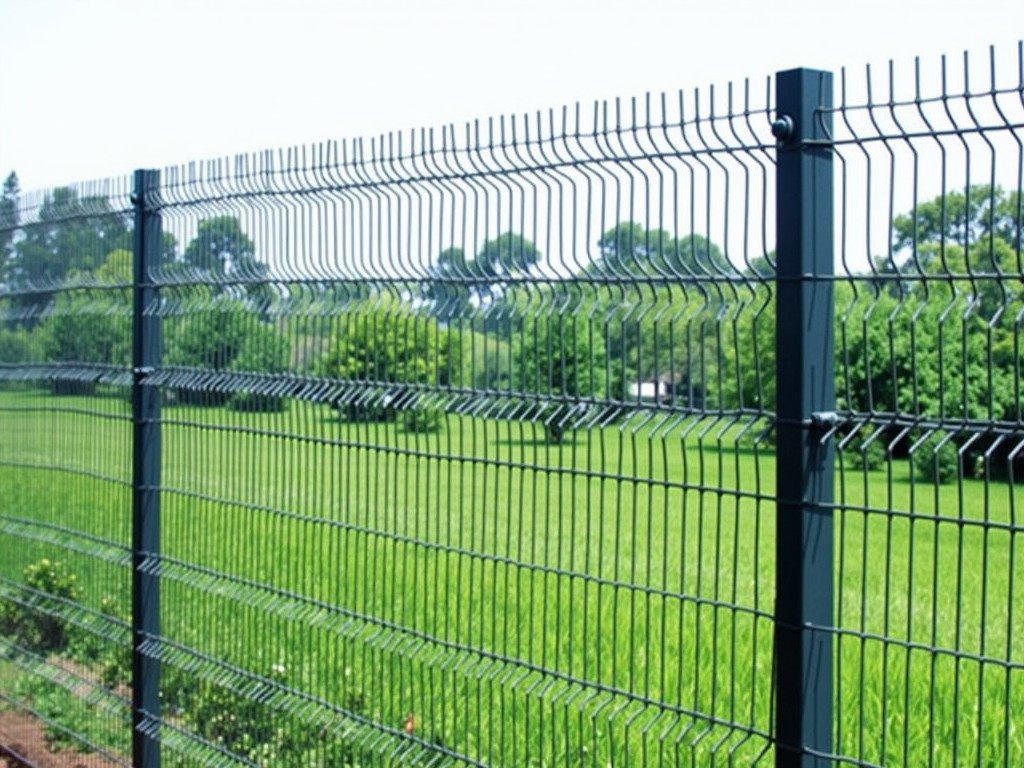
China Fixed Knot Woven Wire Fence Manufacturer
Fixed knot woven wire fence is manufactured by forming a pre‑shaped knot at each wire intersection, which locks the wires in place and eliminates relative movement when the mesh is subjected to
Request a QuoteFixed Knot Woven Wire Fence – Technical Overview
Fixed knot woven wire fence is manufactured by forming a pre‑shaped knot at each wire intersection, which locks the wires in place and eliminates relative movement when the mesh is subjected to tension.
Design and Construction Principles
The knot geometry consists of a helical wrap that creates a mechanical interlock rather than relying solely on friction. This design yields a uniform aperture size across the panel and maintains opening dimensions under load, reducing the risk of mesh deformation or sagging.
Material Selection and Corrosion Protection
Base wire is low‑carbon steel with a typical carbon content of 0.06%–0.12%, providing a balance between formability and tensile strength. Corrosion protection is achieved through hot‑dip galvanizing, delivering a zinc coating mass of 180–250 g/m²; optionally, a PVC over‑coat of 0.3–0.5 mm thickness can be applied for additional barrier properties.
Coating adhesion is verified by the ASTM D3359 tape test, with a target rating of 5B (no peeling) for galvanized layers and 4B–5B for PVC systems.
Typical Configurations and Dimensional Parameters
| Parameter | Typical Range | Unit |
|---|---|---|
| Wire Diameter | 2.0 – 4.0 | mm |
| Mesh Opening (Horizontal × Vertical) | 50 × 50 – 150 × 150 | mm |
| Roll Width | 0.5 – 2.5 | m |
| Roll Length | 10 – 50 | m |
| Tensile Strength (Wire) | 450 – 600 | MPa |
| Elongation at Break | 10 – 20 | % |
Custom dimensions outside these ranges can be produced to meet specific project requirements.
Mechanical Performance and Load Capacity
The fixed knot configuration contributes to a panel tensile strength that is approximately 1.2–1.5 times the sum of the individual wire strengths, due to load sharing at each interlock. Impact resistance is enhanced because the knot dissipates energy across adjacent wires, reducing localized wire fracture.
Applications in Industrial and Agricultural Settings
In livestock containment, the fence maintains a consistent barrier height even when animals exert lateral pressure, preventing escape through mesh deformation. For perimeter security, the rigid aperture resists cutting tools better than flexible woven meshes because the knots inhibit wire separation. In slope stabilization, the mesh retains its shape under soil creep, providing uniform reinforcement without sagging over time.
Customization Options
- Wire diameter selection from 2.0 mm to 4.0 mm
- Mesh aperture tailored to 30 mm–200 mm square or rectangular patterns
- Coating choices: hot‑dip galvanizing, galvanized + PVC, or epoxy‑based powder coating
- Roll length adjusted to site logistics, typically 10 m–50 m
- Edge treatments: knuckled, twisted, or barbed wire integration
- Optional additives such as UV stabilizers for PVC coatings
Quality Assurance and Testing
Each production lot undergoes tensile testing of random wire specimens according to ASTM F1664, with acceptance criteria based on the specified strength range. Coating thickness is measured via magnetic inductance, and aperture uniformity is verified using laser‑scanned mesh geometry, ensuring tolerances within ±2 mm of the nominal dimension.
Packaging and Logistics
Finished rolls are wrapped in UV‑stabilized polyethylene film, placed on sturdy wooden or steel pallets, and secured with polypropylene strapping. For container shipment, pallets are stacked to maximize load stability, and corner protectors are applied to prevent edge damage during transit.
Frequently Asked Questions
Can dimensions be customized?
Yes, wire diameter, mesh opening, roll width, and length can be adjusted according to the customer’s specifications.
What information is required before quotation?
Required details include desired wire diameter, mesh size, coating type, roll length, and any edge treatment preferences.
What materials are available?
Base material is low‑carbon steel; available finishes are hot‑dip galvanizing, galvanized + PVC, and epoxy powder coating.
How is quality inspected?
Inspection includes tensile strength testing, coating thickness measurement, aperture verification, and visual defect checks per internal QA procedures.
What packaging methods are available?
Standard packaging uses polyethylene film wrap and palletizing; custom packaging such as crate or reel options can be arranged upon request.
How are export shipments protected?
Shipments receive corner guards, stretch film, and are secured within the container to prevent movement and impact damage.
What is the typical production lead time?
Lead time varies with order complexity but generally ranges from 2 to 4 weeks after final drawing approval.
How are samples arranged?
Sample rolls of up to 5 m length can be dispatched after receipt of a formal request; shipping costs are borne by the requester.
Request for Quotation
To obtain a detailed quotation, please provide the technical specifications outlined above. You may submit your requirements via the contact form or email.
Contact us to begin the inquiry process.



