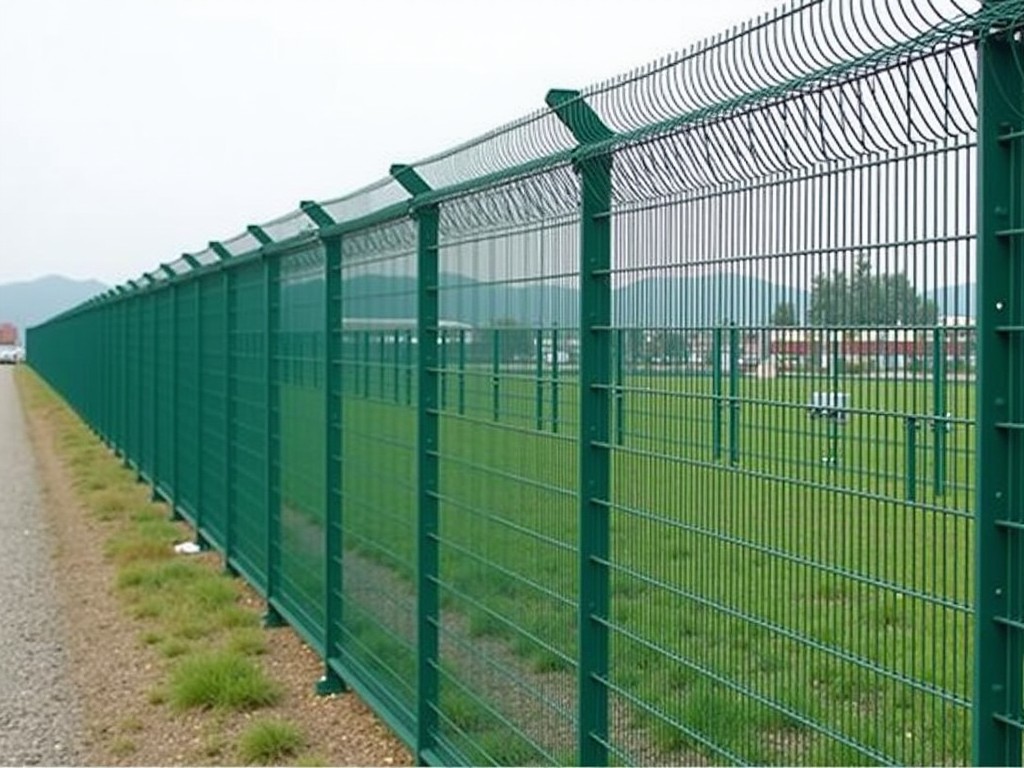
China Diamond Mesh Wire Fencing Supplier
Diamond mesh wire fencing is formed by interlacing steel wires in a uniform hexagonal pattern, creating a lightweight yet strong barrier. The geometry distributes loads evenly across the mesh, which
Request a QuoteChina Diamond Mesh Wire Fencing Supplier
Diamond mesh wire fencing is formed by interlacing steel wires in a uniform hexagonal pattern, creating a lightweight yet strong barrier. The geometry distributes loads evenly across the mesh, which makes it suitable for applications where visibility and airflow are required without compromising security.
Technical Specifications
Standard wire diameters range from 1.2 mm to 3.0 mm, with opening sizes (hole width) typically between 20 mm and 50 mm. Roll heights are available from 0.9 m up to 2.4 m, and lengths can be customized to 10 m, 20 m, or 30 m per roll depending on project logistics.
Material Options
Base material is low‑carbon steel wire, which can be supplied in three finish types: hot‑dip galvanized (minimum 55 µm zinc coating), PVC‑coated (available in green, black, or grey with a 0.3 mm–0.5 mm polymer layer), or stainless steel (grade 304 or 316) for corrosive environments. Each finish affects corrosion resistance, service life, and aesthetic appearance.
Manufacturing Process
Wires are first drawn to the required diameter, then woven on a hexagonal loom where each wire passes over and under adjacent wires to form the diamond pattern. After weaving, the mesh passes through a rolling press to tighten the joints, followed by the selected coating line—galvanizing involves immersion in molten zinc, while PVC coating uses extrusion and curing. Final inspection verifies dimensional stability and coating continuity.
Applications
The open structure provides effective perimeter security for airports, railways, and industrial sites while allowing surveillance cameras and motion sensors to maintain clear sight lines. In agriculture, the fencing contains livestock without causing injury, and its flexibility eases installation on uneven terrain. Municipal projects use it for park boundaries and sports facilities where both durability and visual transparency are required.
Quality Control
Each production lot undergoes tensile strength testing on random wire samples to confirm compliance with the specified yield range (typically 350–550 MPa). Coating thickness is measured with a magnetic‑induction gauge, and adhesion is checked via a cross‑hatch test according to ASTM D3359. Dimensional checks verify hole size tolerance within ±2 mm and roll width tolerance within ±5 mm before packaging.
Customization Options
Customers can specify non‑standard heights, custom roll lengths to match site‑specific spacing, alternative wire diameters for higher load capacity, and special coating colours to blend with surroundings. Additional services include pre‑cut panels, welded edge reinforcement, and the integration of barbed or razor wire tops for heightened security.
Typical Specifications
| Property | Typical Value / Range |
|---|---|
| Wire Diameter | 1.2 mm – 3.0 mm |
| Opening Size (Hole Width) | 20 mm – 50 mm |
| Roll Height | 0.9 m – 2.4 m |
| Roll Length | 10 m – 30 m (customizable) |
| Coating Thickness (Galvanized) | ≥55 µm Zn |
| Tensile Strength (Wire) | 350 MPa – 550 MPa |
Packaging and Shipping
Fencing rolls are wrapped in protective polyethylene film, placed on sturdy wooden pallets, and secured with steel strapping. For container shipment, rolls are stacked vertically to maximize load efficiency, and corner protectors prevent edge damage. Each pallet is labeled with product code, dimensions, and weight to facilitate customs handling and warehouse inventory.
Frequently Asked Questions
- Can dimensions be customized? Yes, height, roll length, wire diameter, and opening size can be adjusted according to project drawings.
- What information is required before quotation? Please provide required height, length, wire gauge, coating type, and any special features such as reinforced edges or top barriers.
- What materials are available? Low‑carbon steel with hot‑dip galvanization, PVC coating, or stainless steel (grades 304/316) are standard options.
- How is quality inspected? Each batch undergoes tensile testing, coating thickness measurement, adhesion testing, and dimensional verification before release.
- What packaging methods are available? Rolls are film‑wrapped, palletized, and strapped; custom packaging such as crate or reel packaging can be arranged upon request.
- How are export shipments protected? Protective film, corner boards, and moisture‑absorbent desiccants are used inside containers to prevent corrosion during transit.
- What is the typical production lead time? Lead time ranges from 10 to 25 working days depending on order size and coating complexity; exact timing is confirmed at quotation.
- How are samples arranged? Sample sections (typically 1 m × 1 m) can be shipped via express courier; charges are creditable against a subsequent order.
Contact for Inquiry
To obtain a detailed quotation or discuss technical requirements, please reach out via the contact form or email. Provide project specifications, desired quantities, and delivery location for a prompt response.
Send Inquiry


