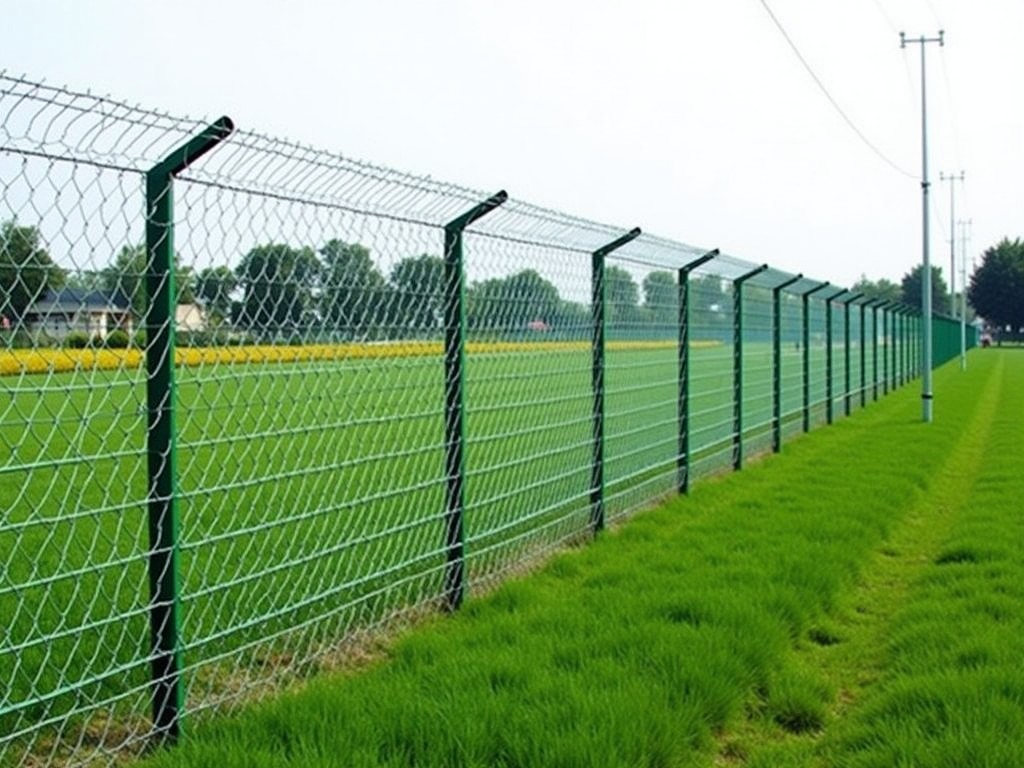
China Cattle High Tensile Wire Fence Manufacturer
Selecting perimeter containment for livestock requires evaluating material strength, corrosion resistance, and installation efficiency. This page explains the engineering basis of high‑tensile welded
Request a QuoteChina Cattle High Tensile Wire Fence Manufacturer
Selecting perimeter containment for livestock requires evaluating material strength, corrosion resistance, and installation efficiency. This page explains the engineering basis of high‑tensile welded wire fences produced for cattle operations in China.
Product Overview
The fence consists of cold‑drawn steel wire welded at each intersection to form a uniform grid. Typical wire diameters range from 2.0 mm to 4.0 mm, delivering tensile strengths between 1,500 MPa and 2,000 MPa after drawing. Standard mesh openings are 75 mm × 150 mm, providing adequate spacing for cattle while preventing hoof entrapment.
Technical Specifications
| Parameter | Typical Value | Unit |
|---|---|---|
| Wire Diameter | 2.0 – 4.0 | mm |
| Tensile Strength | 1,500 – 2,000 | MPa |
| Mesh Opening | 75 × 150 | mm |
| Coating Type | Hot‑dip Galvanized (Zn) | – |
| Coating Weight | 275 | g/m² |
| Roll Length | 50 | m |
| Post Spacing | 3.0 | m |
Material & Construction
The steel wire is produced from low‑carbon billets, then cold‑drawn to achieve the target diameter and tensile strength. After drawing, the wire is cleaned and passed through a molten zinc bath at approximately 450 °C to form a metallurgical bond. Welding is performed using resistance spot welding, creating a fused joint that maintains the wire’s mechanical properties.
Design Features
- Uniform weld strength – each joint tested to exceed 90 % of parent wire tensile capacity.
- Consistent aperture – precision welding maintains opening tolerance within ±2 mm.
- Edge protection – wire ends are curled or capped to reduce snagging during installation.
Applications
Cattle exert lateral pressure on fences through leaning and rubbing, which demands a barrier with high lateral stiffness and minimal deformation. The high‑tensile wire combined with close‑spaced welding yields a flexural rigidity sufficient to resist displacement under typical herd loads. Additionally, the galvanized coating extends service life in humid or saline environments common to pasture lands.
Quality Control & Testing
Each production lot undergoes tensile testing on sampled wires to verify strength meets the specified range. Weld shear strength is measured using a pull‑off fixture, with acceptance criteria set at 85 % of the wire’s tensile capacity. Coating thickness is checked by magnetic induction, ensuring the zinc layer stays within 200–350 g/m².
Customization Options
- Wire diameter – selectable from 2.0 mm, 2.5 mm, 3.0 mm, 3.5 mm, 4.0 mm.
- Mesh aperture – available in rectangular sizes such as 50 mm × 100 mm, 100 mm × 200 mm, or custom dimensions.
- Coating type – hot‑dip galvanized, Galfan alloy, or PVC‑over‑galvanized for extra barrier.
- Roll dimensions – lengths up to 200 m and widths from 1.0 m to 2.5 m adjustable per project.
Packaging & Shipping
Finished rolls are wrapped in UV‑stabilized polyethylene film to protect the coating during transit. Each roll is then placed on a wooden pallet with corner guards and secured with steel strapping. For export, pallets are fitted with heat‑treated lumber and marked with handling symbols per ISPM 15.
FAQ
Can the wire diameter and mesh size be customized?
Yes, both wire diameter and mesh opening can be adjusted to meet specific containment or terrain requirements; technical drawings are reviewed before production.
What information is needed to obtain a quotation?
Required details include desired wire diameter, mesh dimensions, coating type, roll length, quantity, and delivery destination.
How is the fence installed on wooden or steel posts?
The fence is attached using galvanized staples or clips for wood posts, and bolt‑through brackets with isolation pads for steel posts to prevent galvanic corrosion.
What is the typical lead time for an order of 5,000 m?
Standard lead time is 3–4 weeks after receipt of confirmed specifications and deposit, subject to current production load.
Request a Quote


