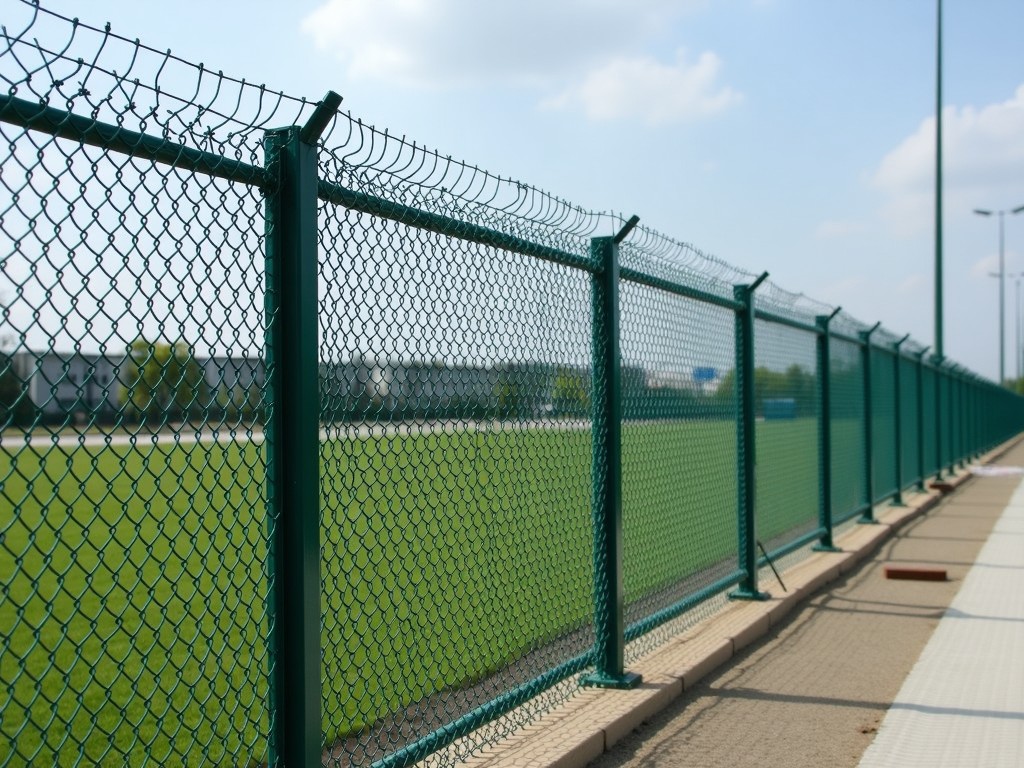
B2B Plastic Coated Chain Link Fence Factory
Plastic coated chain link fence combines a galvanized steel core with an extruded PVC or PE coating, delivering corrosion resistance and a smooth finish suitable for industrial perimeters, security
Request a QuoteB2B Plastic Coated Chain Link Fence Factory
Product Overview
Plastic coated chain link fence combines a galvanized steel core with an extruded PVC or PE coating, delivering corrosion resistance and a smooth finish suitable for industrial perimeters, security enclosures, and agricultural boundaries. The coating is applied continuously to achieve uniform thickness and adhesion.
Construction and Materials
The base wire is typically low‑carbon steel, hot‑dip galvanized to a minimum zinc coating of 275 g/m² (≈40 µm). After galvanizing, the wire is drawn to the final diameter, then passed through a coating extruder where PVC or PE is applied to a nominal thickness of 150 µm to 250 µm, depending on customer specification.
Added coating increases the overall wire diameter by roughly 0.3 mm, which must be accounted for in post‑installation tension calculations. Mesh dimensions are defined by the opening size (e.g., 50 mm × 50 mm) and wire diameter (commonly 2.0 mm to 3.5 mm).
Technical Specifications
| Parameter | Typical Value | Notes |
|---|---|---|
| Base wire material | Low‑carbon steel (ASTM A641) | Galvanized per ASTM A123 |
| Zinc coating weight | ≥275 g/m² | Equivalent to ≈40 µm Zn |
| Coating type | PVC or PE (extruded) | UV‑stabilized, color‑fast |
| Coating thickness | 150 µm – 250 µm | Customizable per project |
| Wire diameter (finished) | 2.0 mm – 3.5 mm | Includes coating |
| Mesh opening | 25 mm – 100 mm | Square or rectangular |
| Tensile strength (base wire) | ≥450 MPa | Measured before coating |
| Roll width | Up to 5 m | Standard lengths 25 m – 50 m |
Typical Applications
In manufacturing facilities, the fence provides a visible barrier that resists chemical splashes and UV degradation, reducing maintenance cycles compared with bare galvanized mesh. The smooth coated surface minimizes snagging of worker clothing and equipment.
For agricultural sites, the PVC coating prevents rust propagation in humid climates, extending service life in livestock enclosures and crop protection zones where exposure to fertilizers and pesticides is common.
Security perimeters around data centers and utility substations benefit from the coating’s electrical insulation properties, which reduce stray currents and improve grounding safety when combined with appropriate hardware.
Customization Options
- Wire diameter: 1.8 mm to 4.0 mm (finished)
- Mesh opening: 20 mm to 150 mm
- Coating material: PVC, PE, or PP with optional anti‑static additive
- Color: standard RAL shades (e.g., 6005 green, 7016 gray) or custom pigment match
- Height: panels up to 3 m, roll lengths adjustable to site logistics
- Edge finishing: knuckle, twist, or barbed configurations
Quality Control and Testing
Each production lot undergoes inline thickness measurement using laser gauges, with acceptance criteria of ±10 % of target coating thickness. Adhesion is verified by cross‑cut tape test per ASTM D3359, requiring a minimum rating of 4B.
Zinc coating mass is checked by gravimetric strip method on random samples, ensuring compliance with the declared minimum. Tensile strength of the base wire is sampled per lot and must meet the specified MPa before coating.
Finished rolls are inspected for uniform color, absence of bubbles, and correct dimensional tolerances before packaging.
Packaging and Logistics
Rolls are wrapped in UV‑stabilized polyethylene film, then placed on wooden pallets with corner protectors. Each pallet is strapped with polyester bands and labeled with product code, length, weight, and coating specifications.
Export shipments include desiccant packets to control moisture, and pallets undergo heat‑treatment to ISPM‑15 standards. Standard container utilization allows up to 22 tons per 40‑ft container, depending on roll diameter.
Frequently Asked Questions
- Can dimensions be customized? Yes, wire diameter, mesh opening, coating thickness, and roll length are adjustable per project requirements.
- Which details are required for a quotation? Required details include desired height, length, wire diameter, mesh size, coating type, color, and any special edge finish.
- What coating materials are available? PVC, PE, and PP are standard; additives for UV stabilization, anti‑static, or fire retardancy can be supplied upon request.
- How is quality inspected? Inline laser thickness measurement, adhesion tape test, zinc coating gravimetry, and tensile sampling are performed per lot.
Get a Quote
To receive a detailed technical proposal, please provide your project specifications via the contact form. Our engineering team will review the requirements and return a quotation with lead times and packaging options.
Request Quote


