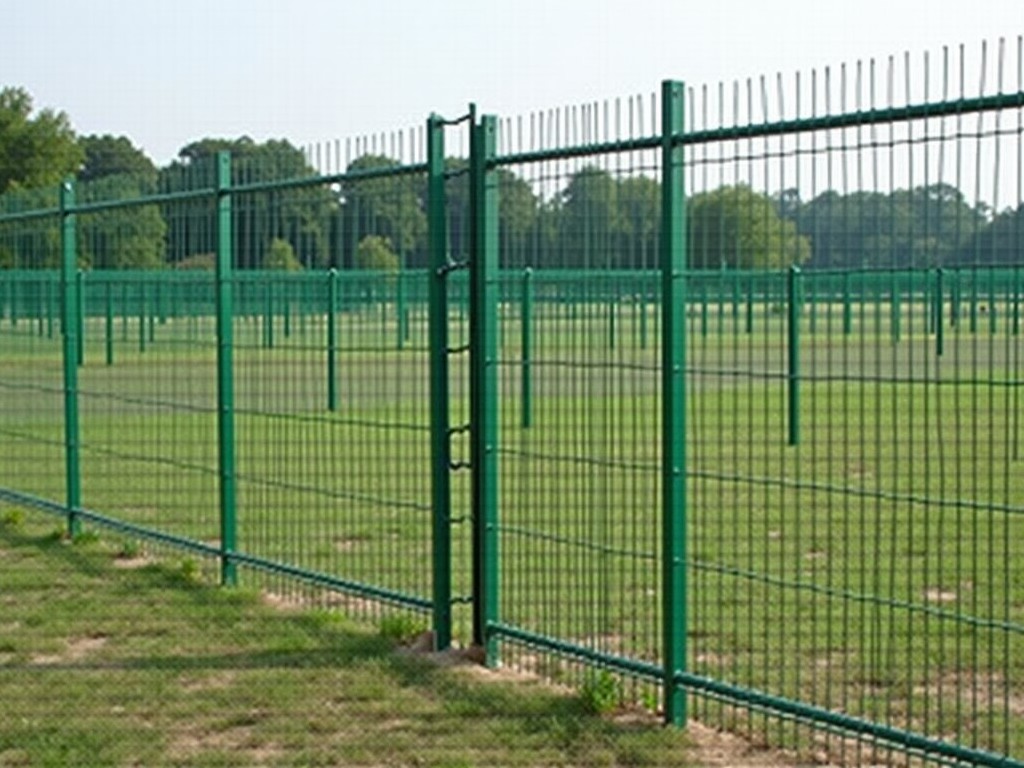
B2B Chicken Wire Fence 8 Ft High Exporter
An 8‑foot‑high chicken wire fence is a welded mesh barrier designed for perimeter security, livestock containment, and crop protection in industrial and agricultural facilities. The product is
Request a QuoteB2B Chicken Wire Fence 8 Ft High Exporter
An 8‑foot‑high chicken wire fence is a welded mesh barrier designed for perimeter security, livestock containment, and crop protection in industrial and agricultural facilities. The product is supplied in continuous rolls, hot‑dip galvanized to resist corrosion, and prepared for export compliance with ISPM‑15 timber‑free packaging.
Technical Specifications
The fence consists of low‑carbon steel wire formed into a uniform square mesh, welded at each intersection, and coated to achieve a minimum service life in outdoor environments. Key dimensions are standardized to simplify integration with posts, gates, and tensioning hardware.
| Parameter | Typical Value |
|---|---|
| Height | 8 ft (2.44 m) |
| Wire Diameter | 2.0 mm (12 ga) – 3.0 mm (9 ga) options |
| Mesh Opening | 50 mm × 50 mm (standard) – 25 mm to 100 mm available |
| Roll Length | 25 m – 50 m (customizable) |
| Weight per Meter | 1.2 kg/m (2 mm wire, 50 mm mesh) |
| Coating Type | Hot‑dip galvanized, Zn ≥ 55 g/m² |
| Corrosion Resistance (Salt Spray) | ≥ 500 h (ISO 9227) |
Material Selection and Manufacturing Process
The base wire is produced from low‑carbon steel rods, cold‑drawn to achieve the required tensile strength (≈ 450 MPa) and uniform diameter. Welding is performed using resistance spot welding, creating a fused joint that maintains the wire’s mechanical properties. Immediately after welding, the mesh passes through a hot‑dip galvanizing bath where a zinc‑iron alloy layer forms, providing barrier and sacrificial protection.
Applications in Industrial and Agricultural Settings
An 8‑ft height provides sufficient barrier to deter large livestock such as cattle and horses while preventing smaller animals from jumping over. In agricultural fields, the fence protects crops from wildlife intrusion and supports netting systems for bird control. Industrial sites use the same specification for perimeter demarcation, equipment guarding, and safety zones where visibility and airflow must be retained.
Customization Options
Buyers can specify alternative wire gauges to match load requirements, tighter or wider mesh openings for specific pest control, and varying roll lengths to reduce on‑site splicing. Edge treatments include knuckled (smooth) or twisted (barbed) finishes, and the coating can be upgraded to a zinc‑aluminum alloy for extended life in aggressive environments.
Quality Control and Testing
Each production lot undergoes dimensional verification of wire diameter, mesh pitch, and roll width using calibrated gauges. Coating thickness is measured with a magnetic induction probe, and adhesion is assessed by a bend test. Representative samples are subjected to tensile testing to confirm weld strength and to salt‑spray chambers to validate corrosion resistance before shipment.
Packaging and Export Logistics
Rolls are wound on a rigid core, wrapped in UV‑stabilized polyethylene film, and placed on wooden pallets that meet ISPM‑15 standards. Each pallet is strapped, corner‑protected, and labeled with product code, dimensions, weight, and handling instructions. Container loading is optimized to maximize payload while minimizing movement during transit.
Frequently Asked Questions
- Can the mesh size be customized?
- Yes, mesh openings from 25 mm to 100 mm are available upon request; tooling adjustments may affect lead time.
- What information is needed for a quotation?
- Required details include desired height, wire gauge, mesh opening, roll length, coating type, and destination port for freight calculation.
- How is quality inspected before shipping?
- Inspection includes dimensional checks, coating thickness measurement, tensile strength testing of welds, and a visual audit for defects.
- What packaging options exist for export?
- Standard packaging is UV‑film wrapped rolls on ISPM‑15 pallets; additional options include waterproof covers, edge protectors, and container desiccants.
- What is the typical production lead time?
- Lead time ranges from 2 to 4 weeks depending on order size and customization complexity; exact timing is confirmed at order acknowledgment.
Request a Quote
To obtain a detailed quotation, please provide your technical specifications and delivery destination via the contact form. Our engineering team will review the requirements and respond with pricing, lead time, and any necessary compliance documentation.



