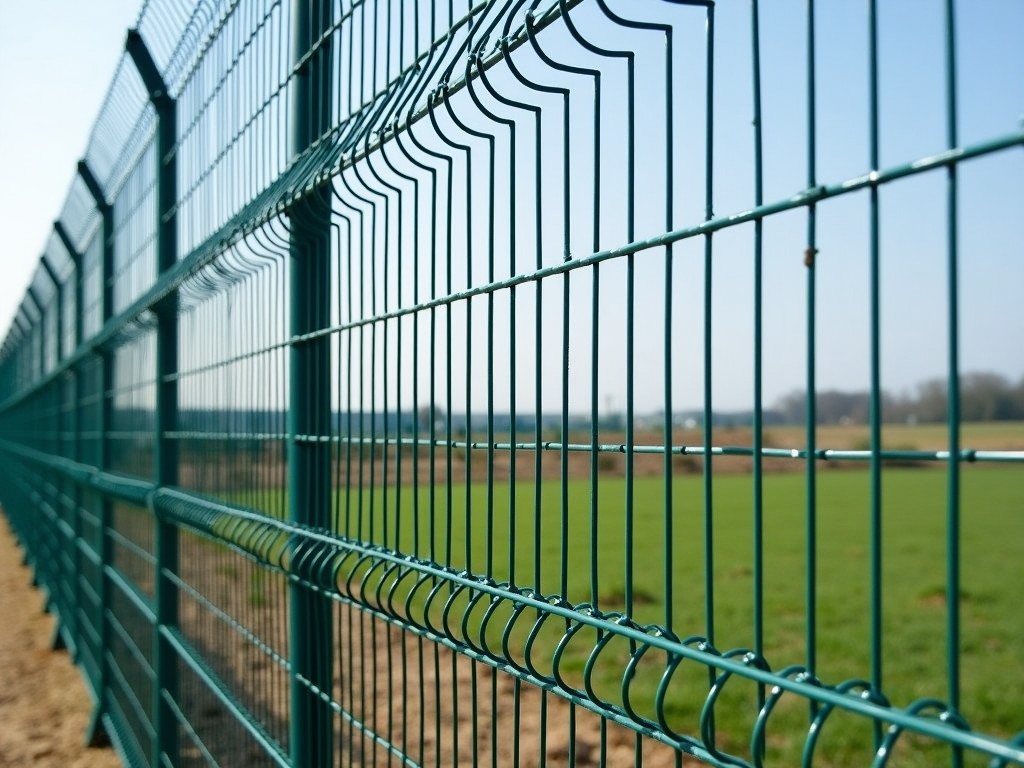
Wholesale Heavy Duty Welded Wire Fence Supplier
Heavy duty welded wire fence provides a rigid barrier formed by electrically welding intersecting steel wires at each intersection. The weld creates a monolithic joint that resists separation under
Request a QuoteWholesale Heavy Duty Welded Wire Fence Supplier
Heavy duty welded wire fence provides a rigid barrier formed by electrically welding intersecting steel wires at each intersection. The weld creates a monolithic joint that resists separation under impact loads, making the panel suitable for high‑security perimeters where deformation must be limited to less than 5 mm under a 500 J impact.
Product Overview
Panels are produced from cold‑drawn steel wire with diameters ranging from 3.0 mm to 5.0 mm. The mesh opening is typically 50 mm × 50 mm or 75 mm × 50 mm, providing a balance between visibility and intrusion resistance. Standard panel heights vary from 1.8 m to 3.0 m with widths of 2.5 m, allowing seamless overlap when installed in runs.
Key Specifications
| Property | Typical Value | Unit |
|---|---|---|
| Wire Diameter | 3.0 – 5.0 | mm |
| Tensile Strength of Wire | 550 – 650 | MPa |
| Mesh Opening | 50 × 50 or 75 × 50 | mm |
| Panel Height | 1.8 – 3.0 | m |
| Panel Width | 2.5 | m |
| Coating Type | Hot‑dip Galvanized (Zn) or PVC‑coated | – |
| Coating Thickness (Zn) | 55 – 85 | µm |
| Wind Load Resistance (Design) | 1500 | Pa |
Material Options
Base wire is supplied in low‑carbon steel grades such as SAE 1008 or SAE 1010, selected for consistent ductility during drawing. For corrosion protection, hot‑dip galvanization provides a zinc alloy layer with a minimum mass of 275 g/m², while PVC overcoat adds a 0.4 mm polymer barrier that improves abrasion resistance and offers color coding for site identification.
Manufacturing Process
Wire is first drawn to the target diameter through a series of dies, reducing cross‑sectional area by up to 40 % while increasing tensile strength. The drawn wire is then fed into a resistance welding machine where overlapping wires are fused at 200 A for 0.2 seconds, creating a weld nugget with a shear strength exceeding 80 % of the parent wire. Finally, the welded mesh passes through a galvanizing bath or a PVC extrusion line before being cut to panel dimensions and stacked for shipment.
Applications
Industrial facilities require perimeter barriers that can withstand attempted climbing, vehicle impact, and environmental exposure without frequent maintenance. The high shear strength of the welded joints prevents panel separation when a force of 2 kN is applied at a single point, making the fence suitable for securing warehouses, manufacturing plants, and logistics centers where unauthorized access must be deterred. Additionally, the open mesh design allows for CCTV visibility and airflow, reducing wind loading on the structure compared to solid panels.
Quality Assurance
Each production lot undergoes dimensional inspection using laser scanners to verify wire diameter tolerance of ±0.05 mm and mesh opening variance of ≤2 mm. Weld strength is quantified by pull‑off tests on five random joints per batch, with acceptance criteria set at a minimum of 600 N. Coating adhesion is assessed via cross‑hatch tape testing per ASTM D3359, requiring a rating of 4B or better for galvanized layers.
Customization
Panel height can be increased in 150 mm increments by adding extra wire rows, while width adjustments are achieved through custom frame spacing. Mesh geometry may be altered to 100 mm × 50 mm for applications requiring greater visibility or to 25 mm × 25 mm for anti‑intrusion zones. Post options include square steel tubes with base plates for concrete embedding or round posts with flange plates for bolt‑down installation, all compatible with the panel’s weld pattern.
Frequently Asked Questions
- Can dimensions be customized?
- Yes, height, width, mesh opening, and coating type are adjusted according to project specifications; provide exact measurements and load requirements for a quotation.
- What information is required before quotation?
- Required data includes desired panel height and length, mesh size, wire diameter, coating preference, post type, and any applicable standards (e.g., ASTM A123 for galvanizing).
- What materials are available?
- Base wire options are SAE 1008/1010 low‑carbon steel; coatings include hot‑dip galvanized zinc (55‑85 µm) or PVC overcoat (0.4 mm).
- How is quality inspected?
- Inspection includes dimensional laser scanning, weld pull‑off testing, and coating adhesion tape testing per ASTM standards, with results documented in a test report shipped with each order.
- What packaging methods are available?
- Panels are bundled in groups of five, wrapped in stretch film, and placed on pallets with corner protectors; custom crating is available for overseas shipments.
- How are export shipments protected?
- Pallets are secured with steel strapping, covered with waterproof tarpaulin, and fitted with shock‑absorbing edge guards to prevent deformation during transit.
- What is the typical production lead time?
- Lead time ranges from 10 to 18 working days after receipt of approved drawings and deposit, depending on order size and coating schedule.
- How are samples arranged?
- Sample sections measuring 500 mm × 500 mm can be dispatched via express courier upon request; costs are credited against the first order.



