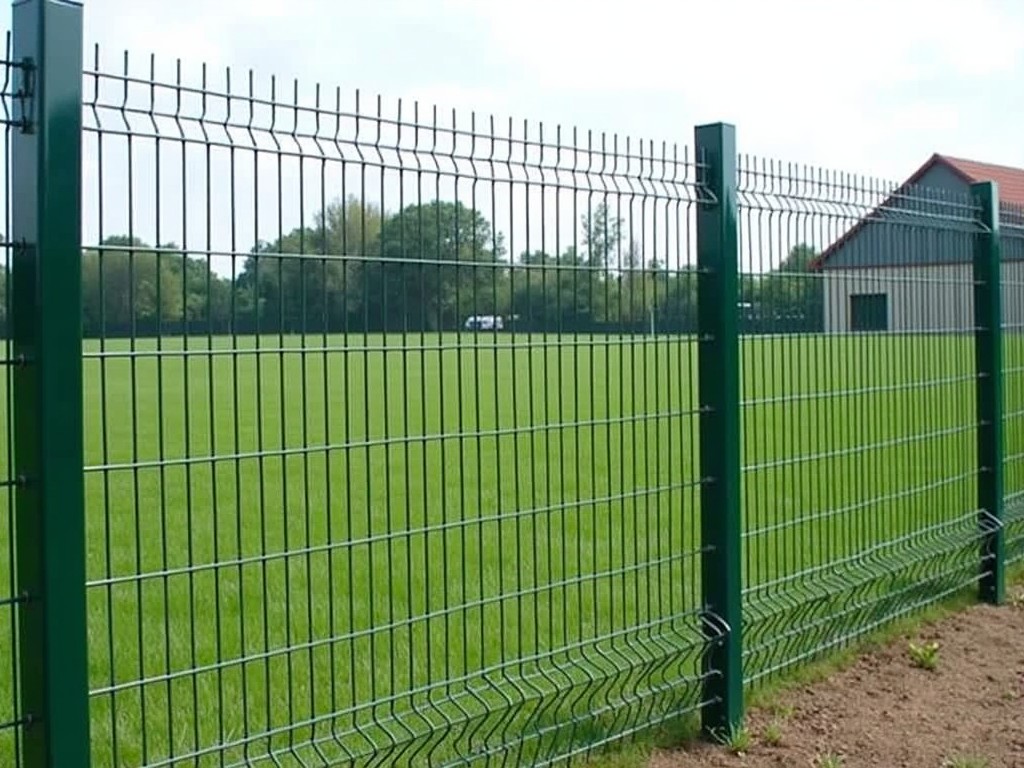
Wholesale Coated Welded Wire Fence Panels Factory
Coated welded wire fence panels consist of steel wires welded at intersections and subsequently protected with a metallic or polymer layer to resist corrosion. The panels are supplied in flat
Request a QuoteWholesale Coated Welded Wire Fence Panels Factory
Coated welded wire fence panels consist of steel wires welded at intersections and subsequently protected with a metallic or polymer layer to resist corrosion. The panels are supplied in flat sections that can be quickly assembled into barriers, enclosures, or safety guards.
Key Specifications
Typical panels use cold‑drawn steel wire ranging from 2.0 mm to 4.0 mm diameter, welded into square or rectangular meshes. Panel width and height are commonly cut to 1.0 m × 2.0 m or 1.2 m × 2.4 m, but lengths can be adjusted to suit site constraints.
| Parameter | Typical Range | Notes |
|---|---|---|
| Wire diameter | 2.0 mm – 4.0 mm | Affects tensile strength and impact resistance |
| Mesh opening | 25 mm × 25 mm to 100 mm × 100 mm | Determines visibility and small‑animal exclusion |
| Panel thickness (after coating) | ≈ wire diameter + coating | Coating adds 0.05 mm–0.2 mm per side |
| Tensile strength of wire | ≥ 550 MPa (typical) | Ensures load‑bearing capacity |
Coating Options and Corrosion Protection
Three main coating systems are offered: hot‑dip galvanizing (Zn), polyvinyl chloride (PVC) over galvanized wire, and epoxy‑based powder coating. Each system provides a distinct barrier against moisture and chemicals, with service life expressed in years to first significant rust.
- Hot‑dip galvanizing: coating weight typically 55 g/m² to 120 g/m² Zn, providing 10–20 years in rural environments.
- PVC coating: thickness 0.4 mm–0.8 mm, adds UV resistance and color options; expected life 15–25 years.
- Powder coating: average film thickness 60 µm–100 µm, offers high chemical resistance; life 12–20 years.
Manufacturing Process
The process begins with drawing high‑carbon steel wire to the target diameter, followed by automated resistance welding at each intersection. After welding, panels are cleaned, pre‑treated, and then passed through the selected coating line—galvanizing bath, PVC extrusion, or powder spray—before curing and final inspection.
Quality Control and Testing
Each batch undergoes dimensional verification (±2 mm tolerance on width/height), weld shear strength testing (minimum 1.5 kN per joint), coating adhesion via cross‑hatch test, and visual inspection for pinholes or uneven thickness. Results are recorded against internal specifications that reference ASTM A123 for galvanizing and ASTM D3452 for powder coating.
Typical Applications
In agricultural settings, the panels deter livestock while allowing airflow and light penetration, reducing heat buildup in enclosures. Industrial facilities use them as perimeter security where visibility is required for surveillance cameras, and the coating withstands exposure to oils, solvents, and UV radiation. Sports complexes select PVC‑coated versions for rebound resistance and color coding of boundaries.
Customization Capabilities
Customers may specify wire diameter, mesh pattern (e.g., rectangular 50 mm×100 mm), panel dimensions, edge treatment (rolled, capped, or with mounting tabs), and coating color. Custom tooling is available for non‑standard aperture shapes, enabling integration with existing gate frames or conveyor guards.
Packaging and Logistics
Panels are stacked flat, separated by corrugated cardboard interleaves, and secured with steel or plastic strapping on wooden pallets. Each pallet is wrapped in stretch film and fitted with corner protectors to prevent deformation during container transport. Standard pallet size accommodates 20–30 panels depending on thickness.
Lead Times and Ordering
Production lead time typically ranges from 15 to 25 working days after receipt of approved drawings and deposit, depending on coating type and order volume. Minimum order quantity is usually one pallet, but samples can be supplied upon request for validation.
Frequently Asked Questions
Can dimensions be customized?
Yes, panel width, height, and wire spacing can be adjusted to match project drawings; custom tooling may apply for non‑standard meshes.
What information is required before quotation?
Required details include wire diameter, mesh size, panel dimensions, coating type, quantity, and any special edge finishes or tolerances.
How is quality inspected?
Inspection includes dimensional checks, weld tensile testing, coating thickness measurement (magnetic or eddy‑current), and adhesion testing per relevant ASTM standards.
What packaging methods are available?
Standard palletizing with interleaving cardboard, stretch film, and corner protectors; custom crating or container‑specific loading can be arranged.
Contact for Inquiry
To discuss technical requirements, request a quotation, or arrange a sample shipment, please reach out via the contact form.
Send Inquiry


