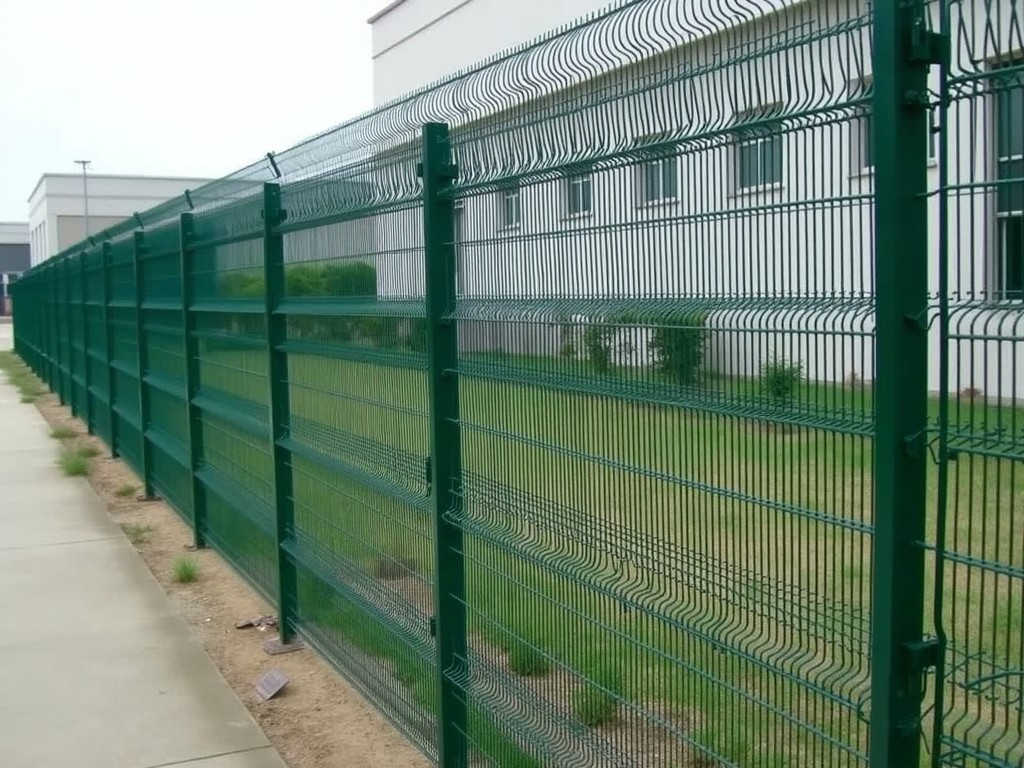
Oem Welded Woven Wire Mesh Fencing Supplier
Welded woven wire mesh fencing is produced by intersecting longitudinal and transverse wires at right angles, then fusing each intersection with resistance welding. The resulting grid provides
Request a QuoteOEM Welded Woven Wire Mesh Fencing
Welded woven wire mesh fencing is produced by intersecting longitudinal and transverse wires at right angles, then fusing each intersection with resistance welding. The resulting grid provides uniform tensile strength across the panel, making it suitable for perimeter security, animal containment, and industrial partitioning where consistent opening size and load distribution are critical.
Technical Overview
The mesh geometry is defined by wire diameter, opening pitch (center‑to‑center spacing), and roll dimensions. Typical wire diameters range from 2.0 mm to 5.0 mm, while opening pitches vary from 25 mm to 150 mm depending on the required barrier performance. Rolls are commonly supplied in widths of 1.0 m to 2.5 m and lengths up to 50 m, facilitating rapid installation with standard post systems.
Material Options
- Low‑carbon steel (ASTM A1008) for general‑purpose applications.
- Galvanized steel (hot‑dip Z275) offering corrosion resistance in outdoor environments.
- Stainless steel grade 304 or 316 for chemical‑exposure or hygienic settings.
- PVC‑coated variants providing additional UV protection and color coding.
Manufacturing Process
Wire is first drawn to the specified diameter, then straightened and cut to length. Longitudinal wires are fed into a weaving machine that interlaces them with transverse wires at the predetermined pitch. The woven mat passes through a series of resistance welders where each crossover is heated to forge a solid bond without compromising ductility. Post‑welding, the mesh may undergo galvanizing, coating, or annealing based on material choice.
Customization Capabilities
Customers can specify wire diameter, opening size, roll width, length, edge finish (knuckled, twisted, or barbed), and surface treatment to match site‑specific load expectations and environmental conditions. The table below illustrates typical adjustable parameters; exact values are confirmed during quoting based on project requirements.
| Parameter | Typical Range | Notes |
|---|---|---|
| Wire Diameter | 2.0 mm – 5.0 mm | Selected per tensile load. |
| Opening Pitch | 25 mm – 150 mm | Smaller openings increase containment. |
| Roll Width | 1.0 m – 2.5 m | Custom widths available on request. |
| Roll Length | Up to 50 m | Longer lengths reduce splices. |
| Edge Finish | Knuckled, Twisted, Barbed | Determines safety and installation method. |
| Coating | None, Galvanized, PVC | Chosen per environmental exposure. |
Applications
In agricultural settings, the mesh prevents livestock intrusion while allowing ventilation and visibility, reducing stress on animals. For industrial facilities, the uniform opening size provides a reliable barrier against unauthorized access without obstructing sightlines for surveillance. In transportation infrastructure, welded woven mesh serves as anti‑throw protection on bridges and overpasses, where its high shear resistance withstands impact from debris or vehicles.
Quality Assurance
Each production lot undergoes dimensional verification of wire diameter and opening pitch using calibrated gauges. Weld strength is assessed via pull‑off tests on random samples to ensure the fused joints meet the specified tensile threshold. Visual inspection checks for consistent coating adhesion and edge integrity before packaging. All inspections follow internal procedures aligned with ISO 9001 principles, though certification status is project‑specific.
FAQ
- Can dimensions be customized? Yes, wire diameter, opening size, roll width, and length are tailored to the customer’s specifications.
- What information is required before quotation? Detailed drawing or sketch indicating required mesh geometry, material preference, coating, edge finish, and quantity.
- How is quality inspected? Dimensional checks, weld tensile tests, and visual coating inspection are performed on each batch.
- What packaging methods are available? Rolls are wrapped in protective film, placed on pallets, and secured with strapping; custom crating is offered for overseas shipments.
- What is the typical production lead time? Lead time varies from 2 to 4 weeks depending on material availability and order size.



