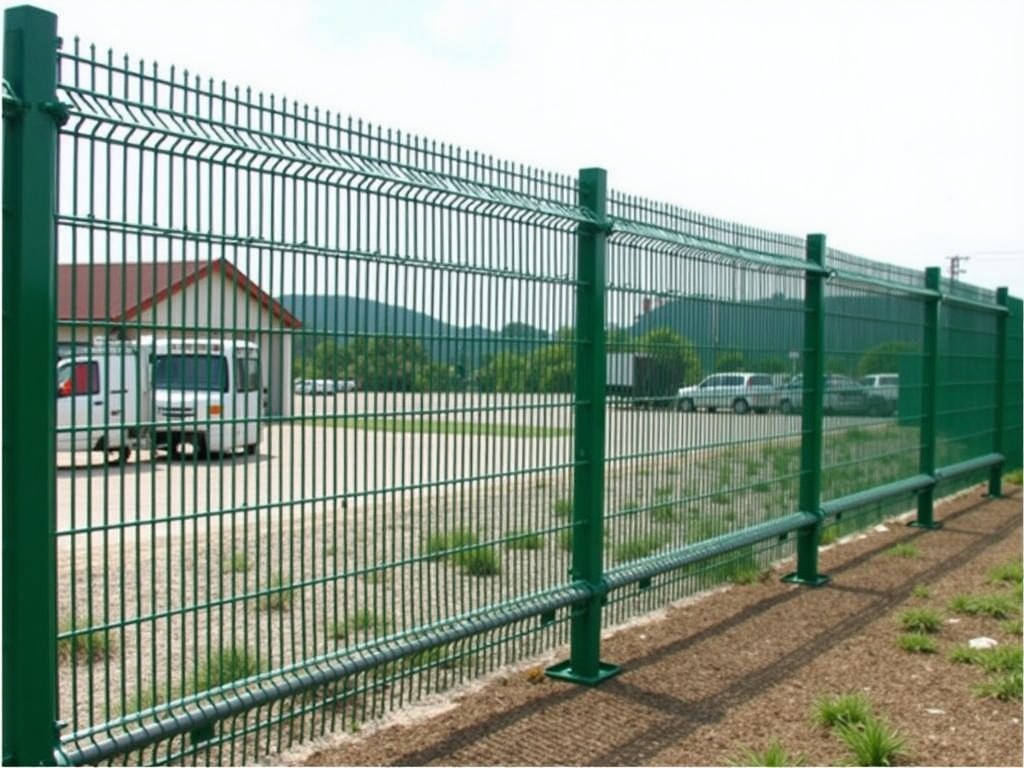
Oem Concrete Welded Wire Mesh Fence Exporter
Concrete welded wire mesh fence consists of steel wires arranged in a rectangular grid, electrically welded at each crossing, and fully encapsulated in a concrete matrix. The resulting panel acts as
Request a QuoteOEM Concrete Welded Wire Mesh Fence Exporter
Concrete welded wire mesh fence consists of steel wires arranged in a rectangular grid, electrically welded at each crossing, and fully encapsulated in a concrete matrix. The resulting panel acts as a composite where the mesh supplies tensile strength and the concrete provides compressive rigidity and impact resistance. Panel thickness typically ranges from 30 mm to 80 mm, allowing designers to balance weight, handling ease, and structural performance.
Technical Specifications
| Parameter | Typical Range | Notes |
|---|---|---|
| Wire Diameter | 3 mm – 6 mm | Selected based on required tensile load |
| Mesh Opening (Center‑to‑Center) | 50 mm – 150 mm | Affects visibility and concrete flow |
| Panel Thickness | 30 mm – 80 mm | Impacts flexural stiffness and handling weight |
| Concrete Grade | C25/30 – C40/50 | Higher grades increase durability in harsh environments |
| Standard Panel Size | 2.4 m × 1.2 m (customizable) | Length and width adjustable to site logistics |
Material Options
The wire mesh is produced from low‑carbon steel wire that meets ASTM A1064 or equivalent standards, offering a yield strength of approximately 400 MPa. For corrosive environments, galvanized coating (Z275) or stainless‑steel wire (grade 304 or 316) can be specified, extending service life in coastal or industrial settings. Concrete mix design incorporates fine and coarse aggregates, Portland cement, and optional silica fume or fly ash to achieve target compressive strength and reduce permeability.
Manufacturing Process
Wire is drawn to the required diameter, straightened, and cut to length before being fed into an automated welding machine that applies precise electrical resistance welds at each intersection. The welded mesh sheet is then placed into a mould where concrete is poured, vibrated to eliminate entrapped air, and cured under controlled temperature and humidity. Demolding occurs after the concrete reaches sufficient early strength, typically 12–24 hours depending on mix design and ambient conditions.
Quality checks are performed at each stage: wire tensile test, weld shear strength verification, concrete slump test, and compressive strength testing of cured cubes. Dimensional inspection ensures panel width, length, and thickness conform to tolerances of ±3 mm.
Applications
- Perimeter security for industrial facilities, where the mesh‑concrete composite resists cutting and impact forces.
- Noise barrier panels along highways, benefiting from the mass of concrete and the damping effect of the welded mesh.
- Architectural precast cladding that provides both aesthetic texture and structural backing for façade systems.
- Retaining wall systems where the mesh reinforces thin concrete sections, reducing material usage while maintaining stability.
Quality Control Philosophy
Each production lot undergoes a documented inspection regime aligned with ISO 9001 principles. Wire chemistry is verified via spectroscopy, weld integrity is assessed by tensile pull‑off tests on sample coupons, and concrete properties are confirmed by cylinder compressive strength tests at 7 and 28 days. Finished panels are measured for flatness and edge straightness using laser scanners, with acceptance criteria based on project‑specific tolerances.
Traceability is maintained through batch numbers affixed to each panel, enabling rapid investigation should any field performance issue arise. This systematic approach reduces uncertainty for OEM buyers who require consistent product performance across large‑scale orders.
Customization
OEM customers can specify variations in wire diameter, mesh spacing, panel dimensions, concrete grade, and surface finish. Surface treatments include exposed aggregate, acid‑etched textures, or applied pigmented coatings to meet architectural requirements. Customization is limited only by the capabilities of the welding equipment and mould design; therefore, early collaboration with our engineering team ensures feasible solutions.
Typical lead time for a custom order ranges from 3 to 6 weeks after final drawing approval, depending on order complexity and current production load. Prototypes or sample panels can be produced within 5‑7 working days for validation testing.
Packaging and Shipping
Finished panels are stacked on pallets with protective edge guards and secured with stretch film. Each pallet is labeled with part number, quantity, weight, and handling instructions. For overseas shipments, panels are placed in weather‑resistant crates or containerized with dunnage to prevent movement and moisture ingress during transit.
Standard pallet dimensions accommodate 20‑foot and 40‑foot containers, facilitating efficient loading and unloading at destination ports. Documentation includes material test reports, certificates of conformity, and packing lists to support customs clearance.
Frequently Asked Questions
Can dimensions be customized to match our project layout?
Yes, panel length, width, thickness, and mesh geometry can be adjusted within the limits of our welding and moulding equipment. Detailed shop drawings are required before tooling preparation.
What information is needed to generate a quotation?
We require the desired wire diameter, mesh opening, panel dimensions, concrete grade, quantity, delivery destination, and any special surface finish or certification requirements.
How is quality inspected before shipment?
Each batch undergoes wire tensile testing, weld shear verification, concrete slump and compressive strength tests, and final dimensional inspection. Test reports are available upon request.
What packaging options protect the panels during export?
Panels are palletized with edge guards, stretch‑wrapped, and either placed in weather‑proof crates or containerized with dunnage. Custom packaging can be arranged for sensitive destinations.
What is the typical production lead time?
Standard items ship within 2‑3 weeks after order confirmation. Customized orders typically require 3‑6 weeks, inclusive of sample approval and tooling setup.
To discuss your specific requirements, request technical datasheets, or arrange a sample shipment, please contact our export team.
Contact Us for a Quotation


