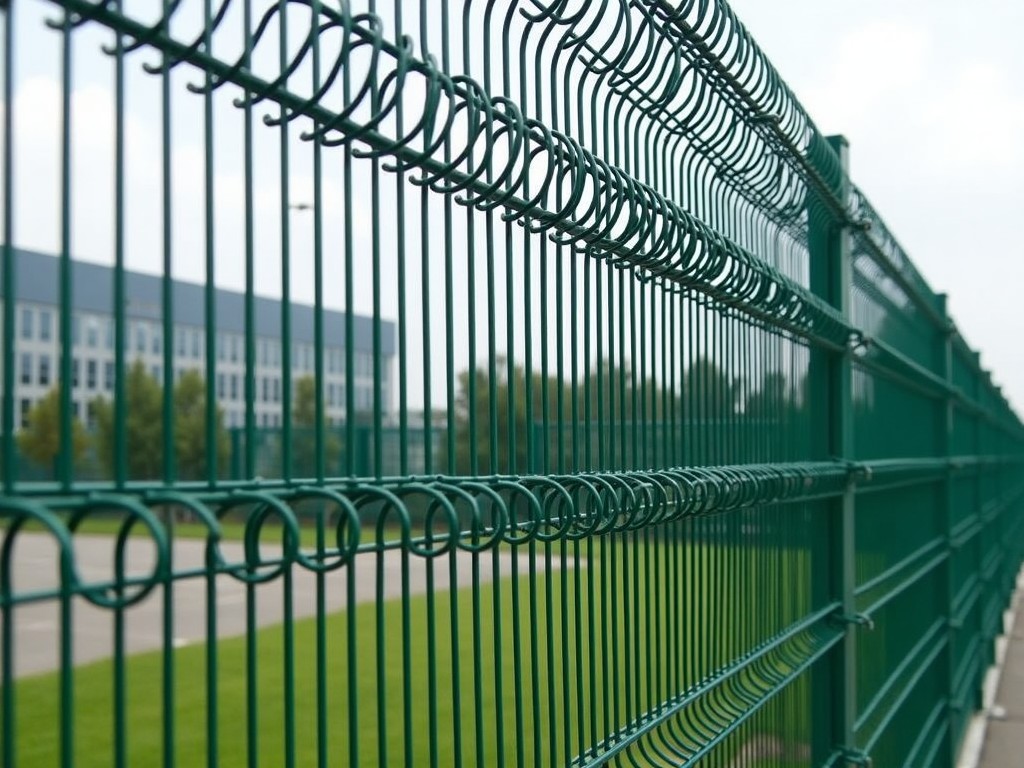
Factory Direct Double Wire Welded Mesh Fence Factory
A double wire welded mesh fence consists of two parallel longitudinal wires that are electrically resistance‑welded to a series of transverse wires at every intersection, forming a rectangular grid.
Request a Quotefactory direct double wire welded mesh fence factory
A double wire welded mesh fence consists of two parallel longitudinal wires that are electrically resistance‑welded to a series of transverse wires at every intersection, forming a rectangular grid. The dual‑wire configuration increases the moment of inertia of each longitudinal member, which improves resistance to bending and impact loads compared with single‑wire mesh of the same overall weight.
The manufacturing process begins with cold‑drawn low‑carbon steel wire, typically supplied in grades SAE 1008 or SAE 1010, with diameters ranging from 2.0 mm to 4.0 mm. After straightening, the wires are fed into a high‑speed welding machine where precisely controlled current pulses create fusion bonds at each crossover. The weld nugget size is monitored to achieve a shear strength of at least 90 % of the parent wire tensile strength.
Post‑welding, the mesh panels undergo a hot‑dip galvanizing line (Zn ≥ 55 µm) or a PVC coating line (coating thickness 0.15 mm–0.25 mm) to provide corrosion protection suitable for outdoor industrial environments. The coating adheres uniformly to both the weld zones and the wire surfaces, preventing localized rust initiation.
Technical specifications
| Parameter | Typical value |
|---|---|
| Wire diameter (longitudinal) | 2.0 mm – 4.0 mm |
| Wire diameter (transverse) | 2.0 mm – 3.5 mm |
| Aperture size (opening) | 25 mm × 25 mm up to 100 mm × 100 mm |
| Panel width | 0.5 m – 2.5 m (customizable) |
| Panel height | 0.5 m – 3.0 m (customizable) |
| Tensile strength of wire | ≥ 350 MPa (cold‑drawn) |
| Coating type | Hot‑dip galvanized (Zn ≥ 55 µm) or PVC (0.15–0.25 mm) |
| Wind load resistance (per panel) | Up to 1.5 kPa depending on aperture and wire size |
Material selection logic
Low‑carbon steel is chosen for its excellent weldability and ductility, which allows the formation of strong, ductile weld nuggets without cracking. The carbon content (0.08 %–0.10 %) provides a yield strength that balances ease of drawing with sufficient tensile capacity for fence applications.
For environments with high chloride exposure (e.g., coastal zones or chemical plants), a PVC overcoat is applied over the galvanized layer. The PVC acts as a barrier to ion migration, extending service life beyond 25 years in C5‑M corrosivity categories as defined by ISO 12944.
Wire diameter selection follows a simple rule: increase diameter by 0.5 mm for every 25 mm increase in aperture size to maintain comparable stiffness. This relationship helps designers keep deflection under wind load within serviceability limits (L/200).
Quality control philosophy
Each production lot undergoes three inspection stages: incoming wire verification (diameter, tensile strength, elongation), in‑process weld monitoring (current, voltage, nugget diameter via non‑destructive eddy‑current testing), and final panel evaluation (dimensional accuracy, coating thickness, visual defect scanning).
Weld shear strength is sampled using a pull‑test on five random intersections per panel; the average must exceed 315 N (90 % of the wire’s tensile capacity). Coating thickness is measured with a magnetic induction probe at ten points per square meter, with acceptance criteria of ≥ 55 µm for zinc and ≥ 0.15 mm for PVC.
Panels that fail any criterion are segregated for rework or scrap, ensuring that only conforming units leave the facility. Traceability is maintained via laser‑etched lot numbers on the panel frame, enabling rapid response to field performance data.
Typical industrial applications
- Perimeter security for manufacturing plants where impact resistance against vehicular intrusion is required.
- Machine guarding areas where the mesh provides visibility while containing debris and preventing operator contact with moving parts.
- Storage yard enclosures for bulk materials (e.g., aggregates, pellets) where the open aperture reduces wind loading and allows drainage.
- Agricultural facilities for livestock pens, offering durability against animal pressure and resistance to corrosion from feed and waste.
- Infrastructure projects such as highway median barriers and railway right‑of‑way fencing, where long‑term maintenance intervals are a priority.
Customization options
Clients may specify wire diameter, aperture size, panel dimensions, and coating type according to project‑specific load calculations and environmental classifications. The factory can produce panels with tapered edges for easy overlapping installation or with integrated tension wires for pre‑stressed applications.
Additional features such as anti‑climb barbs, powder‑coat finishes in RAL colors, or integrated grounding straps for electromagnetic shielding are available upon request. All customizations are reviewed for compliance with relevant standards (e.g., ISO 1461 for galvanizing, ASTM F1664 for welded wire mesh).
Packaging and logistics
Finished panels are stacked on wooden pallets with interleaved corrugated cardboard sheets to prevent surface abrasion. Each stack is secured with polypropylene strapping and stretch‑wrapped with UV‑stabilized film. For export, pallets are placed inside ISPM‑15 compliant wooden crates or steel frames, and desiccant packets are added to control humidity during transit.
Standard pallet dimensions are 1.2 m × 1.0 m, accommodating up to 20 panels depending on thickness. Load capacity per pallet is rated at 1 500 kg, and the packaging system has passed ISTA‑3A vibration and shock tests.
Frequently asked questions
Can dimensions be customized?
Yes. Wire diameter, aperture size, panel width and height are all adjustable based on structural calculations and site constraints. Provide the required load cases and environmental exposure for a detailed quotation.
What information is needed before quotation?
We require the intended aperture, wire diameter or desired panel weight, coating preference (galvanized or PVC), panel dimensions, quantity, and delivery destination. If you have a design drawing or load specification, include it to expedite the review.
How is quality inspected?
Inspection includes incoming wire testing, real‑time weld monitoring, and final panel checks for dimensional tolerance, coating thickness, and visual defects. Test reports are available upon request.
What packaging methods are available?
Standard packaging is palletized with cardboard interleaving and stretch film. Export crates, steel frames, and moisture‑barrier wrapping can be supplied for overseas shipments.
What is the typical production lead time?
Lead time ranges from 2 to 4 weeks for standard specifications, depending on order size and current plant capacity. Custom coatings or non‑standard apertures may extend this period; a precise schedule is provided after order confirmation.
Contact for technical inquiry
To discuss your project requirements, request a sample, or obtain a formal quotation, please reach out via our contact form. Provide the details outlined in the FAQ section to ensure a prompt and accurate response.
Send inquiry


