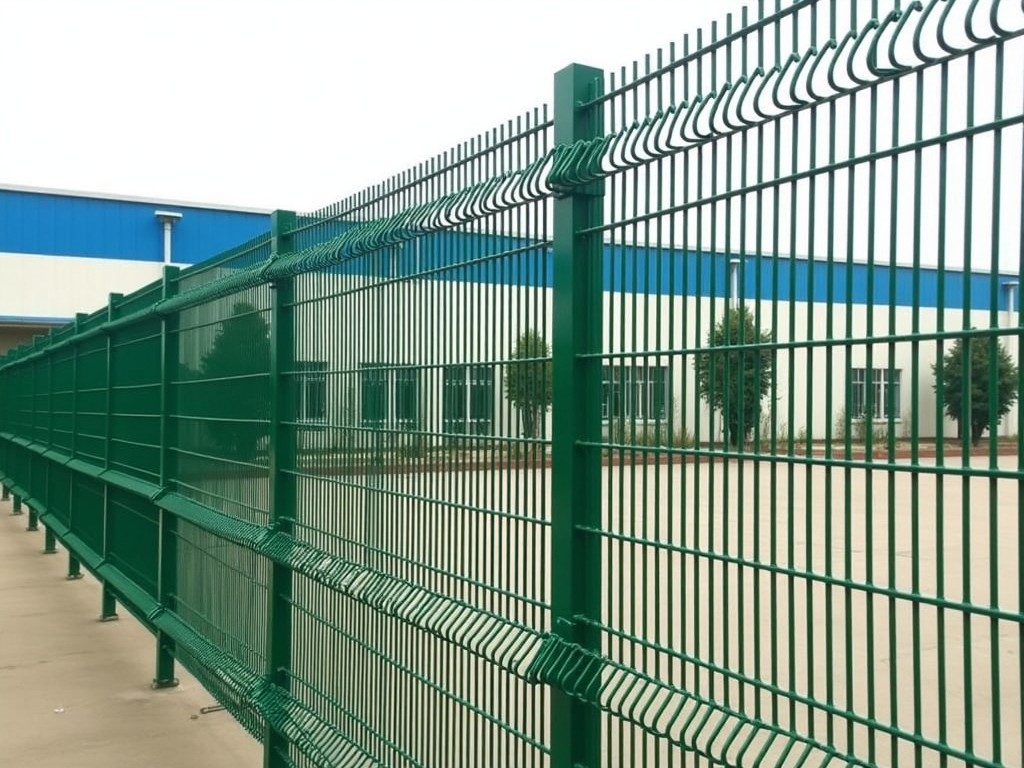
Factory Direct Anti Climb Welded Mesh Fence Exporter
Anti-climb welded mesh fence is formed by resistance welding vertical and horizontal steel wires at each intersection, creating a rigid grid with uniformly small apertures. The tight opening,
Request a QuoteFactory Direct Anti Climb Welded Mesh Fence Exporter
Anti-climb welded mesh fence is formed by resistance welding vertical and horizontal steel wires at each intersection, creating a rigid grid with uniformly small apertures. The tight opening, typically 12.5 mm × 12.5 mm or smaller, eliminates usable footholds and handholds, while the welded joints resist deformation under impact or cutting attempts.
Factory direct supply allows the exporter to control raw material traceability, adjust welding parameters per order, and maintain consistent lead times for overseas shipments. This model reduces intermediary handling, which helps preserve dimensional tolerances and coating integrity from production to destination.
Technical Specifications
| Parameter | Typical Value / Customizable |
|---|---|
| Mesh Opening (mm) | 12.5 × 12.5 (standard), 8 × 8 or 6 × 6 available on request |
| Wire Diameter (mm) | 3.0 mm low‑carbon steel, 3.5 mm or 4.0 mm for higher load |
| Panel Height (mm) | 1800 mm–3000 mm (custom lengths) |
| Panel Width (mm) | 2400 mm–3000 mm (standard) |
| Tensile Strength of Wire (MPa) | ≥ 350 MPa (cold‑drawn) |
| Coating Type | Hot‑dip galvanized (Zn ≥ 55 g/m²), optionally powder‑coated or stainless steel |
| Coating Thickness (µm) | Typical Zn ≥ 55 µm; powder coat 60‑80 µm |
Applications
In correctional facilities, the small aperture prevents inmates from gaining a foothold for climbing, while the welded panel resists tampering with common tools. The same principle applies to high‑voltage substations where personnel safety and equipment protection require a barrier that cannot be easily scaled or breached.
Data centers and telecommunications sites use anti‑climb fence to deter unauthorized access to critical infrastructure, where even a brief intrusion can cause service disruption. The fence’s rigidity also supports integration with motion sensors and vibration detectors along the perimeter.
Material Options
- Low‑carbon steel core for economical projects, supplied with hot‑dip galvanization
- Stainless steel grade 304 or 316 for corrosive environments such as chemical plants or coastal installations
- Pre‑galvanized wire with additional powder‑coat finish in RAL colors for aesthetic or UV‑resistance requirements
Customization Options
- Panel dimensions: height, width, and length adjusted to site‑specific measurements
- Aperture size: reduced to 6 mm × 6 mm for maximum anti‑climb performance
- Wire diameter: increased up to 5 mm for high‑impact zones
- Coating color: standard galvanized grey, black, green, or custom RAL powder coat
- Top treatments: angled overhang, razor‑ribbon, or barbed tape integration
- Gate configurations: single leaf, double leaf, sliding, with matching mesh infill and lock provisions
Quality Assurance & Testing
Each production batch undergoes weld shear testing to verify joint strength meets ≥ 80 % of parent wire tensile strength. Coating adhesion is assessed using ASTM D3359 tape test, ensuring ≥ 4B rating for galvanized layers. Dimensional inspection confirms aperture uniformity within ± 0.5 mm across the panel surface.
Visual inspection under standardized lighting identifies surface defects such as weld spatter, coating pitting, or wire deformation before packaging. Test reports are retained and can be supplied with shipment documentation upon request.
Export Packaging & Logistics
Finished panels are stacked flat with edge protectors, then wrapped in stretch‑film to prevent abrasion during handling. The bundled load is placed in steel‑frame stillages or fumigated wooden crates, secured with polyester strapping for containerized shipment.
Each crate includes a packing list, material certificate, and test summary. Shipping marks conform to ISPM 15 standards, and the exporter arranges marine insurance and customs documentation to facilitate smooth clearance at destination ports.
Frequently Asked Questions
| Question | Answer |
|---|---|
| Can panel dimensions be customized? | Yes, height, width, and length are adjusted per project drawings; typical limits are 1800–3000 mm height and 2400–3000 mm width. |
| What information is needed for a quotation? | Required details include panel size, mesh opening, wire diameter, coating type, quantity, and delivery destination. Optional: gate specs, top treatment, and any special packaging. |
| Which materials are available for corrosive environments? | Stainless steel grades 304 and 316 are offered; alternatively, hot‑dip galvanized steel with additional powder‑coat provides a cost‑effective barrier against moisture and chemicals. |
| How is quality verified before shipment? | Each lot undergoes weld shear, coating adhesion, and dimensional checks; results are documented in an inspection report that accompanies the cargo. |
| What is the typical production lead time? | Lead time ranges from 2 to 4 weeks depending on order complexity and current factory load; exact timing is confirmed at quote stage. |
Contact for Project Inquiry
To discuss specifications, obtain a detailed quotation, or request a sample panel, please reach out using the form below. Our engineering team will respond with technical feedback and lead‑time estimates within one business day.



