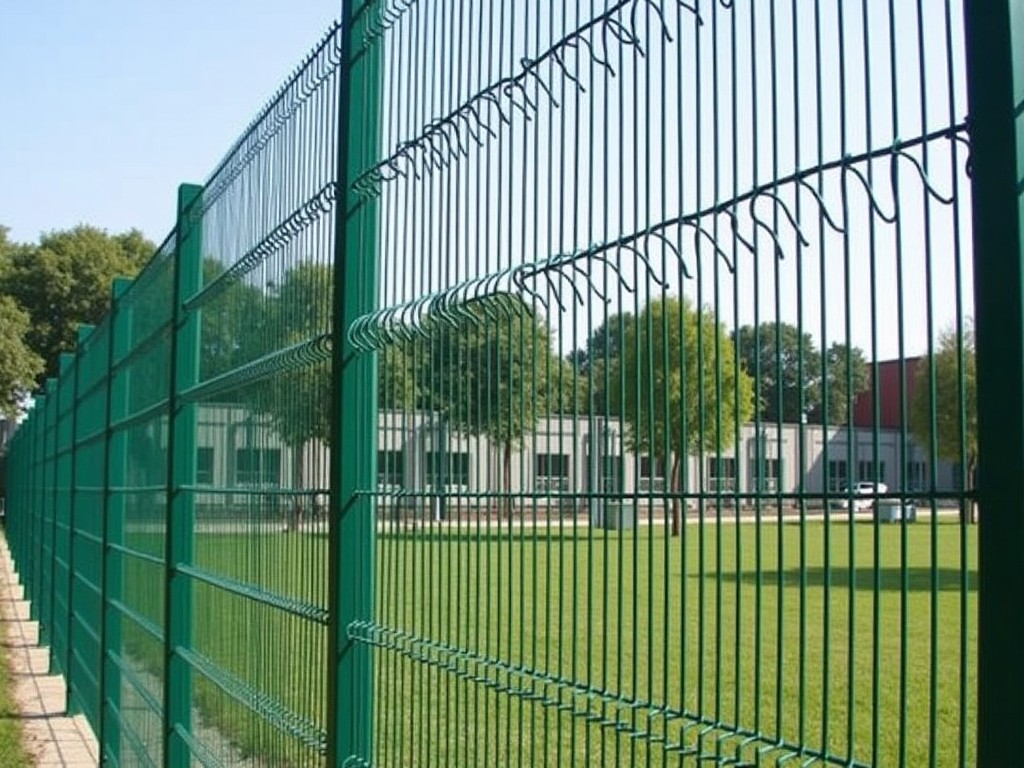
Direct Factory Welding Aluminum Mesh Security Fence Factory
This product consists of welded aluminum mesh panels formed from extruded alloy bars that are joined at each intersection by precision welding. The resulting grid provides a continuous barrier with
Request a QuoteDirect Factory Welded Aluminum Mesh Security Fence
This product consists of welded aluminum mesh panels formed from extruded alloy bars that are joined at each intersection by precision welding. The resulting grid provides a continuous barrier with high shear resistance while maintaining a low mass per unit area, suitable for perimeter security where weight and corrosion resistance are critical.
Material Composition and Alloy Selection
The primary alloy used is AA 6063‑T5, offering a minimum tensile strength of 200 MPa and yield strength of 140 MPa. The alloy’s magnesium‑silicon composition provides excellent atmospheric corrosion resistance, allowing untreated surfaces to survive in coastal environments for extended periods. Density is approximately 2.7 g/cm³, giving a weight advantage over steel mesh of comparable strength.
Manufacturing Process: Welding Technique
Panels are produced on automated welding lines where tungsten inert gas (TIG) or metal inert gas (MIG) torches apply a controlled heat input to fuse the crossing wires. Weld penetration is maintained between 0.6 mm and 0.9 mm for wire diameters ranging from 2.0 mm to 4.0 mm, ensuring joint strength that exceeds 80 % of the base metal tensile capacity. Post‑weld heat treatment is avoided to preserve the alloy’s temper and dimensional stability.
Technical Specifications
| Parameter | Typical Value | Unit | Notes |
|---|---|---|---|
| Mesh opening (clear) | 50 × 50 | mm | Customizable from 20 mm to 100 mm |
| Wire diameter | 2.5 – 4.0 | mm | Selected per load requirement |
| Panel height | Up to 3000 | mm | Standard lengths 2000 mm, 2500 mm, 3000 mm |
| Panel width | Up to 2500 | mm | Modular design allows splicing |
| Frame extrusion thickness | 3.0 – 5.0 | mm | Provides edge rigidity |
| Weld tensile strength | ≥160 | MPa | Measured per ISO 9016 |
| Surface finish | Mill finish / Anodized (10‑15 µm) / Powder coat (60‑80 µm) | – | Selected per environmental exposure |
| Weight per square meter | 2.8 – 4.5 | kg/m² | Dependent on wire diameter and mesh opening |
Design Advantages
The high strength‑to‑weight ratio of aluminum reduces foundation loads and simplifies handling during installation. The non‑magnetic nature of the alloy eliminates interference with nearby electronic security equipment. Additionally, the welded joints eliminate points of loosening that are common in woven or knotted mesh systems, providing a rigid barrier that resists deformation under impact loads.
Typical Applications
- Perimeter protection for substations and power plants where electromagnetic transparency is required.
- Secure enclosures for data centers and telecommunications hubs, offering visibility while preventing unauthorized access.
- Airside fencing at airports, where low weight reduces structural support requirements and corrosion resistance ensures longevity.
- Industrial facility boundaries that need resistance to chemical splashes and UV exposure, particularly when powder‑coated.
Customization Options
- Mesh opening size: adjustable from 20 mm to 100 mm in 5 mm increments.
- Wire diameter: selectable between 2.0 mm and 5.0 mm to meet specific load cases.
- Panel dimensions: height and width can be tailored to site constraints; splicing kits available for larger spans.
- Frame profiles: various extrusion shapes (square, rectangular, L‑type) with optional reinforcement ribs.
- Surface treatments: clear anodize, colored anodize, or polyester powder coat in standard RAL colors.
- Additional features: integrated anti‑climb toppings, barbed wire brackets, or sensor mounting provisions.
Quality Control and Testing
Each production lot undergoes visual inspection for weld uniformity and surface defects. A sample from every batch is subjected to tensile shear testing of welded joints according to ASTM E8/E8M, with acceptance criteria requiring a minimum of 80 % of base metal strength. Coating thickness is verified using a magnetic induction gauge for anodize and a dry‑film thickness gauge for powder coat, ensuring compliance with the specified micron range. Dimensional accuracy is checked via laser scanning to confirm mesh opening tolerances within ±0.5 mm.
Packaging and Shipping
Panels are stacked flat on wooden pallets with interleaving polyethylene sheets to prevent surface abrasion. Corner protectors are applied to all vertical edges, and the entire load is secured with polyester strapping. Standard export packaging fits 20‑foot and 40‑foot containers, allowing up to 25 pallets per 40‑ft unit depending on panel height. Each pallet is labeled with part number, lot number, and QR code linking to the material test certificate.
Frequently Asked Questions
- Can dimensions be customized? Yes, panel height, width, mesh opening, and wire diameter can be adjusted to project specifications; custom tooling may be required for non‑standard openings.
- What information is required before quotation? We need the required panel size, mesh opening, wire diameter, desired finish, quantity, and delivery destination.
- What materials are available? Standard offering is AA 6063‑T5; other alloys such as 6005‑A or 6101 are available upon request for higher conductivity or strength.
- How is quality inspected? Visual inspection, weld tensile shear testing, coating thickness measurement, and dimensional verification are performed per lot.
- What packaging methods are available? Standard palletizing with protective interleaves and strapping; custom crating or container‑specific loading can be arranged.
- How are export shipments protected? Moisture‑barrier wraps, corner guards, and shock‑absorbing pallet bases are used to mitigate corrosion and impact during transit.
- What is the typical production lead time? Lead time ranges from 3 to 6 weeks after receipt of final drawing approval, depending on order size and customization level.
- How are samples arranged? Sample panels (up to 500 mm × 500 mm) can be shipped via express courier at the recipient’s expense; larger samples require freight arrangement.
Contact for Technical Quotation
To obtain a detailed quotation, please provide the project specifications listed above. Our engineering team will review the requirements and return a formal offer with lead time and payment terms.



