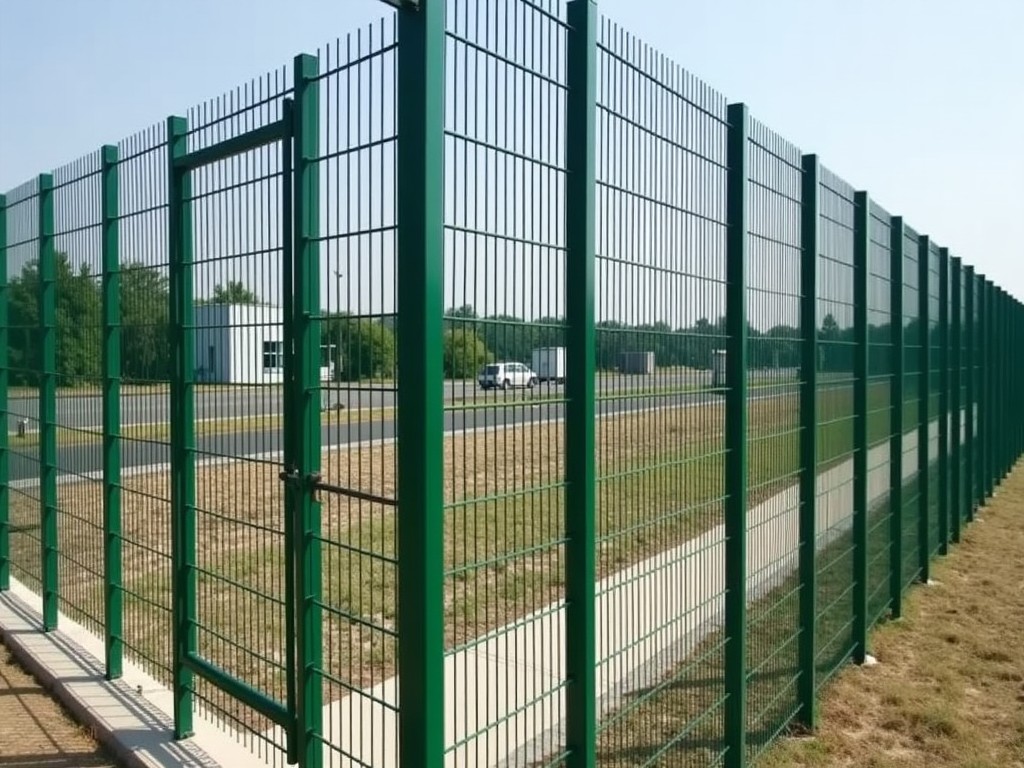
Custom Welded Wire Mesh Fence Panel Manufacturer
Welded wire mesh fence panels are fabricated by intersecting longitudinal and transverse wires at precise intervals and fusing them with resistance welding. This process creates a rigid grid that
Request a QuoteCustom Welded Wire Mesh Fence Panel Manufacturer
Welded wire mesh fence panels are fabricated by intersecting longitudinal and transverse wires at precise intervals and fusing them with resistance welding. This process creates a rigid grid that resists deformation under load while maintaining open area for visibility and airflow.
Selecting the correct wire diameter, mesh opening, and panel dimensions directly influences the fence’s structural capacity, corrosion resistance, and installation efficiency.
Material Options and Their Engineering Implications
Low-carbon steel wire (ASTM A1064) provides a balance of tensile strength (~550 MPa) and weldability, making it suitable for general-purpose perimeter fencing where coating protects against rust.
Galvanized steel wire, either hot-dip dipped to a minimum zinc coating of 60 µm or electro-galvanized to 12 µm, extends service life in humid environments by slowing oxidation rates.
Stainless steel wire (grades 304 or 316) offers inherent corrosion resistance with chromium content ≥10.5%, eliminating the need for additional coatings in chemical processing or marine settings.
- Wire diameters typically range from 2.0 mm to 5.0 mm, affecting panel rigidity and load‑bearing capacity.
- Mesh openings vary from 12.5 mm × 12.5 mm for security barriers to 100 mm × 100 mm for agricultural enclosures.
- Panel heights are commonly produced between 0.8 m and 2.4 m, with widths limited by handling equipment to 3.0 m.
Customization Logic for Project‑Specific Requirements
Customization begins with defining the design load: wind pressure, impact forces, or animal pressure that the fence must withstand without permanent deflection.
From the load case, engineers select wire diameter and spacing using the formula for bending stress in a simply supported grid, ensuring the safety factor meets local codes (often 1.5 to 2.0).
Surface treatment is then chosen based on environmental corrosivity classification (C1–C5 per ISO 9223), dictating coating thickness or alloy selection.
- Optional features include integrated barbed wire, anti‑climb brackets, or powder‑coated finishes in custom RAL colors.
- Panel edges can be finished with folded flanges, welded frames, or post‑insertion slots to simplify field assembly.
- For projects requiring rapid deployment, panels are supplied with pre‑drilled hole patterns matching standard post spacings.
Manufacturing Considerations that Affect Consistency
Wire is first drawn to the specified diameter, then straightened and cut to length before being fed into a CNC‑controlled welding machine.
The resistance welding parameters—current, voltage, and dwell time—are calibrated per wire gauge to achieve a nugget diameter of at least 0.5× the wire thickness, ensuring joint strength exceeds 90% of the base wire tensile capacity.
After welding, panels pass through a flattening roller to relieve residual stress, followed by a visual inspection for weld uniformity and wire alignment tolerance of ±1 mm.
- Coating lines apply hot‑dip zinc via a controlled immersion speed, producing a uniform coating thickness measured by magnetic induction.
- Powder‑coating booths use electrostatic spray with curing at 180 °C for 10 minutes, delivering a film thickness of 60–80 µm.
- Final dimensional checks are performed on a coordinate measuring machine (CMM) with repeatability of ±0.2 mm.
Typical Industrial Applications and Rationale
In petrochemical facilities, welded mesh panels serve as secondary containment barriers where the open mesh allows gas dispersion while preventing unauthorized access to hazardous zones.
Data centers use panels with small apertures (12.5 mm) to restrict particulate ingress while maintaining adequate airflow for cooling systems, reducing the need for additional filtration.
Agricultural operations select larger openings (50 mm × 50 mm) to contain livestock while enabling visibility for herd monitoring, lowering stress compared with solid barriers.
- Transport infrastructure: median barriers and glare screens where high impact resistance and low weight are critical.
- Renewable energy sites: fencing around solar farms that must withstand wind loads without casting shade on panels.
- Military bases: perimeter security with anti‑climb features and tamper‑resistant welds.
Quality Assurance Practices Aligned with Industrial Standards
Each production lot undergoes tensile testing on representative welds according to ASTM E8, with acceptance criteria set at a minimum of 95% of the wire’s ultimate tensile strength.
Coating adhesion is verified by ASTM D4541 pull‑off testing, ensuring a minimum adhesion strength of 2.5 MPa for hot‑dip galvanized layers.
Dimensional audits are performed on a statistical sample basis (AQL 0.65) for length, width, and mesh opening, with measurement uncertainty below 0.1 mm.
- Visual inspection under 500 lux lighting identifies surface defects such as zinc drips or coating pinholes.
- Packaging integrity is checked by verifying that corner protectors and stretch film retain 95% of their original tension after a 24‑hour simulated transit test.
- Traceability is maintained via laser‑etched batch codes linking raw material certificates to finished panel records.
| Parameter | Typical Value / Range | Remarks |
|---|---|---|
| Wire Diameter | 2.0 mm – 5.0 mm | Selected based on load requirements |
| Mesh Opening | 12.5 mm × 12.5 mm – 100 mm × 100 mm | Square or rectangular configurations |
| Panel Height | 0.8 m – 2.4 m | Custom lengths available |
| Panel Width | Up to 3.0 m (limited by handling) | Can be spliced for longer runs |
| Tensile Strength of Wire | ≥ 550 MPa (low‑carbon steel) | Higher for stainless grades |
| Coating Thickness (Zn) | 60 µm (hot‑dip) – 12 µm (electro) | Measured per ASTM A123/A153 |
| Wind Load Capacity | Up to 2.0 kN/m² (depending on spec) | Verified via finite element analysis |
Frequently Asked Questions
Can dimensions be customized to match existing post layouts?
Yes. Panel height, width, and mesh opening are adjusted during the CNC programming stage to align with standard post spacings (e.g., 2.4 m centers) or custom intervals supplied by the client.
What information is required before a quotation can be issued?
The quote request should include wire diameter or grade, desired mesh opening, panel dimensions, coating type, quantity, and any special features such as barbed wire or integrated brackets.
Which materials are available for corrosive environments?
Hot‑dip galvanized low‑carbon steel, electro‑galvanized steel, and stainless steel grades 304 or 316 are offered, with coating thickness tailored to the ISO 9223 corrosivity category.
How is quality inspected before shipment?
Each batch undergoes tensile weld testing, coating adhesion pull‑off, and dimensional audits per AQL 0.65, with records retained for traceability.
What packaging methods protect panels during export?
Panels are stacked on pallets, separated by corrugated sheets, wrapped in UV‑stabilized stretch film, and fitted with steel corner protectors to withstand stacking forces up to 2 t.
Ready to Discuss Your Project?
Provide your technical specifications, and our engineering team will return a detailed feasibility review, including wire selection, welding parameters, and lead time estimate within two business days.
Request Technical Review


