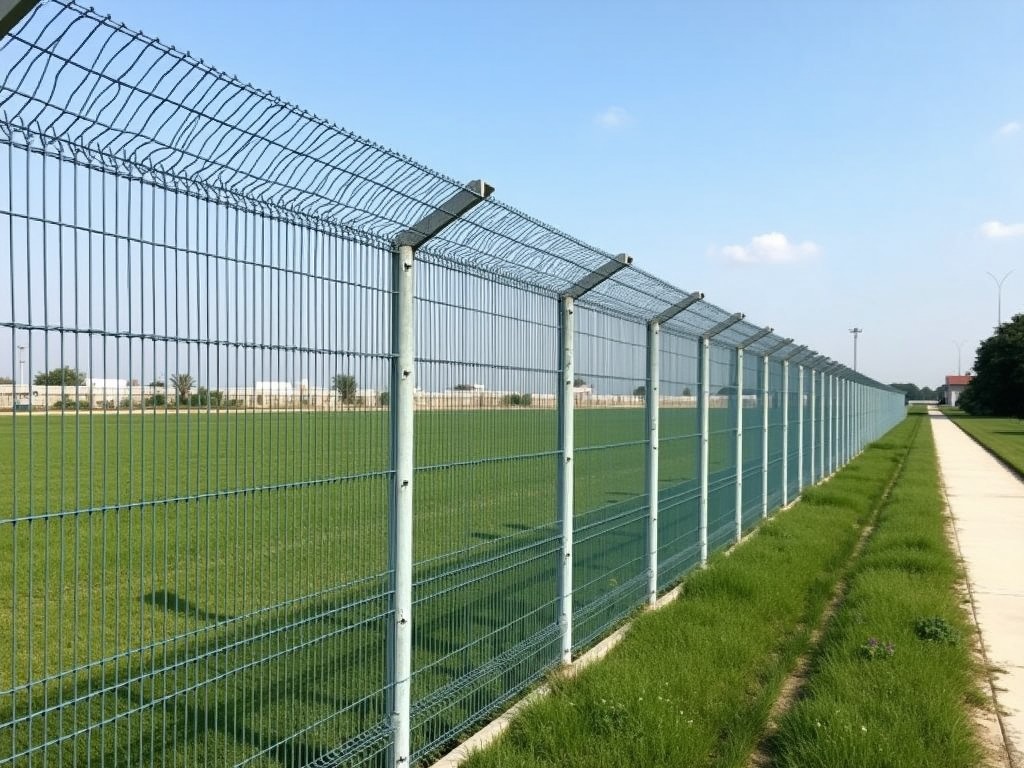
Custom Welded Razor Wire Mesh Fence Factory
The factory produces razor‑wire mesh panels by welding high‑tensile steel wire to a reinforced grid, creating a barrier that combines cutting resistance with structural rigidity. Each panel is
Request a QuoteCustom Welded Razor Wire Mesh Fence Factory
The factory produces razor‑wire mesh panels by welding high‑tensile steel wire to a reinforced grid, creating a barrier that combines cutting resistance with structural rigidity. Each panel is fabricated to project‑specific dimensions, wire gauges, and coil configurations to meet site security requirements.
Material Selection
Core wire is typically cold‑drawn carbon steel with a tensile strength of 550–700 MPa, galvanized to a minimum coating weight of 270 g/m² for corrosion resistance. The razor‑wire strips are formed from the same base material, sharpened to a blade angle of 45° and heat‑treated to achieve a hardness of 48–52 HRC.
Alternative alloys such as stainless steel (grade 304 or 316) are available upon request for environments with high chloride exposure or where aesthetic finish is required. The base grid can be supplied as welded mesh, expanded metal, or perforated panel depending on load‑bearing needs.
Manufacturing Process
Wire is first straightened and cut to length, then fed through a series of rollers that form the razor‑wire profile. The formed wire is positioned onto the grid and spot‑welded at predetermined intervals using resistance welding equipment calibrated to 15–20 kA welding current.
After welding, panels undergo a secondary pass through a tensioning line to ensure uniform wire tension across the mesh, preventing sagging under load. Final inspection includes visual examination of weld integrity and dimensional verification against CAD models.
Customization Options
- Panel height: 1.0 m to 3.0 m (custom lengths available)
- Wire diameter: 2.0 mm to 4.0 mm for core grid; razor‑wire thickness 0.5 mm to 1.0 mm
- Mesh opening: 25 mm × 25 mm to 100 mm × 100 mm
- Coating: hot‑dip galvanization, PVC coating, or powder‑coat in RAL colors
- Mounting provisions: pre‑drilled posts, brackets, or integrated tension wires
Technical Specifications
| Parameter | Typical Value | Notes |
|---|---|---|
| Core Wire Tensile Strength | 550–700 MPa | Depends on wire grade |
| Galvanized Coating Weight | ≥270 g/m² | Minimum for outdoor exposure |
| Razor‑Wire Blade Angle | 45° | Standard cutting geometry |
| Hardness (HRC) | 48–52 | After heat treatment |
| Panel Weight (per m²) | 8–15 kg | Varies with wire diameter and mesh size |
Applications
Perimeter security for critical infrastructure such as power substations, water treatment facilities, and telecommunications towers benefits from the dual deterrent of visual obstruction and physical cutting resistance. The welded mesh distributes impact loads, reducing the likelihood of panel deformation under attempted breach.
Correctional facilities employ razor‑wire mesh atop existing fences to increase climb difficulty without adding excessive weight that could compromise existing support structures. The modular panel design allows rapid installation on uneven terrain using adjustable post brackets.
Industrial storage yards use the mesh as a secondary barrier around hazardous material zones, where the razor‑wire provides a clear visual warning while the underlying grid prevents unauthorized vehicle penetration.
Quality Assurance
Each production lot is subject to tensile testing of random wire samples, confirming conformity to the specified strength range. Weld strength is evaluated using peel tests on coupon specimens, targeting a minimum shear load of 1.2 kN per weld point.
Dimensional accuracy is verified with laser scanning equipment, ensuring panel height and width tolerances remain within ±3 mm. Surface coating thickness is measured via magnetic induction, with acceptance criteria aligned to ISO 1461 for galvanization.
Final visual inspection under standardized lighting identifies any defects such as incomplete welds, wire deformation, or coating holidays before packaging.
Packaging and Logistics
Panels are stacked on wooden pallets with interleaving corrugated sheets to prevent surface abrasion. Each pallet is secured with steel straps and stretch film, providing protection against moisture and shifting during transit.
Standard pallet dimensions accommodate 20‑foot and 40‑foot container loads, facilitating efficient handling at ports and distribution centers. Custom packaging, such as crate‑mounted panels for air freight, can be arranged according to project timelines.
Frequently Asked Questions
- Can dimensions be customized? Yes, panel height, width, wire gauge, and mesh opening are tailored to the provided CAD drawings or site measurements.
- What information is required before quotation? Required inputs include desired panel size, wire material (galvanized steel, stainless steel, or coated), coating type, mounting accessories, and delivery destination.
- How is quality inspected? Quality control includes tensile testing of wire, weld shear testing, dimensional verification via laser scanning, and coating thickness measurement per ISO standards.
- What packaging options are available? Standard palletized packing with interleaving layers and stretch film; custom crates or container‑specific configurations upon request.
- What is the typical production lead time? Lead time ranges from 2 to 4 weeks depending on order complexity and current factory load; exact schedule is confirmed at order acknowledgment.
For technical discussions or to request a detailed quotation, please contact our engineering team via the inquiry form.
Send Inquiry


