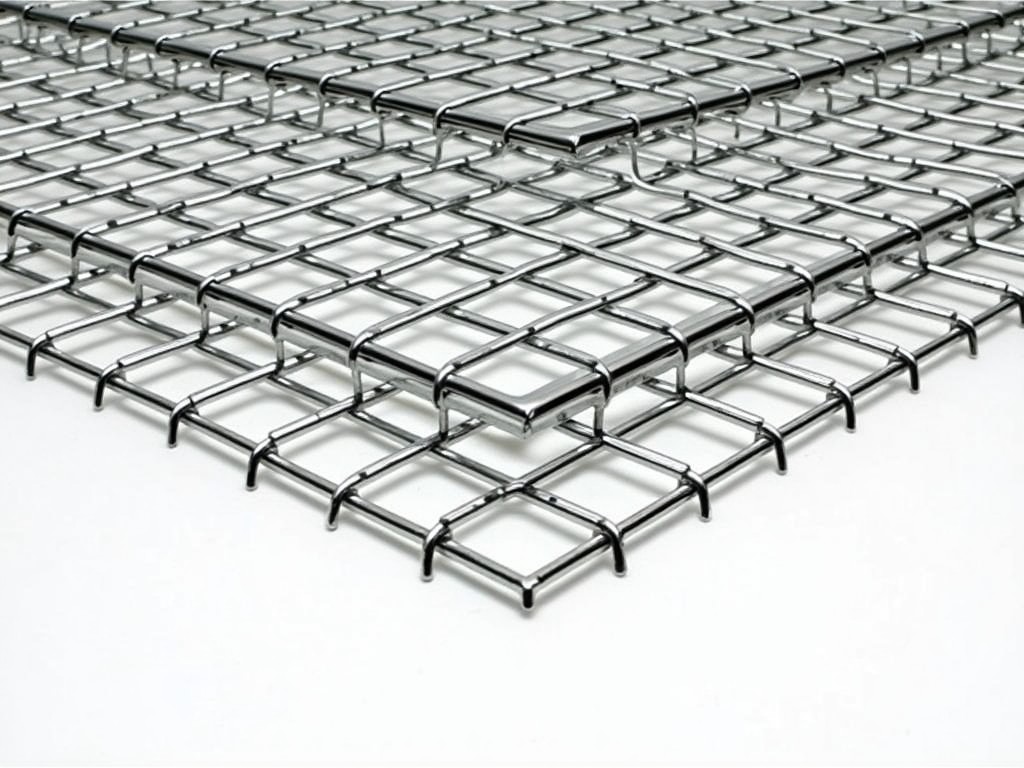
Custom Heavy Duty Welded Wire Mesh Panels Manufacturer
Manufacturers produce welded wire mesh panels by joining intersecting wires at each crossover point through resistance welding, creating a rigid grid suitable for structural reinforcement, safety
Request a QuoteCustom Heavy Duty Welded Wire Mesh Panels
Manufacturers produce welded wire mesh panels by joining intersecting wires at each crossover point through resistance welding, creating a rigid grid suitable for structural reinforcement, safety barriers, and filtration applications.
Material Options
The base wire influences corrosion resistance, mechanical strength, and weldability. Commonly selected materials include low‑carbon steel, galvanized steel, and stainless steel alloys.
- Low‑carbon steel (ASTM A1008) – tensile strength ~400 MPa, suitable for indoor or painted applications.
- Hot‑dip galvanized steel (ASTM A123) – zinc coating ≥55 µm, provides atmospheric corrosion resistance for outdoor use.
- Stainless steel grade 304 (ASTM A240) – chromium‑nickel alloy, resistant to mild chemicals and moisture.
Typical Specification Ranges
Actual dimensions are tailored to project requirements; the table below shows common adjustable parameters.
| Parameter | Adjustable Range | Notes |
|---|---|---|
| Wire diameter | 2 mm – 8 mm | Thicker wire increases load capacity. |
| Opening size (clear gap) | 10 mm – 150 mm | Smaller openings improve containment. |
| Panel width | 500 mm – 2500 mm | Limited by handling equipment. |
| Panel height | 500 mm – 3000 mm | Can be split for transport. |
| Weld tensile strength | ≥90 % of wire base strength | Verified per AWS D1.2. |
Customization Logic
Design decisions follow load calculations, environmental exposure, and installation constraints. The manufacturer typically asks for:
- Required uniform load (kN/m²) or impact rating.
- Corrosion class per ISO 12944 (C1‑C5).
- Mounting method (post‑set, clamps, embed).
- Surface finish (plain, powder‑coated, PVC‑coated).
Typical Applications
Heavy duty welded wire mesh panels serve where both flexibility and rigidity are needed. The open grid allows drainage while resisting deformation.
- Retaining wall reinforcement – distributes lateral soil pressure across the panel.
- Machine guard panels – provides visibility while containing debris.
- Security fencing for substations – high tensile welds resist cutting.
- Concrete formwork facing – prevents grout loss and allows reuse.
- Animal containment enclosures – smooth welded edges reduce injury risk.
Quality Control Philosophy
Inspection focuses on weld integrity, dimensional accuracy, and coating uniformity. Each batch undergoes:
- Visual inspection of welds for cracks or incomplete fusion.
- Dimensional verification of wire pitch and panel squareness (±2 mm).
- Pull‑off test on a sample weld to confirm ≥90 % base wire strength.
- Coating thickness measurement (galvanize or paint) per relevant ASTM.
Packaging and Delivery
Panels are bundled to prevent deformation during transit. Protective measures depend on finish and destination.
- Flat stacks with edge protectors and steel straps for galvanized panels.
- Crate‑wrapped with vapor barrier for powder‑coated units.
- Containerized loads include corner bracing and moisture‑absorbing desiccants.
Production Lead Time
Lead time varies with complexity and current shop load. Typical windows are:
- Standard galvanized panels, 2 mm‑5 mm wire: 2‑3 weeks.
- Stainless steel or custom coating: 4‑6 weeks.
- Large panels (>2000 mm width) requiring special handling: add 1‑2 weeks.
Frequently Asked Questions
Yes. Wire diameter, opening size, panel width and height are adjusted per drawing or load specification.
Please provide load requirements, environmental corrosivity class, panel dimensions, desired finish, and quantity.
Low‑carbon steel, hot‑dip galvanized steel, and stainless steel grades 304/316 are standard; other alloys are available upon request.
Each lot undergoes visual inspection and mechanical pull‑off testing on a sacrificial weld to confirm strength.
Galvanized panels are bundled with steel straps; painted or powder‑coated panels are wrapped in polyethylene film and placed in crates with corner protectors.
To discuss your project requirements and receive a detailed quotation, please contact our engineering team.
Request a Quote


