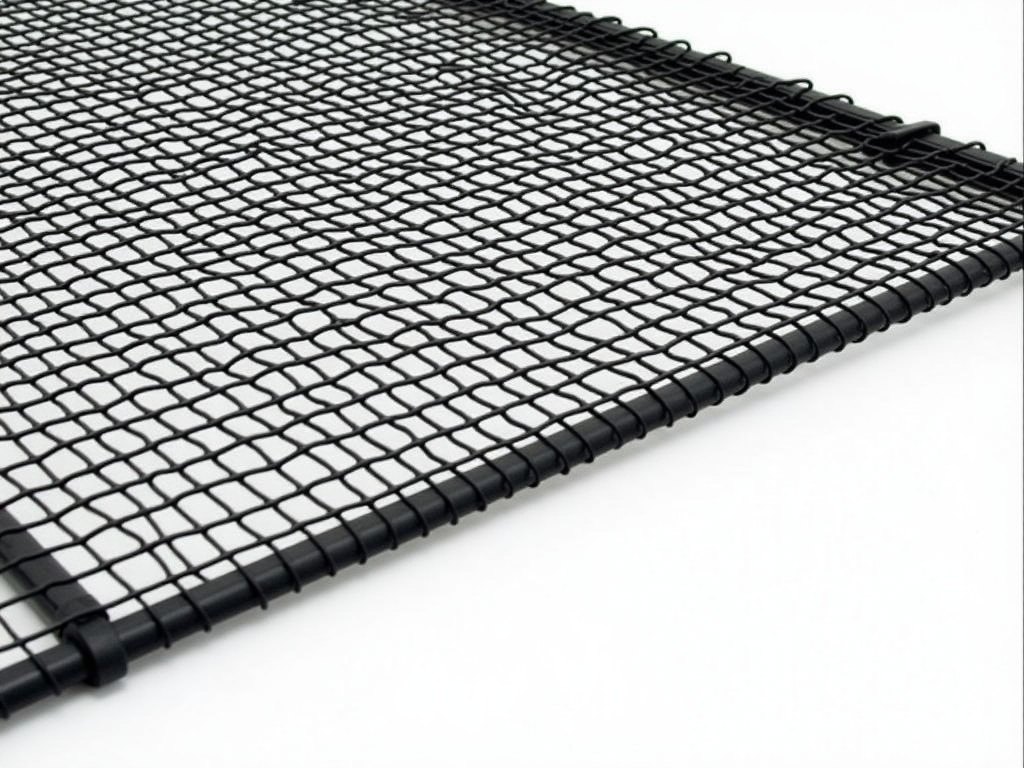
Custom Black Vinyl Coated Welded Wire Mesh Factory
The factory produces welded wire mesh that receives a uniform black vinyl coating after the welding process. The coating is applied to the entire mesh surface, providing a barrier against moisture,
Request a QuoteCustom Black Vinyl Coated Welded Wire Mesh Factory
The factory produces welded wire mesh that receives a uniform black vinyl coating after the welding process. The coating is applied to the entire mesh surface, providing a barrier against moisture, chemicals, and UV exposure while maintaining the mechanical strength of the underlying steel grid.
Material & Construction
Base wire is typically low‑carbon steel, drawn to precise diameters ranging from 1.2 mm to 4.0 mm. Wires are arranged in a rectangular or square grid and joined by resistance welding at each intersection, creating a joint whose tensile strength exceeds 90 % of the parent wire strength.
After welding, the mesh passes through a dip‑coating line where a plastisol‑based vinyl compound is applied. The coating thickness is controlled to 0.25 mm ± 0.05 mm, resulting in a smooth, black finish that resists cracking under flex and adheres with a peel strength greater than 1.5 N/mm.
Customization Options
- Wire diameter: 1.2 mm – 4.0 mm (increments of 0.2 mm)
- Mesh opening: 10 mm – 150 mm (square or rectangular)
- Roll width: 0.5 m – 3.0 m (custom slitting available)
- Roll length: 10 m – 100 m (standard lengths or per‑cut)
- Coating thickness: 0.20 mm – 0.40 mm (adjustable per project)
- Edge finish: plain, hemmed, or with welded fringe for added safety
Typical Applications
In agricultural settings the coated mesh is used for livestock pens and poultry houses because the black vinyl reduces visual glare for animals and prevents corrosion from manure‑based ammonia. The smooth coating also limits snagging on animal hides, improving welfare.
Security fencing around utilities and substations benefits from the coating’s resistance to rust in humid or coastal environments, while the black colour provides a low‑profile appearance that blends with surrounding structures. The welded joints maintain panel integrity under impact loads, reducing the need for frequent tension adjustments.
Industrial partitioning systems employ the mesh as a protective barrier for machinery zones. The vinyl coating prevents corrosion from cutting fluids and lubricants, and the uniform black surface aids in visual detection of debris accumulation, simplifying maintenance routines.
Quality Assurance
Each batch undergoes weld strength testing on a sample of 10 joints, with results recorded against a minimum threshold of 350 N for 2.0 mm wire. Coating adhesion is measured by a cross‑hatch tape test; a pass rating requires no more than 5 % coating loss per test area.
Dimensional verification includes wire diameter (±0.02 mm), opening size (±1.0 mm), and roll width (±2 mm). Visual inspection under 500 lux lighting checks for pinholes, blisters, or uneven colour, with any defect exceeding 0.5 mm in diameter triggering rework.
Specifications
| Parameter | Typical Value | Customizable Range |
|---|---|---|
| Wire Diameter | 2.0 mm | 1.2 mm – 4.0 mm |
| Mesh Opening | 50 mm × 50 mm | 10 mm – 150 mm |
| Coating Thickness | 0.25 mm | 0.20 mm – 0.40 mm |
| Roll Width | 1.5 m | 0.5 m – 3.0 m |
| Tensile Strength (Wire) | 550 MPa | Dependent on wire grade |
Frequently Asked Questions
Can dimensions be customized?
Yes. Wire diameter, opening size, roll width, length, and coating thickness are all adjusted according to project drawings or sample specifications.
What information is required before quotation?
We need the desired wire size, opening dimensions, roll dimensions, coating thickness, and any special edge treatment. A sketch or CAD file helps avoid misinterpretation.
How is quality inspected?
Each lot is subjected to weld pull‑off tests, coating adhesion checks, and dimensional audits. Results are documented in a test report that accompanies the shipment.
Call to Action
To discuss your specific mesh requirements, request a quote, or obtain a sample, please contact our technical team.
Request Quote


