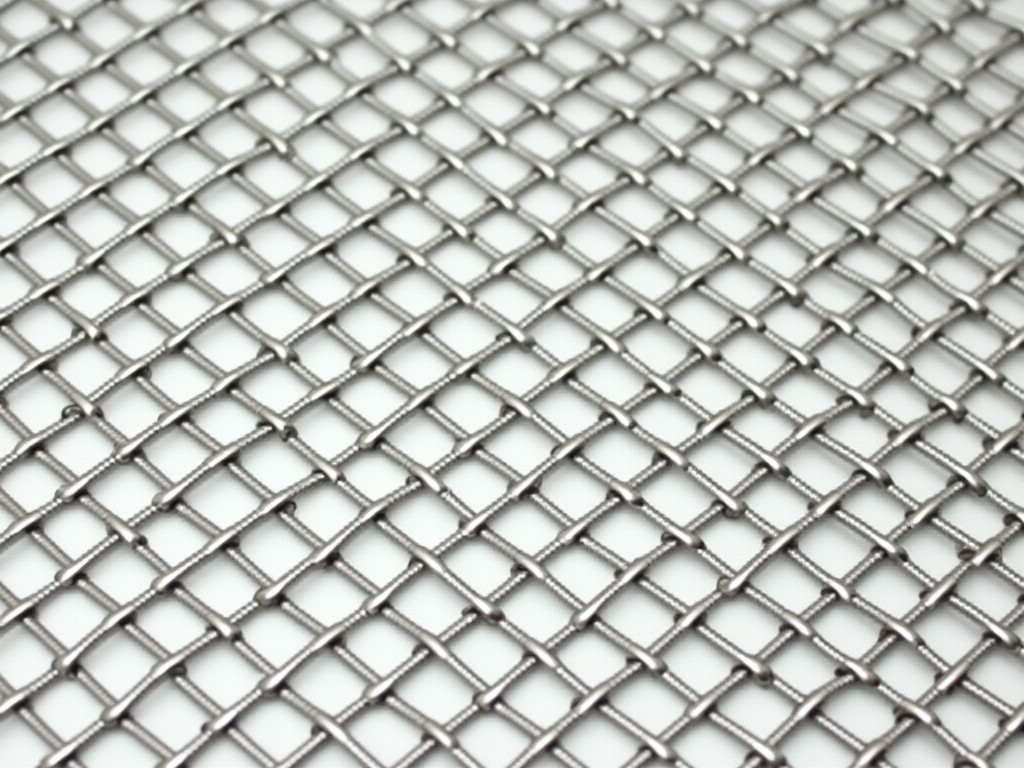
Custom 316 Stainless Steel Welded Wire Mesh Panel Factory
Production of welded wire mesh panels utilizes 316 austenitic stainless steel, allowing precise tailoring of wire diameter, opening size, and overall dimensions to meet project specifications.
Request a QuoteCustom 316 Stainless Steel Welded Wire Mesh Panel Factory
Production of welded wire mesh panels utilizes 316 austenitic stainless steel, allowing precise tailoring of wire diameter, opening size, and overall dimensions to meet project specifications.
Resistance spot welding fuses each wire intersection, creating joints that retain the corrosion‑resistant properties of the base alloy.
The resulting panels deliver uniform mechanical performance suitable for demanding chemical, marine, and architectural environments.
Material Characteristics of 316 Stainless Steel
316 stainless steel contains roughly 16‑18% chromium, 10‑14% nickel, and 2‑3% molybdenum, which improves resistance to chloride‑induced pitting.
Typical mechanical values include a yield strength near 205 MPa and tensile strength ranging from 515 to 690 MPa in the annealed condition.
In marine and chemical settings, the molybdenum addition reduces corrosion rates compared with 304 grade, particularly in sulfide‑containing environments.
Customization Options
- Wire diameter: selectable from 0.5 mm to 6.0 mm in 0.1 mm increments.
- Opening size (clear gap): ranging from 2 mm square to 150 mm square, customizable to suit filtration, shielding, or architectural needs.
- Panel dimensions: width up to 2400 mm and length up to 6000 mm, with options for custom framing or edge flanges.
- Edge finish: plain cut, welded edge band, or folded flange for easier handling and installation.
- Surface treatment: pickled and passivated, electropolished, or left as‑welded depending on aesthetic and corrosion requirements.
Manufacturing Process Overview
The process begins with straightening and cutting 316 stainless steel wire to the specified diameter.
Wires are laid out in a precise grid pattern on a welding jig that maintains exact spacing before resistance spot welding fuses each intersection.
After welding, panels undergo tension leveling to remove residual distortion and achieve flatness within ±0.5 mm over a one‑meter span.
Typical specification ranges for custom mesh panels are shown below; values can be adjusted according to project requirements.
| Parameter | Typical Range | Notes |
|---|---|---|
| Wire Diameter | 0.5 – 6.0 mm | Custom increments available |
| Opening Size (Clear) | 2 – 150 mm square | Rectangular or custom patterns possible |
| Panel Width | Up to 2400 mm | Larger widths achievable with splicing |
| Panel Length | Up to 6000 mm | Limited by handling and transport |
| Weld Shear Strength | ≥ 80% of wire tensile strength | Measured per ASTM F1267 |
| Flatness Tolerance | ±0.5 mm per 1000 mm | After tension leveling |
Industrial Applications
In chemical processing plants, 316 mesh panels function as catalyst supports, filter media, and protective guards where exposure to acidic chlorides and elevated temperatures is common.
Marine offshore installations employ the mesh for splash zone barriers, aquaculture cages, and safety enclosures, benefiting from its combination of corrosion resistance and mechanical strength.
Architectural projects specify the panels for façade screening, balustrade infill, and sun shading, where a uniform weld‑finished surface can be further refined with electropolishing for a reflective appearance.
Quality Control Philosophy
Each production lot undergoes visual inspection for weld consistency, surface cleanliness, and edge integrity.
Dimensional checks are performed using calibrated calipers and laser scanning to verify opening size, wire diameter, and overall panel flatness.
Mechanical testing includes weld shear strength sampling per ASTM F1267, with a minimum acceptance criterion of 80% of the base wire tensile strength.
Corrosion resistance is validated through salt‑spray testing (ASTM B117) for a minimum of 500 hours without red rust when applicable.
Documentation includes material test reports, welding procedure specifications, and inspection records that are traceable to the specific batch of 316 stainless steel wire used.
Packaging and Shipping
Panels are stacked on wooden pallets with interleaving corrugated cardboard to prevent surface abrasion.
Edge protectors are applied to safeguard welded edges during handling.
For export shipments, panels are wrapped in heat‑shrink polyethylene and secured with steel strapping to meet ISPM‑15 standards.
Custom packaging options include wooden crates, protective coating applications, or container‑specific loading frames upon request.
All packages are labeled with part numbers, heat numbers, and QR codes for easy tracking.
Lead Time and Ordering Information
Standard lead time for customized mesh panels ranges from 3 to 5 weeks, depending on wire diameter, opening size, and order volume.
Expedited production is available for critical projects, subject to capacity confirmation.
To initiate a quotation, provide the following technical details: wire diameter, opening size (or mesh count), panel width and length, edge finish preference, any required surface treatment, and the intended service environment.
Frequently Asked Questions
Common questions from industrial buyers are addressed below.
- Can dimensions be customized beyond the standard limits? – Yes, larger panels can be fabricated by splicing multiple sections with reinforced joints.
- What information is required before quotation? – Wire diameter, opening size, panel dimensions, edge finish, surface treatment, and service conditions.
- Which materials are available besides 316 SS? – 304 SS, 321 SS, duplex grades, and specialty alloys are offered upon request.
- How is quality inspected? – Visual, dimensional, weld shear testing, and corrosion testing per applicable standards.
- What packaging methods are available? – Palletized with cardboard interleaving, wooden crates, heat‑shrink wrapping, and custom crates.
- How are export shipments protected? – Heat‑shrink wrap, steel strapping, and ISPM‑15 compliant pallets.
- What is the typical production lead time? – 3‑5 weeks for standard customization; expedited options available.
- How are samples arranged? – Sample panels can be produced upon receipt of a detailed specification and are shipped via express courier.
For a detailed quotation or to discuss your specific requirements, please contact our technical sales team.
Request a Quote


