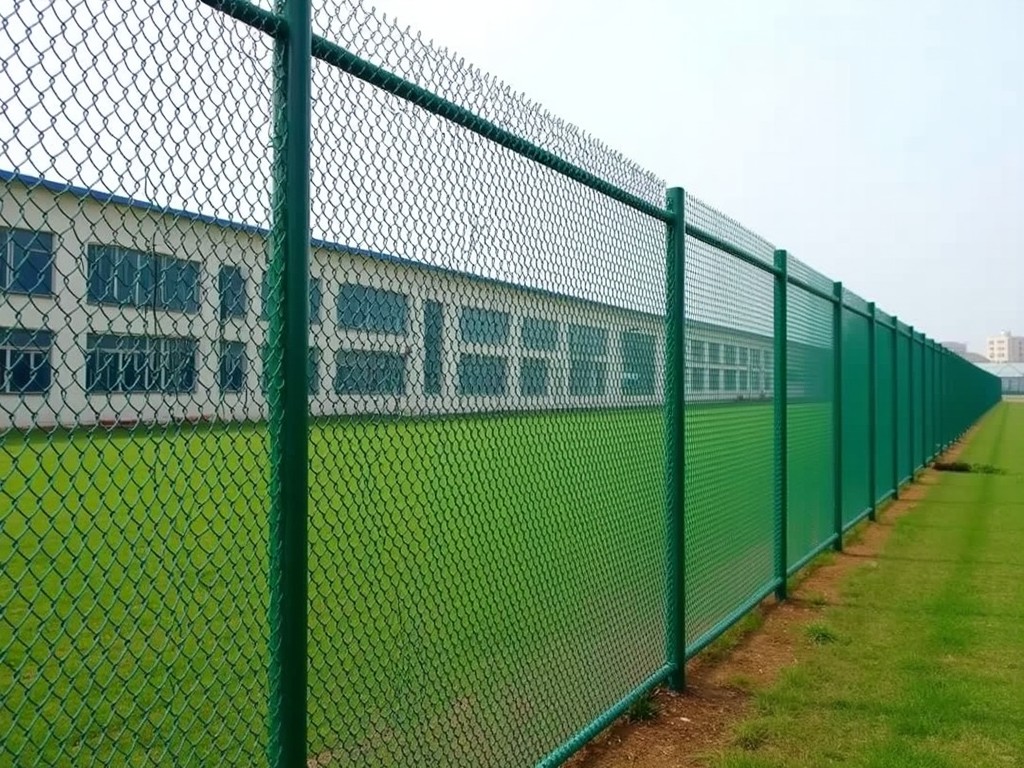
China Welding Chain Link Fence Panels Manufacturer
Welding chain link fence panels are fabricated by electrically resistance welding the intersections of galvanized or PVC-coated steel wires forming a uniform mesh. The process creates a rigid panel
Request a QuoteChina Welding Chain Link Fence Panels Manufacturer
Product Overview
Welding chain link fence panels are fabricated by electrically resistance welding the intersections of galvanized or PVC-coated steel wires forming a uniform mesh. The process creates a rigid panel that retains the flexibility of traditional chain link while providing increased resistance to deformation under impact loads.
Key Technical Characteristics
| Parameter | Typical Range | Units |
|---|---|---|
| Wire diameter | 2.0 – 4.0 | mm |
| Mesh opening (clear) | 50 – 100 | mm |
| Panel width | 1.0 – 3.0 | m |
| Panel height | 0.5 – 2.5 | m |
| Tensile strength of wire | ≥ 450 | MPa |
| Zinc coating weight (galvanized) | 55 – 275 | g/m² |
| PVC coating thickness | 0.3 – 0.8 | mm |
Materials and Coatings
Base wire is typically low-carbon steel with a carbon content below 0.12% to ensure good weldability. Two primary finishes are offered: hot-dip galvanized coating conforming to EN 10244-2, and a fused PVC over‑coat applied after galvanization for additional corrosion resistance and color options.
- Galvanized only – suitable for environments with moderate humidity and occasional splash.
- PVC‑coated – provides a barrier against chlorides and UV, extending service life in coastal or industrial settings.
Manufacturing Process
The production line begins with wire drawing to the specified diameter, followed by cleaning and coating application. Wires are then woven into the mesh pattern on a high‑speed loom. Resistance welding stations apply a controlled current and pressure at each crossover, forming a solid metallurgical bond without compromising the zinc or PVC layer. After welding, panels are cut to length, flattened, and subjected to a final inspection.
Applications and Suitability
These panels are selected where a combination of perimeter security, visibility, and structural integrity is required. The welded joints prevent the mesh from unraveling under impact, making the system appropriate for high‑traffic zones, machine guarding, and temporary site enclosures.
- Industrial facility perimeters – provides clear sight lines while resisting climb attempts.
- Sports field boundaries – retains ball containment without sagging.
- Highway work zones – quick installation and re‑deployment due to panel rigidity.
Quality Control and Testing
Each batch undergoes dimensional verification, weld shear testing, and coating adhesion checks. Weld shear strength is measured according to ASTM A90/A90M, with a minimum acceptable value of 1.5 kN per weld point. Coating thickness is verified by magnetic or eddy‑current methods, and visual inspection confirms uniformity of the mesh.
Customization Options
Manufacturers can adjust wire gauge, mesh opening, panel dimensions, and coating type to match project specifications. Additional features such as reinforced edge frames, integrated barbed wire arms, or powder‑coated finishes are available upon request.
- Wire diameter: 1.8 mm to 5.0 mm
- Mesh opening: 25 mm to 150 mm (clear)
- Panel width: up to 4 m (sectional)
- Height: up to 3 m with optional vertical stiffeners
Packaging and Logistics
Panels are stacked flat on wooden pallets, interleaved with corrugated cardboard to prevent surface abrasion. Each pallet is secured with steel straps and stretch film. For export, pallets are placed in standard 20‑ft or 40‑ft containers with moisture‑absorbing desiccants and are marked with handling instructions.
Frequently Asked Questions
- Can dimensions be customized?
- Yes, panel width, height, and mesh opening can be tailored to the project drawings; tooling adjustments are typically completed within 3‑5 working days.
- What information is required before quotation?
- Required data include wire diameter, mesh opening, panel dimensions, coating type (galvanized or PVC), quantity, and any special features such as edge frames or barbed wire.
- What materials are available?
- Base wire is low‑carbon steel; finishes offered are hot‑dip galvanized (Zn coating 55‑275 g/m²) and PVC over‑coat (thickness 0.3‑0.8 mm).
- How is quality inspected?
- Inspection includes dimensional checks, weld shear strength testing (ASTM A90), coating thickness measurement, and visual surface inspection per ISO 9001‑aligned procedures.
- What packaging methods are available?
- Standard packaging is flat‑stacked on pallets with cardboard interleaving and stretch film; custom crating or container‑specific loading can be arranged.
- How are export shipments protected?
- Pallets are wrapped in stretch film, corner protectors applied, and desiccant packs included to control humidity during transit.
- What is the typical production lead time?
- Lead time varies with size and coating but generally ranges from 10 to 25 working days after receipt of confirmed order and deposit.
- How are samples arranged?
- Sample panels (up to 1 m²) can be shipped via express courier; costs are credited against the first order if the customer proceeds to purchase.
Contact for Inquiry
To discuss your project requirements, request a detailed quotation, or arrange technical support, please use the inquiry form linked below. Our engineering team will respond with a feasibility review and lead‑time estimate within one business day.
Send Inquiry


