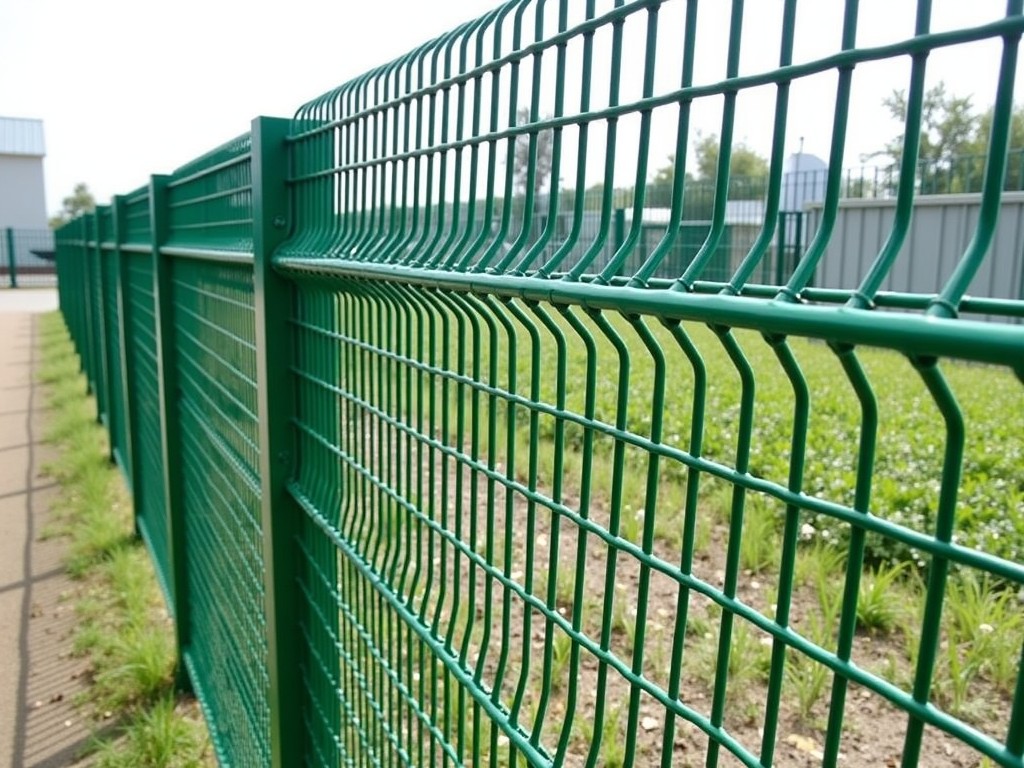
China Vinyl Coated Welded Wire Fence Panels Supplier
These panels consist of steel wires welded at intersections and subsequently coated with a polyvinyl chloride (PVC) layer. The coating provides corrosion resistance and a uniform appearance suitable
Request a QuoteChina Vinyl Coated Welded Wire Fence Panels
These panels consist of steel wires welded at intersections and subsequently coated with a polyvinyl chloride (PVC) layer. The coating provides corrosion resistance and a uniform appearance suitable for perimeter security, agricultural enclosures, and industrial site demarcation.
Material and Construction
The core wire is typically low‑carbon steel with a diameter ranging from 2.0 mm to 4.0 mm. Welding is performed using electric resistance welding, achieving a tensile strength at the joint that exceeds 90 % of the base wire strength. After welding, the panel passes through a PVC extrusion line where the coating thickness is controlled between 0.3 mm and 0.6 mm on each side, yielding a total coated diameter increase of 0.6 mm to 1.2 mm.
Typical Specifications
| Parameter | Range / Typical Value |
|---|---|
| Wire diameter (steel core) | 2.0 mm – 4.0 mm |
| Mesh opening (center‑to‑center) | 25 mm × 25 mm to 100 mm × 100 mm |
| Panel width | 0.5 m – 2.5 m (customizable) |
| Panel height | 0.5 m – 3.0 m (customizable) |
| PVC coating thickness | 0.3 mm – 0.6 mm per side |
| Coating color | Standard: green, black, white; custom colors available on request |
| Tensile strength of base wire | ≥ 350 MPa (typical) |
Applications
- Perimeter fencing for warehouses and logistics centers where corrosion resistance reduces maintenance cycles.
- Livestock enclosures; the smooth PVC surface minimizes animal injury compared with bare wire.
- Temporary site barriers on construction projects; panels can be quickly installed and removed.
- Noise‑abatement barriers when combined with absorptive backing; the coating adds mass and dampens vibration.
Quality Control Philosophy
Each production lot undergoes visual inspection for coating uniformity, followed by spark testing to detect pinholes in the PVC layer. Weld shear strength is sampled according to ISO 14341, with acceptance criteria set at a minimum of 300 N per weld point. Dimensional checks are performed on a statistical basis using calibrated gauges; tolerances are held to ±2 mm for panel width and height, and ±10 % for mesh opening.
Customization Options
Buyers can specify wire diameter, mesh size, panel dimensions, and PVC color. Additional treatments such as UV stabilizers or antimicrobial additives can be incorporated into the coating formulation upon request. Custom perforation patterns or integrated mounting brackets are also feasible, subject to tooling lead times.
Packaging and Shipping
Panels are stacked flat, separated by corrugated cardboard interleaves, and secured with steel or polyester strapping. Standard export packaging uses ISPM‑15 compliant wooden pallets, each pallet holding up to 20 m² of fencing. For long‑haul shipments, a moisture‑barrier film is applied to the palletized stack to prevent coating degradation during transit.
Frequently Asked Questions
Q: Can the panel dimensions be customized to match existing post spacing?
A: Yes. Width and height are adjustable in 10 mm increments; the mesh opening can also be altered to suit specific load or visibility requirements.
Q: What information is needed to obtain a quotation?
A: Required details include wire diameter, mesh size, panel width and height, desired PVC color, quantity, and delivery destination. Any special coating additives or accessories should also be listed.
Q: How is the coating quality verified before shipment?
A: Each batch undergoes spark testing at 10 kV to detect pinholes, and a cross‑section adhesion test (ASTM D4541) is performed on a sacrificial sample to confirm coating‑to‑steel bond strength ≥ 2 MPa.



