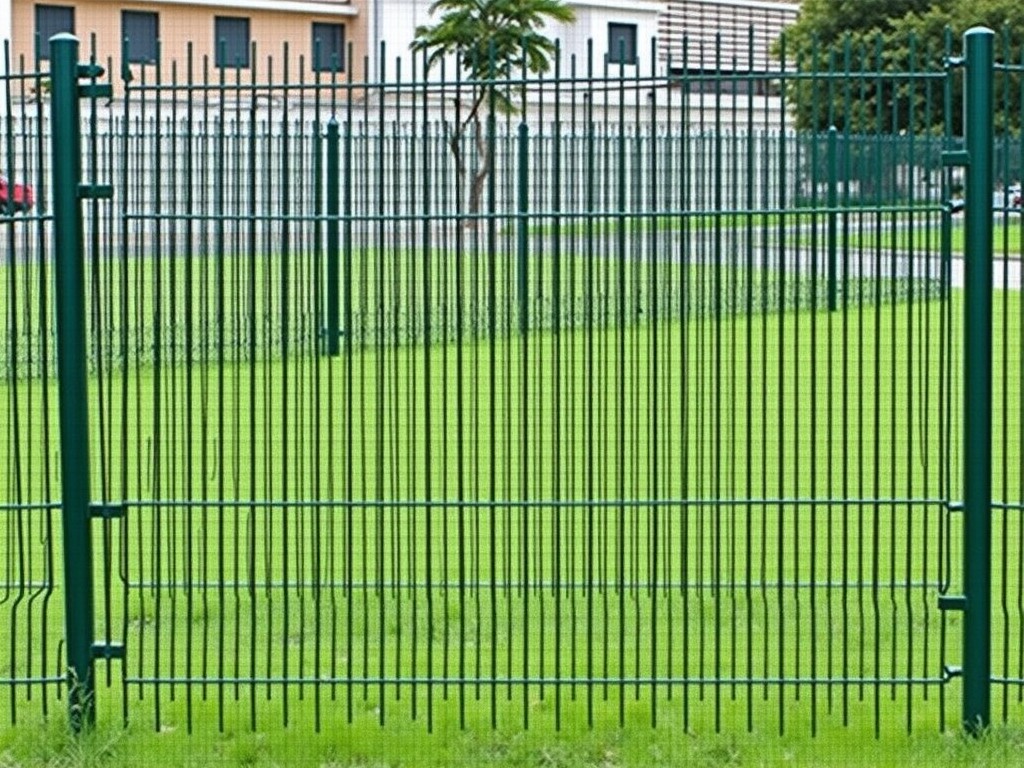
China Galvanized Steel Welded Wire Garden Fence Manufacturer
The fence consists of low‑carbon steel wires that are electrically welded at each intersection, forming a rigid mesh. After welding, the entire panel undergoes a hot‑dip galvanizing process that
Request a QuoteChina Galvanized Steel Welded Wire Garden Fence Manufacturer
The fence consists of low‑carbon steel wires that are electrically welded at each intersection, forming a rigid mesh. After welding, the entire panel undergoes a hot‑dip galvanizing process that applies a uniform zinc coating to protect the steel from oxidation. Typical wire diameters range from 2.0 mm to 4.0 mm, and the zinc coating weight is commonly 120 g/m² to 275 g/m² depending on the corrosion‑resistance requirement.
Mesh openings are usually square or rectangular, with standard sizes of 50 mm × 50 mm, 75 mm × 50 mm, or 100 mm × 50 mm. The welding points achieve a shear strength of at least 90 % of the base wire tensile strength, ensuring the panel retains its shape under impact loads. Panels are supplied in standard heights of 0.9 m, 1.2 m, 1.5 m, and 2.0 m, with lengths customizable to project specifications.
Technical Specifications
| Parameter | Typical Value | Notes |
|---|---|---|
| Wire Diameter | 2.0 mm – 4.0 mm | Customizable per load requirement |
| Zinc Coating Weight | 120 g/m² – 275 g/m² | Hot‑dip galvanized |
| Mesh Opening | 50 mm × 50 mm (standard) | Other sizes available |
| Tensile Strength of Wire | 350 MPa – 550 MPa | Based on steel grade |
| Panel Height | 0.9 m – 2.0 m | Custom lengths on request |
| Corrosion Resistance (ISO 9223) | C3 – C5 (depending on coating) | Suitable for urban and industrial atmospheres |
Applications and Functional Benefits
In residential landscaping, the fence provides a clear boundary while allowing light and air to pass through, which supports healthy plant growth. The rigid welded mesh resists deformation from wind pressure and occasional impacts from garden equipment, reducing maintenance cycles.
For commercial properties such as parks, schools, and sports facilities, the fence offers a durable barrier that meets safety standards for crowd control. Its open mesh design prevents climbing while maintaining visibility for surveillance purposes.
In agricultural settings, the same product is used to create livestock enclosures and crop protection barriers. The zinc coating withstands exposure to fertilizers, pesticides, and varying soil moisture levels, extending service life compared to untreated steel alternatives.
Quality Control Philosophy
Each production batch undergoes dimensional verification using calibrated gauges to ensure wire diameter and mesh opening tolerances stay within ±0.1 mm. Weld integrity is checked by tensile pull‑off tests on a sample of intersections, confirming that the weld strength meets or exceeds 90 % of the base wire strength.
Coating thickness is measured with magnetic inductance probes at multiple points across the panel surface; the average must meet the specified zinc weight range. Visual inspection under standardized lighting identifies surface defects such as missed welds, coating pitting, or deformation before packaging.
Final inspection includes a stack‑ability test where panels are subjected to a simulated load equivalent to 1.5 times the design wind pressure for 10 minutes; no permanent deformation is accepted. Documentation of all test results is retained for traceability.
Customization Options
- Wire diameter: 1.8 mm to 5.0 mm (affects tensile strength and flexibility)
- Mesh opening: 25 mm × 25 mm up to 150 mm × 100 mm (influences visibility and rigidity)
- Panel dimensions: height up to 3.0 m, length cut to site‑specific requirements
- Zinc coating: hot‑dip (standard) or electro‑galvanized for thinner coating needs
- Post and accessories: square or round steel posts, tension wires, brackets, and gate kits
Customization is driven by project‑specific load calculations, environmental exposure levels, and aesthetic preferences. Engineering support is available to convert client specifications into production drawings and bill of materials.
Frequently Asked Questions
Can dimensions be customized? Yes, wire diameter, mesh size, panel height, and length are all adjustable according to structural calculations and site constraints.
What information is required before quotation? Detailed drawings or a list of required dimensions, coating type, quantity, and delivery destination are needed to generate an accurate price and lead time.
What materials are available? The base material is low‑carbon steel (grades Q195–Q235). Optional stainless‑steel wire is available upon request for highly corrosive environments.
How is quality inspected? In‑process checks include wire diameter measurement, weld tensile testing, and coating thickness verification. Final inspection covers dimensional accuracy, visual appearance, and stack‑ability performance.
What packaging methods are available? Panels are bundled with steel straps, wrapped in water‑proof polyethylene film, and placed on pallets suitable for forklift handling. Custom crating is offered for overseas shipments.
How are export shipments protected? Pallets are secured with corner boards and stretch film; desiccant packs are included to control moisture during transit.
What is the typical production lead time? For standard specifications, lead time is 15–20 working days after receipt of deposit and confirmed drawings. Custom orders may extend to 25–30 working days.
How are samples arranged? Sample panels (up to 1 m × 1 m) can be shipped via express courier; the cost is credited against the first formal order.
Contact for Technical Inquiry
To discuss your project requirements, request a detailed quotation, or obtain engineering support, please use the contact form or email provided below. Our technical team will respond with design recommendations, lead time confirmation, and pricing within one business day.
Submit Inquiry


