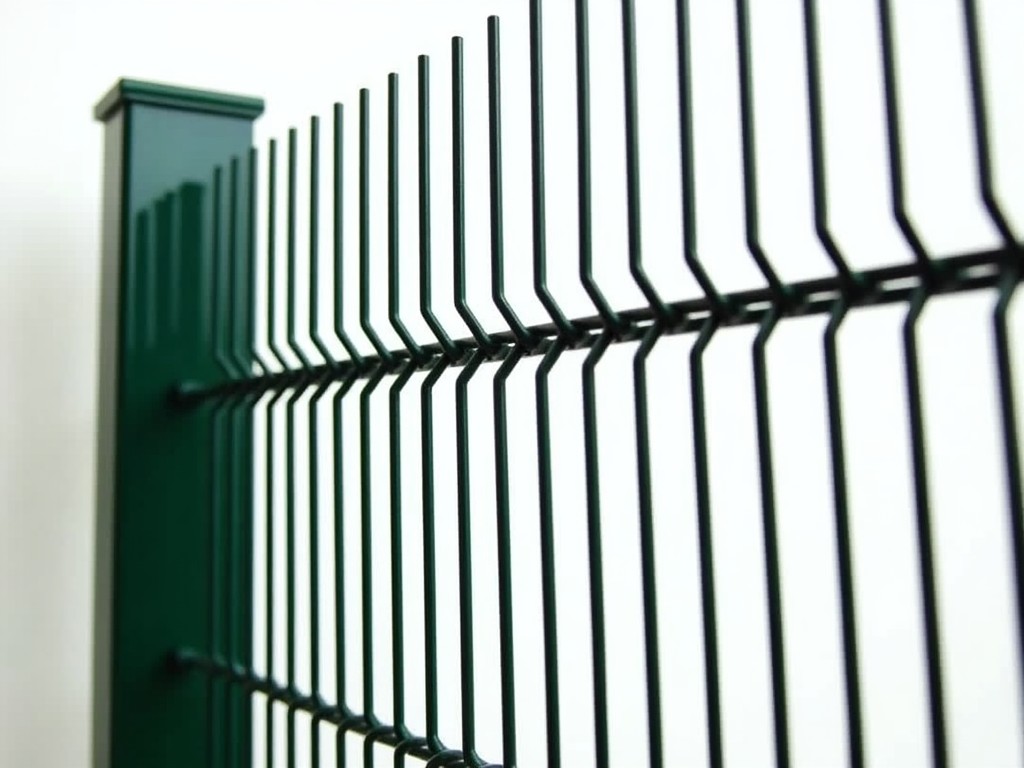
China Black Pvc Coated Welded Wire Fence Manufacturer
This product consists of low‑carbon steel wires welded at each intersection to form a uniform grid, then uniformly coated with a black polyvinyl chloride (PVC) layer. The welding creates a monolithic
Request a QuoteChina Black PVC Coated Welded Wire Fence Manufacturer
Product Overview
This product consists of low‑carbon steel wires welded at each intersection to form a uniform grid, then uniformly coated with a black polyvinyl chloride (PVC) layer. The welding creates a monolithic joint that resists separation under tensile loads, while the PVC coating provides a barrier against moisture, UV radiation, and chemical exposure. Typical wire diameters range from 2.0 mm to 4.0 mm, and the coating thickness is controlled between 0.3 mm and 0.5 mm to meet outdoor durability requirements.
Material Composition and Coating
The core wire is manufactured from SAE 1008/1010 low‑carbon steel, selected for its consistent elongation (≥ 20 %) and yield strength (≈ 250 MPa). The PVC compound includes plasticizers for flexibility, stabilizers for thermal resistance, and carbon black pigment for UV stability. Coating adhesion is achieved through a pre‑heating and extrusion process that ensures a minimum peel strength of 1.5 N/mm, preventing delamination under flexural stress.
Welded Mesh Geometry
Mesh openings are defined by the center‑to‑center spacing of parallel wires, commonly offered as 50 mm × 50 mm, 75 mm × 75 mm, or 100 mm × 100 mm. The welding pitch matches the wire spacing, producing square apertures with a tolerance of ± 2 mm. Wire count per square meter varies from 400 (for 50 mm spacing) to 100 (for 100 mm spacing), directly influencing the fence’s rigidity and wind load capacity.
Performance Characteristics
| Parameter | Typical Value | Test Method / Note |
|---|---|---|
| Tensile Strength of Wire | ≥ 350 MPa | ASTM A370 |
| Coating Adhesion (Peel) | ≥ 1.5 N/mm | ASTM D903 |
| UV Resistance (Color Retention) | ΔE < 5 after 1000 h | ASTM G154 |
| Impact Resistance (Charpy) | ≥ 15 J | ISO 179 |
| Service Life (Outdoor) | 15‑20 years (typical) | Based on field exposure data |
Typical Applications
- Perimeter security for industrial compounds where corrosion resistance reduces maintenance cycles.
- Agricultural enclosures requiring a smooth, non‑abrasive surface to protect livestock and crops.
- Temporary site fencing for construction projects, allowing rapid installation and removal.
- Noise barrier backing when combined with absorptive panels, due to the fence’s open area ratio.
- Sports facility boundaries where visibility and low glare are important.
Customization Options
- Wire diameter: 1.8 mm to 5.0 mm, adjustable for load requirements.
- Mesh aperture: 25 mm × 25 mm to 150 mm × 150 mm, customizable per project.
- PVC color: black (standard), green, grey, or custom RAL upon request.
- Coating thickness: 0.2 mm to 0.8 mm, tailored for specific environmental conditions.
- Edge finishing: knuckle, twist, or barbed configurations for enhanced safety.
Quality Assurance and Testing
Each production batch undergoes inline dimensional checks using laser scanners to verify wire diameter and pitch within ± 0.1 mm. Coating thickness is measured with a magnetic induction gauge at ten random points per roll, ensuring uniformity. Mechanical samples are pulled to failure to confirm tensile strength, while adhesion tests are performed on coated specimens before and after accelerated weathering. All test records are retained for traceability and are available to customers upon request.
Packaging and Logistics
Rolls are typically wound on Ø 300 mm steel cores with a width matching the fence height, then wrapped in UV‑stabilized polyethylene film and secured with polyester strapping. Standard roll lengths are 20 m or 50 m, but lengths up to 100 m can be accommodated for large‑scale projects. Palletized shipments use heat‑treated wooden pallets conforming to ISPM‑15, and each pallet is labeled with product code, batch number, and net weight for customs clearance.
Frequently Asked Questions
Can dimensions be customized?
Yes, wire diameter, mesh aperture, roll height, and length can be adjusted according to project specifications. Provide detailed drawings or a requirement sheet for a precise quotation.
What information is required before quotation?
Required data include desired wire size, opening dimensions, coating thickness, color, total linear meters, and any special edge treatment. Delivery destination and preferred Incoterms help calculate freight costs.
How is quality inspected?
Inspection covers dimensional accuracy, coating thickness, tensile strength, adhesion, and visual appearance. Reports are generated per batch and can be shared digitally.
What packaging methods are available?
Standard packaging uses stretch film and strapping on steel cores. Optional wooden crates or metal frames are available for extra protection during overseas transit.
What is the typical production lead time?
Lead time ranges from 10 to 25 working days depending on order complexity and current factory load. Expedited options are available for urgent projects.
Contact for Inquiry
To discuss your specific requirements, request samples, or obtain a detailed quotation, please reach out via the contact form. Our technical team will respond with engineering data, lead time estimates, and packaging options tailored to your project.
Send Inquiry


