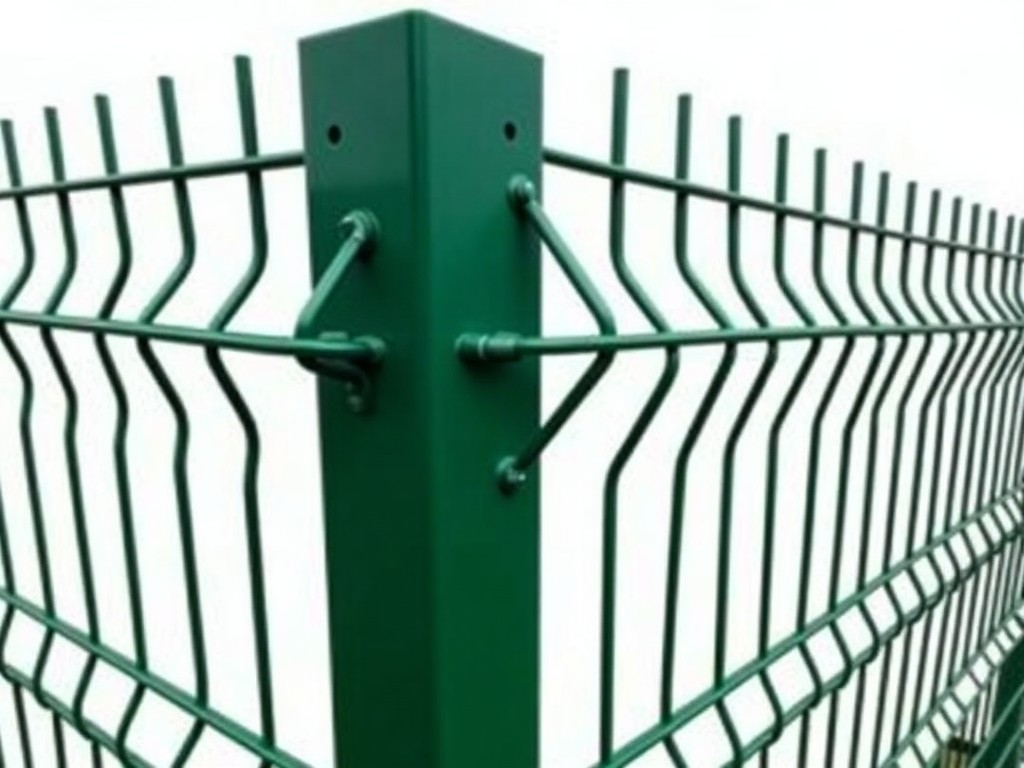
Best Price Green Vinyl Coated Welded Wire Fencing Supplier
This product consists of low‑carbon steel wires welded at each intersection to form a uniform grid, then coated with a polyvinyl chloride (PVC) layer colored green. The welding creates a monolithic
Request a QuoteGreen Vinyl Coated Welded Wire Fencing – Technical Overview
This product consists of low‑carbon steel wires welded at each intersection to form a uniform grid, then coated with a polyvinyl chloride (PVC) layer colored green. The welding creates a monolithic joint that resists separation under tensile loads, while the vinyl coating provides barrier protection against corrosion and UV degradation.
Material Composition and Coating Process
The core wire is typically ASTM A510 grade 1008 steel with a carbon content of 0.08 % max, yielding a base tensile strength of approximately 380 MPa. After welding, the mesh passes through a fluidized‑bed PVC dip where the coating thickness is controlled to 0.35 mm ± 0.05 mm on each side, measured by micrometer across ten random points per roll.
The PVC formulation includes 10 % titanium dioxide for UV stability and 5 % calcium‑zinc stabilizer to prevent dehydrochlorination during outdoor exposure. This composition meets ASTM D2240 hardness of 75 ± 5 Shore A after 24 h cure at 23 °C.
Key Dimensional Parameters
| Parameter | Typical Value | Unit | Notes |
|---|---|---|---|
| Mesh opening (square) | 50 | mm | Center‑to‑center distance |
| Wire diameter (core) | 2.0 | mm | Before coating |
| Overall diameter (wire + coating) | 2.7 | mm | After PVC dip |
| Roll width | 1.0 – 2.5 | m | Customizable per order |
| Roll length | 20 – 50 | m | Standard lengths; splices available |
Mechanical Performance Characteristics
Tensile strength of the welded joint is measured according to EN 10223‑1, yielding values of 340 MPa ± 20 MPa for the 2 mm core wire. Peel adhesion of the PVC coating to steel exceeds 12 N/mm (ASTM D903), indicating resistance to delamination under flexural stress.
Impact resistance is evaluated using a falling‑weight test (ISO 179‑1) with a 0.5 kg striker dropped from 0.5 m; the coated mesh shows no cracking or coating loss at this energy level, confirming suitability for areas exposed to occasional mechanical contact.
Typical Industrial Applications
- Perimeter security for substations and transformer yards where electromagnetic interference must be minimized; the non‑conductive PVC layer prevents stray currents.
- Infill panels for modular livestock enclosures, providing visibility while resisting urine‑induced corrosion.
- Temporary site barriers for construction zones, offering quick installation and reusable rolls.
- Ornamental fencing for municipal parks, where color stability and low maintenance are specified.
- Ventilation guards for HVAC equipment housings, balancing airflow restriction with debris exclusion.
Quality Assurance and Testing
Each production lot undergoes dimensional verification on a laser‑scanning system that checks opening size and wire diameter across a 1 m² sample area, with acceptance criteria of ±0.2 mm for opening and ±0.05 mm for wire.
Coating thickness is verified by ultrasonic gauge on ten random points per roll; batches with average thickness below 0.30 mm are rejected. Additionally, salt‑spray exposure (ASTM B117) for 500 h is performed on representative specimens, with rust rating not exceeding 1 per ISO 4628‑3.
Final visual inspection checks for coating uniformity, weld integrity, and absence of foreign inclusions; any defect detected triggers a full‑lot review.
Customization Options
Wire diameter can be adjusted between 1.6 mm and 3.0 mm to meet load‑bearing requirements, with corresponding changes in tensile capacity. Opening size ranges from 25 mm to 100 mm square, enabling fine‑mesh filtration or larger‑gap security barriers.
PVC color is not limited to green; standard RAL shades (e.g., 6005, 7035) are available upon request, and custom pigments can be matched to client specifications. Coating thickness can be increased to 0.50 mm for heightened chemical resistance in agro‑chemical environments.
Roll lengths can be spliced using stainless‑steel clamps to create continuous barriers exceeding 100 m without compromising tensile performance.
Packaging and Logistics
Finished rolls are wound onto a 50 mm diameter cardboard core, then wrapped in UV‑stabilized polyethylene film to prevent moisture ingress during transit. Each pallet holds up to 20 rolls, secured with polypropylene straps and corner protectors.
For overseas shipments, rolls are placed in ISPM‑15 compliant wooden crates lined with desiccant packs, meeting ISPM‑15 heat‑treatment standards. Documentation includes material test reports (MTR) and coating certification per EN 10204‑3.1.
Frequently Asked Questions
Can dimensions be customized?
Yes. Wire diameter, opening size, roll width and length are all adjustable according to project drawings. Provide the required specifications and we will issue a confirmation drawing before production.
What information is required before quotation?
We need the desired wire diameter, mesh opening, overall dimensions (width × length), coating thickness, color (RAL or custom), and any special packaging or labeling instructions. Quantities and delivery destination also affect pricing.
How is quality inspected?
Each lot undergoes dimensional laser scanning, ultrasonic coating thickness measurement, tensile testing of welded joints, and salt‑spray corrosion evaluation. Test reports are available upon request.
What packaging methods are available?
Standard packaging includes polyethylene‑wrapped rolls on cardboard cores, palletized with straps. Export shipments can be crated in ISPM‑15 wood with desiccant. Custom labeling or barcoding is also offered.
What is the typical production lead time?
For standard specifications (2 mm wire, 50 mm opening, green PVC, 1 m × 30 m rolls) lead time is 10‑12 working days after receipt of approved drawing. Custom colors or thicknesses may add 3‑5 days.



