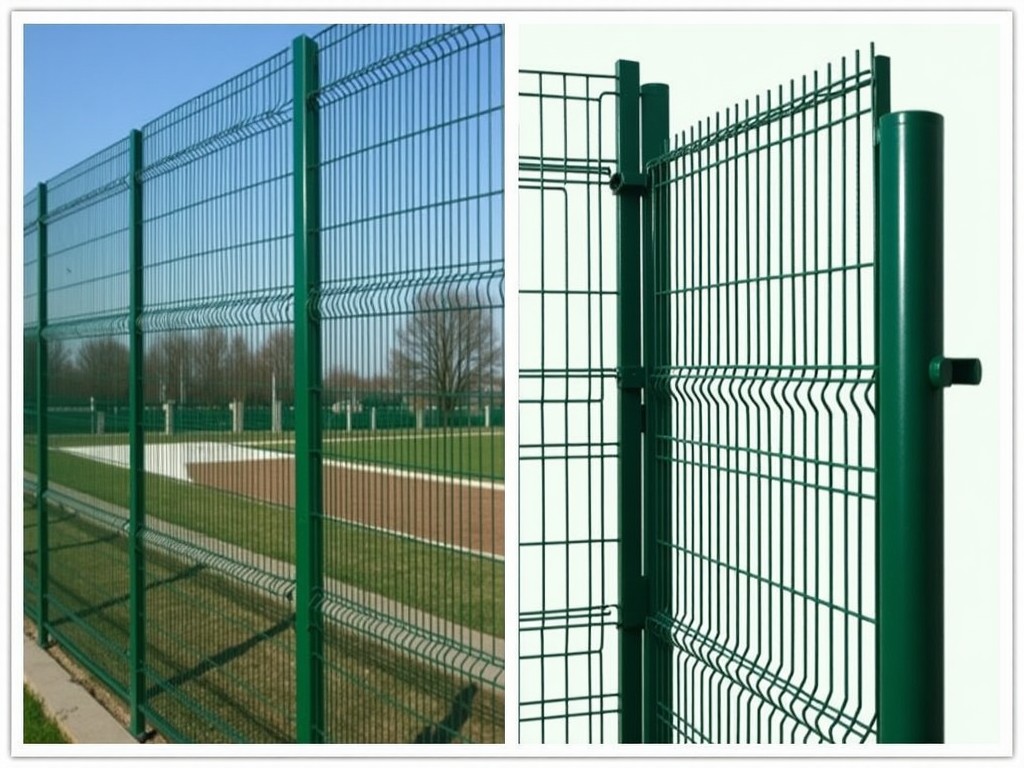
B2B 2D Double Wire Welded Mesh Fence Panel Supplier
A double‑wire welded mesh fence panel consists of two parallel steel wires welded at each intersection to form a rigid rectangular grid. This configuration provides increased shear resistance
Request a QuoteB2B 2D Double Wire Welded Mesh Fence Panel Supplier
A double‑wire welded mesh fence panel consists of two parallel steel wires welded at each intersection to form a rigid rectangular grid. This configuration provides increased shear resistance compared with single‑wire mesh while maintaining a relatively low weight per square meter, making it suitable for perimeter security, animal containment, and industrial partitioning where impact loads are expected.
Technical Specifications
| Parameter | Typical Value | Notes |
|---|---|---|
| Wire diameter (each) | 3.0 mm – 5.0 mm | Cold‑drawn low‑carbon steel |
| Mesh opening (center‑to‑center) | 50 mm × 50 mm – 100 mm × 100 mm | Square or rectangular options |
| Panel width | Up to 3.0 m | Custom lengths available |
| Panel height | Up to 2.5 m | Standard heights 1.0 m, 1.5 m, 2.0 m |
| Weld tensile strength | ≥ 350 MPa | Measured per ISO 14692 |
Material Options
- Low‑carbon steel wire (Q195/Q235) with hot‑dip galvanized coating (Zn ≥ 200 g/m²)
- Stainless steel wire (Grade 304 or 316) for corrosive environments
- PVC‑coated wire (color options: green, black, white) for aesthetic applications
- Pre‑galvanized wire with additional powder‑coat finish for enhanced UV resistance
Typical Applications
The double‑wire configuration increases the panel’s flexural rigidity, which reduces deflection under impact from livestock or vehicular bumpers. Consequently, the product is frequently specified for:
- Agricultural fencing where cattle or sheep exert lateral forces on the barrier
- Industrial site perimeter protection requiring resistance to accidental collisions from forklifts or delivery vehicles
- Temporary construction site enclosures that must withstand wind loads and occasional impact from equipment
- Sports facilities such as tennis courts or batting cages where ball rebound forces are repeated
Customization and Manufacturing Considerations
Panels are produced on automated welding lines where precise wire tension and weld timing ensure consistent joint strength. The process allows variation in wire gauge, opening size, and panel dimensions without changing tooling, which shortens lead time for non‑standard orders.
Typical customization options include:
- Alternative wire diameters (2.5 mm to 6.0 mm) for higher load capacity
- Non‑square openings such as 50 mm × 100 mm to accommodate specific visibility or airflow requirements
- Integrated mounting features: pre‑drilled holes, C‑channel brackets, or post‑sleeves welded to the panel edges
- Surface treatments: galvanization thickness, powder‑coat RAL colors, or anti‑graffiti clear coat
Quality Control Philosophy
Each production batch undergoes three inspection stages: incoming wire diameter verification, in‑process weld strength sampling, and final panel dimensional audit. The weld strength test follows a pull‑off method on a representative sample, with acceptance criteria set at 95 % of the minimum specified tensile strength.
Visual inspection checks for uniform coating thickness, absence of weld spatter, and correct alignment of mesh openings. Panels that fail any criterion are segregated for rework or scrap, ensuring that only conforming units leave the facility.
Packaging and Shipment Protection
Finished panels are stacked flat on pallets with interleaving corrugated cardboard sheets to prevent surface abrasion. The stack is secured with steel or polyester strapping and wrapped in UV‑stabilized stretch film. For overseas shipments, pallets are placed inside ISPM‑15 compliant wooden crates or metal frames to protect against handling impacts and moisture ingress.
Frequently Asked Questions
- Can dimensions be customized? Yes, panel width, height, wire gauge, and mesh opening can be adjusted to project requirements; tooling changes are not required for most variations.
- What information is needed for a quotation? Provide desired dimensions, wire diameter, coating type, quantity, and any special features such as mounting holes or post sleeves.
- Which materials are available? Low‑carbon steel (galvanized or PVC‑coated), stainless steel grades 304/316, and pre‑galvanized wire with powder‑coat finishes.
- How is quality inspected? Incoming wire diameter, weld tensile strength (sampled), and final dimensional checks are performed per internal standards aligned with ISO 9001.
- What packaging methods are offered? Flat‑stacked on pallets with cardboard interleaving, strapping, stretch film; optional wooden crates or metal frames for export.
- How are export shipments protected? Pallets are placed in ISPM‑15 compliant crates or frames, and the entire unit is wrapped with UV‑stretch film to guard against moisture and UV exposure.
- What is the typical production lead time? Standard sizes ship within 2‑3 weeks after receipt of purchase order; customized panels may require an additional 3‑5 days depending on complexity.
- Are samples available? Yes, sample panels (up to 1 m²) can be supplied upon request; shipping costs are borne by the requester.
Get a Technical Quote
To discuss your project specifications, request a detailed quotation, or arrange a sample shipment, please contact our technical sales team.
Contact Technical Sales


