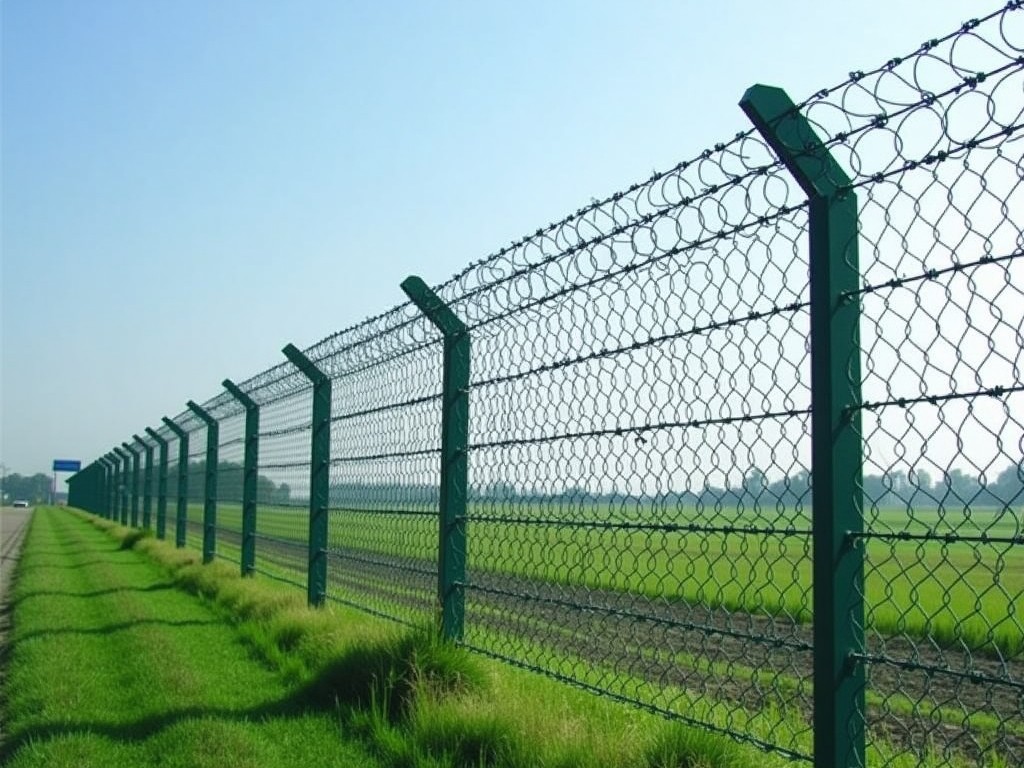
Wholesale Spiral Barbed Wire Fence Supplier
Spiral barbed wire fence consists of a high‑tensile steel core wound in a tight helix, with barbs formed by cutting and bending the wire at regular intervals. The helical shape distributes load
Request a QuoteWholesale Spiral Barbed Wire Fence Supplier
Spiral barbed wire fence consists of a high‑tensile steel core wound in a tight helix, with barbs formed by cutting and bending the wire at regular intervals. The helical shape distributes load evenly along the length, reducing stress concentrations that can lead to fatigue failure.
Design and Materials
The core wire is typically cold‑drawn carbon steel with a diameter ranging from 2.0 mm to 3.5 mm, selected based on required tensile strength and corrosion resistance. Barb length varies from 15 mm to 25 mm, and barb spacing is kept uniform at 75 mm to 100 mm to prevent easy hand‑holds.
To extend service life in outdoor environments, the wire is hot‑dip galvanized (Zn coating ≥ 55 g/m²) or coated with a zinc‑aluminum alloy (Zn‑5Al‑MM) for enhanced rust protection. Stainless‑steel grades (AISI 304 or 316) are available for highly corrosive settings such as marine or chemical‑plant perimeters.
Mechanical Properties
| Parameter | Typical Value | Notes |
|---|---|---|
| Tensile strength of core wire | 900–1200 MPa | Depends on diameter and cold‑work level |
| Elongation at break | 8–12 % | Ensures ductility during installation |
| Barb tip hardness (HV) | 350–450 | Provides resistance to cutting tools |
| Coating adhesion (ASTM D3359) | Grade 5B | Minimum for hot‑dip galvanized finish |
These values are representative; actual specifications can be adjusted to match project‑specific load cases, environmental exposure, and service life expectations.
Installation Considerations
The helical configuration allows the fence to be unrolled and tensioned with standard wire‑grip tools, reducing labor compared with welded panel systems. Proper anchoring requires corner posts set in concrete footings with a minimum embedment depth of 600 mm, and intermediate posts spaced no more than 3 m apart to limit sag under wind load.
Tension should be applied to achieve a nominal sag of less than 2 % of the span length under a design wind pressure of 0.6 kN/m². Over‑tensioning can induce premature fatigue in the core wire, while under‑tensioning reduces the barrier’s effectiveness against intrusion.
Applications
Spiral barbed wire is widely used for perimeter security of industrial facilities, warehouses, and logistics centers where a continuous, low‑maintenance deterrent is required. The uniform barb spacing prevents easy hand‑holds, making it difficult for intruders to gain a foothold without specialized tools.
In agricultural settings, the fence protects livestock enclosures from predators while allowing visibility for herd monitoring. The corrosion‑resistant coatings ensure longevity in environments with high humidity or occasional chemical exposure, such as fertilizer storage areas.
Transportation infrastructure, including highway right‑of‑way and rail corridors, employs spiral barbed wire to discourage trespassing and reduce the risk of vehicle‑wildlife collisions. The product’s flexibility accommodates ground‑movement caused by frost heave or settlement without losing tension.
Quality Assurance
Each production lot undergoes dimensional verification of wire diameter, barb length, and pitch using calibrated laser micrometers. Tensile testing is performed on random samples according to ASTM A370 to confirm strength meets the specified range.
Coating thickness is measured with magnetic‑induction gauges, and adhesion is assessed via cross‑hatch tape tests. Visual inspection checks for uniform barb formation and absence of defects such as cracks or uneven galvanization.
Test results are recorded and traceable to the specific coil number, providing customers with documented proof of compliance for procurement audits.
Customization Options
- Wire diameter: 2.0 mm – 3.5 mm (custom sizes available)
- Barb length: 12 mm – 30 mm
- Barb spacing: 50 mm – 150 mm
- Coating: hot‑dip galvanized, Zn‑Al alloy, PVC‑over‑galvanized, stainless steel
- Roll length: 50 m – 500 m (standard) or custom lengths
- Optional pre‑tensioning equipment for faster on‑site installation
Customization is driven by project‑specific security ratings, environmental corrosivity, and installation constraints. Engineering support is available to select the optimal combination of diameter, barb geometry, and coating for the intended service life.
Packaging and Logistics
Finished coils are wrapped in UV‑stabilized polyethylene film and placed on wooden pallets with steel strapping to prevent shifting during transport. Each pallet is labeled with product code, coil number, weight, and handling instructions.
For overseas shipments, coils are containerized in 20‑ft or 40‑ft dry containers with desiccant packs to control moisture. Pallets are stacked no higher than three layers to avoid deformation of the wire under its own weight.
Lead time depends on order volume and coating type; typical production cycles range from 10 to 25 working days after receipt of technical specifications and approved drawings.
Frequently Asked Questions
- Can dimensions be customized? Yes, wire diameter, barb length, barb spacing, and coating type can be tailored to meet specific project requirements.
- What information is needed for a quotation? Required details include desired wire diameter, barb geometry, coating preference, roll length, quantity, and delivery destination.
- How is quality inspected? Each lot undergoes dimensional checks, tensile testing, coating thickness measurement, and adhesion testing per international standards.
- What packaging options are available? Standard packaging is UV‑stabilized film on steel‑strapped pallets; custom crating or container‑specific solutions can be arranged.
- How are export shipments protected? Coils are wrapped in moisture‑resistant film, packed with desiccant, and secured within containers to prevent corrosion during transit.
- What is the typical production lead time? Lead times range from 10 to 25 working days, depending on coating complexity and order size.
Contact our technical team to discuss your specifications and receive a detailed quote.
Call to Action
If you require a reliable source for spiral barbed wire fence that meets rigorous security and durability standards, reach out to our sales engineers. Provide your project parameters, and we will return a comprehensive technical proposal, including lead time, pricing, and packaging details.



