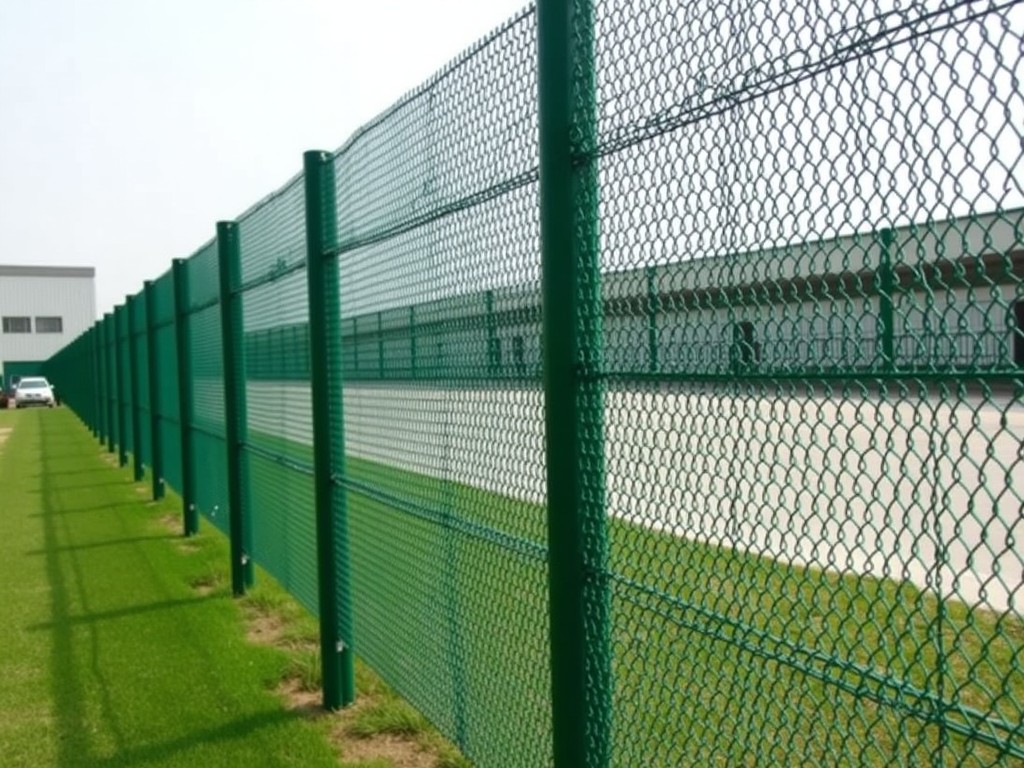
Wholesale Ripper Razor Mesh Fencing Manufacturer
Ripper razor mesh fencing consists of high‑tensile steel wires welded into a uniform grid with integrated razor‑sharp barbs protruding from each intersection. The barbs are formed by cold‑pressing
Request a QuoteWholesale Ripper Razor Mesh Fencing Manufacturer
Ripper razor mesh fencing consists of high‑tensile steel wires welded into a uniform grid with integrated razor‑sharp barbs protruding from each intersection. The barbs are formed by cold‑pressing the wire at the weld points, creating a continuous deterrent surface that resists climbing and cutting.
Manufacturing begins with cold‑drawn steel wire ranging from 2.5 mm to 4.0 mm diameter. The wire is straightened, cut to length, and fed into a resistance‑welding machine that fuses intersecting wires at 200 kA pulses. Simultaneously, a forming die presses the wire at each node to produce a barb length of 12 mm to 20 mm and a barb angle of 45°.
Typical performance values include a wire tensile strength of 550 MPa, mesh opening of 50 mm × 50 mm or 75 mm × 75 mm, and a barb spacing of 100 mm along each wire. The finished panel resists a static load of 2 kN per barb without permanent deformation.
Material Options
- Hot‑dip galvanized steel (Zn coating 55 µm minimum, ASTM A123)
- Stainless steel grade 304 or 316 (corrosion resistance >1500 h salt spray per ASTM B117)
- PVC‑coated steel (coating thickness 0.5 mm, UV‑stabilized, color options RAL 7016, 9005)
Typical Specifications
| Parameter | Standard Value | Customizable Range |
|---|---|---|
| Wire Diameter | 3.0 mm | 2.5 mm – 4.0 mm |
| Mesh Opening | 50 mm × 50 mm | 30 mm × 30 mm – 100 mm × 100 mm |
| Barb Length | 16 mm | 12 mm – 25 mm |
| Barb Spacing | 100 mm | 50 mm – 150 mm |
| Panel Height | 2.0 m | 1.5 m – 3.5 m |
| Panel Width | 2.5 m | 1.0 m – 3.0 m |
| Coating Type | Hot‑dip Galvanized | Stainless Steel, PVC‑Coated, Powder‑Coated |
Applications
Correctional facilities install ripper razor mesh along perimeter walls because the sharp barbs increase climb time by an average of 4.2 seconds per meter, delaying unauthorized access and giving response teams additional reaction time.
Electrical substations use the fencing to deter both human intruders and large animals; the conductive steel mesh maintains grounding continuity while the barbs prevent birds from perching on energized equipment.
Military bases select the product for forward operating posts where rapid deployment is required; panels can be bolted to existing concrete barriers in under 30 minutes per 10 linear meters, providing immediate perimeter hardening.
Quality Control Philosophy
Each batch undergoes dimensional verification using laser‑scanned profilometers; mesh opening tolerance is held to ±2 mm and wire diameter to ±0.05 mm.
Tensile strength is sampled from every coil with a universal testing machine; acceptance criterion is ≥530 MPa for galvanized wire and ≥580 MPa for stainless steel.
Coating adhesion is evaluated per ASTM D3359 (tape test) with a minimum rating of 4B for galvanized layers; PVC coatings are checked for holiday detection using a 67.5 V DC holiday detector.
Corrosion resistance is validated by salt‑spray exposure; galvanized panels must survive 500 hours without red rust, while stainless steel panels endure 1500 hours.
Customization Options
- Wire diameter adjusted to meet specific load‑bearing requirements
- Mesh opening altered to balance visibility with anti‑climb performance
- Barb length and angle tuned for regional threat assessments
- Panel dimensions fabricated to fit site‑specific mounting points
- Alternative finishes such as powder‑coat in custom RAL colors or duplex galvan‑plus‑paint systems
Packaging & Shipping
Finished panels are stacked flat on wooden pallets, separated by corrugated cardboard layers to prevent surface abrasion. Each pallet is secured with PET strapping and stretch‑wrapped with 80 µm polyethylene film.
Standard export loads accommodate 24 pallets per 40‑foot container, corresponding to approximately 480 linear meters of 2.0 m × 2.5 m fencing. Custom crating is available for oversized panels exceeding 3.0 m in height.
Shipping documents include mill test reports, coating certificates, and a packing list detailing panel count, dimensions, and gross weight per pallet.
Frequently Asked Questions
Can dimensions be customized?
Yes. Wire diameter, mesh opening, barb length, panel height and width are all adjustable according to project specifications. Provide the required values and we will generate a CAD drawing for approval.
What information is needed before quotation?
We require the intended application, desired material (galvanized, stainless, PVC‑coated), wire diameter range, mesh size, barb length, panel dimensions, quantity, and delivery destination.
What materials are available?
Hot‑dip galvanized steel (Zn ≥55 µm), stainless steel grades 304/316, and PVC‑coated steel with UV‑stabilized 0.5 mm coating. Other finishes such as powder‑coat or duplex systems are offered on request.
How is quality inspected?
Inspection includes dimensional laser scanning, tensile testing of wire samples, coating adhesion tape tests, and salt‑spray corrosion testing per ASTM B117. All results are documented in the mill test report.
What packaging methods are available?
Standard packaging uses palletized flat stacks with cardboard interleaving, PET strapping, and PE stretch film. Custom wooden crates or steel frames are available for oversized or high‑value shipments.
Get a Quote
To receive a detailed quotation, share your project requirements via the contact form or email. Our technical team will respond with a specification sheet, lead time, and pricing within one business day.



