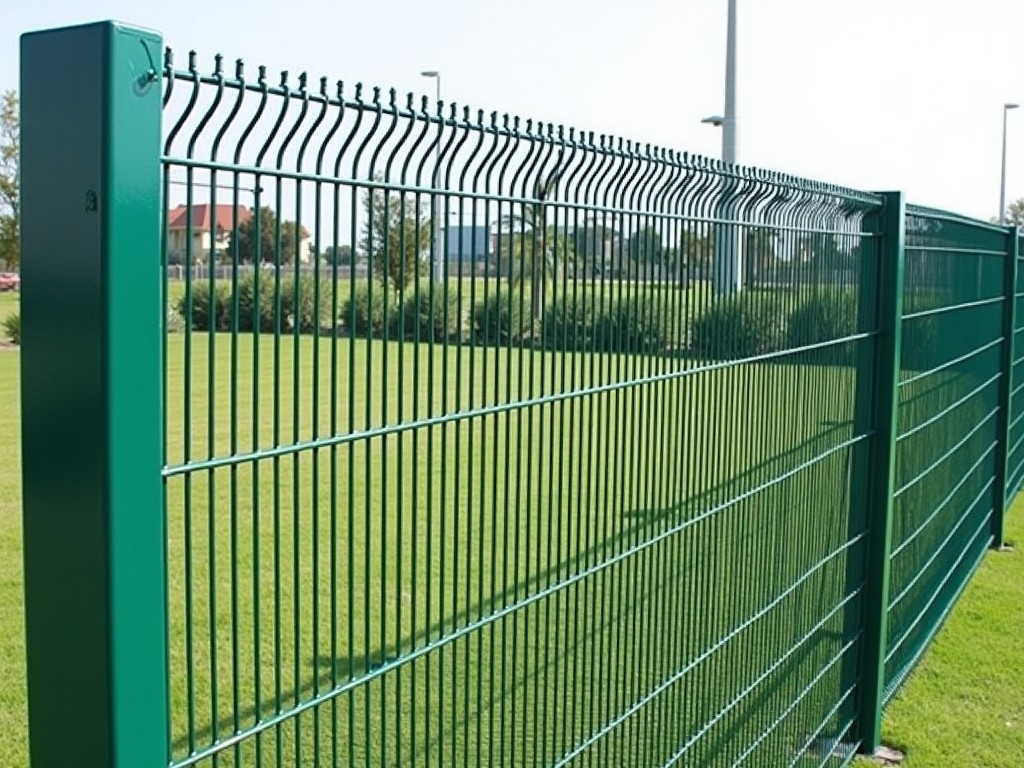
Wholesale Razor Mesh Fence Panels Supplier
Razor mesh fence panels are formed by welding high-tensile steel wire into a diamond‑shaped grid with sharp‑edge protrusions along each strand. The geometry creates a continuous barrier that resists
Request a QuoteWholesale Razor Mesh Fence Panels Supplier
Razor mesh fence panels are formed by welding high-tensile steel wire into a diamond‑shaped grid with sharp‑edge protrusions along each strand. The geometry creates a continuous barrier that resists climbing and cutting while maintaining visibility for surveillance. Panels are typically supplied in standard widths of 2.4 m and heights ranging from 1.8 m to 3.0 m, allowing modular installation on concrete or steel posts.
Product Overview
The core wire is usually cold‑drawn low‑carbon steel with a diameter of 2.5 mm to 3.0 mm, providing a minimum tensile strength of 550 MPa. After welding, the mesh undergoes a hot‑dip galvanizing process that deposits a zinc coating of at least 55 µm, meeting ISO 1461 standards for corrosion resistance. For environments with higher chemical exposure, a PVC over‑coat of 0.5 mm thickness can be applied, adding UV stability and a choice of colors such as green, black, or white.
Technical Specifications
| Parameter | Typical Value | Unit | Notes |
|---|---|---|---|
| Wire Diameter | 2.5 – 3.0 | mm | Cold‑drawn steel |
| Mesh Opening (Diamond) | 50 × 50 | mm | Standard configuration |
| Panel Width | 2.4 | m | Custom widths available |
| Panel Height | 1.8 – 3.0 | m | In 0.2 m increments |
| Zinc Coating | ≥55 | µm | Hot‑dip galvanized |
| PVC Over‑coat (optional) | 0.5 | mm | UV‑stabilized, color options |
Applications
Correctional facilities rely on razor mesh because the sharp protrusions deter hand‑holds and make rapid scaling impractical, while the open mesh allows guards to maintain visual contact with interior areas. Industrial sites such as power substations and water treatment plants use the fence to prevent unauthorized access to hazardous equipment without obstructing airflow or light needed for operational safety. Military installations value the combination of high tensile strength and corrosion‑resistant coating, which ensures perimeter integrity under harsh weather and potential sabotage attempts.
Customization Options
- Wire gauge adjustments from 2.0 mm to 4.0 mm for varying load requirements.
- Alternative coatings including hot‑dip galvanized‑aluminum (Galvalume) or powder‑coated finishes for specific aesthetic or chemical resistance needs.
- Panel dimensions tailored to site constraints, with lengths up to 6.0 m and heights up to 4.0 m.
- Edge treatments such as rolled‑over tops or reinforced bottom rails to improve post‑panel connection stability.
- Compatibility with various post types: C‑channel, square tube, or concrete‑embedded anchors.
Quality Control & Testing
Each production batch undergoes tensile testing on random wire samples to confirm minimum strength of 550 MPa, with results recorded in batch traceability logs. Coating thickness is measured using a magnetic‑induction probe at ten points per panel, ensuring uniformity within ±5 µm of the target. Bend tests simulate impact forces by deflecting a 300 mm sample 90° over a 20 mm radius; panels must show no cracking or coating delamination. Final visual inspection checks for welding consistency, uniform mesh opening, and absence of sharp burrs that could compromise installer safety.
Packaging & Shipping
Panels are stacked in bundles of five, separated by corrugated cardboard dividers to prevent surface abrasion during handling. Each bundle is wrapped in UV‑stabilized polyethylene shrink film and secured with steel straps rated for 2 ton load. Pallets are sized to fit standard 20‑foot and 40‑foot containers, with a maximum gross weight of 24 ton per container to comply with international shipping regulations. Corner protectors and edge guards are added to protect the razor protrusions from deformation.
Frequently Asked Questions
Can dimensions be customized?
Yes, panel width, height, and length can be adjusted to match project specifications; custom tooling may be required for non‑standard lengths beyond 6.0 m.
What information is required before quotation?
To generate an accurate quote we need the required panel dimensions, coating preference (galvanized, PVC, or other), quantity, delivery location, and any special packaging or labeling requests.
How is quality inspected?
Quality control includes tensile strength testing, coating thickness measurement, bend and impact tests, and a final visual audit for weld consistency and surface finish.



