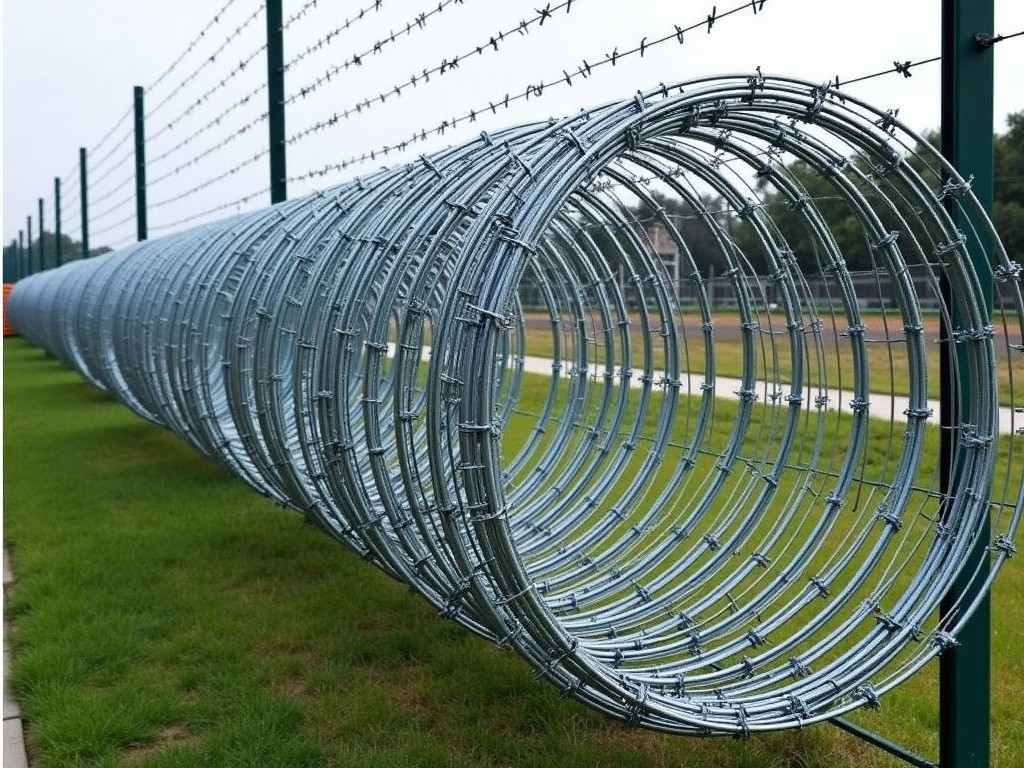
Oem Circular Coiled Barbed Wire Fencing Factory
Circular coiled barbed wire fencing consists of high‑tensile steel wire formed into a tight helix, with evenly spaced barbs projecting radially from the coil. The geometry provides a continuous
Request a QuoteOEM Circular Coiled Barbed Wire Fencing Factory
Circular coiled barbed wire fencing consists of high‑tensile steel wire formed into a tight helix, with evenly spaced barbs projecting radially from the coil. The geometry provides a continuous barrier that resists climbing and cutting while allowing rapid deployment as a roll‑out fence.
Product Overview
The coil diameter typically ranges from 150 mm to 300 mm, depending on the required stiffness and handling convenience. Wire gauge is expressed as diameter; common sizes are 2.0 mm, 2.5 mm, and 3.0 mm (corresponding to 12 GA, 10 GA, and 9 GA). Barb length is usually 15 mm to 25 mm, spaced at 75 mm to 150 mm intervals along the helix.
Tensile strength of the base wire is ≥ 550 MPa for low‑carbon steel and ≥ 650 MPa for high‑carbon grades. After galvanization, the coating weight averages 275 g/m² (Zn) or 10 µm for hot‑dip, providing corrosion resistance suitable for outdoor exposure.
Material Selection
Base wire is produced from cold‑drawn steel rods. Available grades include:
- Q195/Q235 low‑carbon steel – economical, suitable for temporary enclosures.
- Q345 medium‑carbon steel – higher strength, used where impact resistance is required.
- High‑carbon steel (C1060/C1070) – maximum tensile strength for permanent security barriers.
Surface treatments:
- Hot‑dip galvanizing (Zn) – coating weight 200‑350 g/m², per ASTM A123.
- Electro‑galvanizing – thinner coating, smoother finish.
- PVC or PE over‑coat – optional color coding and additional UV protection.
Manufacturing Process
The production line begins with wire drawing to the target diameter, followed by cleaning and annealing to relieve drawing stresses. The wire is then fed into a rotary former that shapes it into a helix while a barb‑forming die cuts and bends the protrusions at programmed intervals. After coiling, the product passes through a hot‑dip galvanizing bath or electro‑galvanizing line, then is cooled, inspected, and wound onto reusable spools or pallets.
Technical Specifications
| Parameter | Typical Value | Unit | Customizable? |
|---|---|---|---|
| Coil Diameter | 150‑300 | mm | Yes (per project) |
| Wire Diameter | 2.0‑3.0 | mm | Yes |
| Barb Length | 15‑25 | mm | Yes |
| Barb Spacing | 75‑150 | mm | Yes |
| Tensile Strength (base wire) | ≥ 550 (low‑carbon) / ≥ 650 (high‑carbon) | MPa | Dependent on grade |
| Galvanizing Coating Weight | 200‑350 | g/m² | Yes (per spec) |
| Standard Coil Length | 20‑50 | m per coil | Yes |
Customization Options
- Alternative coil diameters (100 mm‑400 mm) for specialized handling equipment.
- Custom barb geometry (length, angle, spacing) to meet specific security standards.
- Choice of coating: hot‑dip Zn, Zn‑Al alloy, or polymer over‑coat in RAL colors.
- Pre‑stretched coils to reduce sag during installation.
- Integrated tensioning loops or clips for rapid attachment to posts.
Applications
Circular coiled barbed wire is employed where a flexible yet formidable barrier is needed. In perimeter security, the coil can be unrolled and stapled to wooden or metal posts, providing a continuous obstacle that defeats hand‑hold climbing and wire‑cutting tools. For livestock containment, the helical shape distributes impact forces, reducing injury to animals while preventing escape. Temporary construction sites benefit from the rapid deployment and reusability of the coil, which can be recovered and rewound after project completion.
Quality Control & Testing
Each batch undergoes dimensional verification using laser gauges to confirm coil diameter, wire diameter, and barb spacing within ± 0.2 mm. Tensile tests are performed on wire samples according to ISO 6892‑1, with results recorded for each lot. Coating thickness is measured by magnetic induction, targeting the specified galvanizing weight. Visual inspection checks for uniform barb formation, absence of burrs, and proper winding tension. All test data are retained for traceability.
Packaging and Shipping
Finished coils are placed on protective corrugated sleeves to prevent surface abrasion, then stacked on wooden pallets with corner protectors. Each pallet is secured with stretch film and steel straps, and a desiccant packet is added to control moisture during transit. For export, pallets are fitted with ISPM‑15 compliant heat‑treated lumber and marked with handling instructions. Typical pallet load ranges from 800 kg to 1 200 kg, depending on coil dimensions.
FAQ
Can dimensions be customized? Yes, coil diameter, wire gauge, barb length, and spacing can be adjusted to meet project specifications.
What information is required before quotation? Required details include desired coil diameter, wire diameter, barb geometry, coating type, quantity, and delivery destination.
What materials are available? Low‑carbon (Q195/Q235), medium‑carbon (Q345), and high‑carbon steel grades, with hot‑dip or electro‑galvanizing finishes.
How is quality inspected? Dimensional checks, tensile testing, coating thickness measurement, and visual inspection per lot.
What packaging methods are available? Corrugated sleeves, palletized stretch‑film wrapping, desiccant inclusion, and ISPM‑15 compliant pallets for export.
How are export shipments protected? Moisture‑absorbing desiccants, UV‑stable stretch film, and corner boards prevent corrosion and mechanical damage.
What is the typical production lead time? Lead time varies from 2 weeks for standard specifications to 4‑6 weeks for customized orders, subject to material availability.
How are samples arranged? Sample coils (up to 5 m length) can be dispatched upon receipt of a formal request; shipping charges are collect or prepaid as agreed.
Contact for Inquiry
To discuss your specific requirements or request a formal quotation, please reach out to our technical sales team.



