

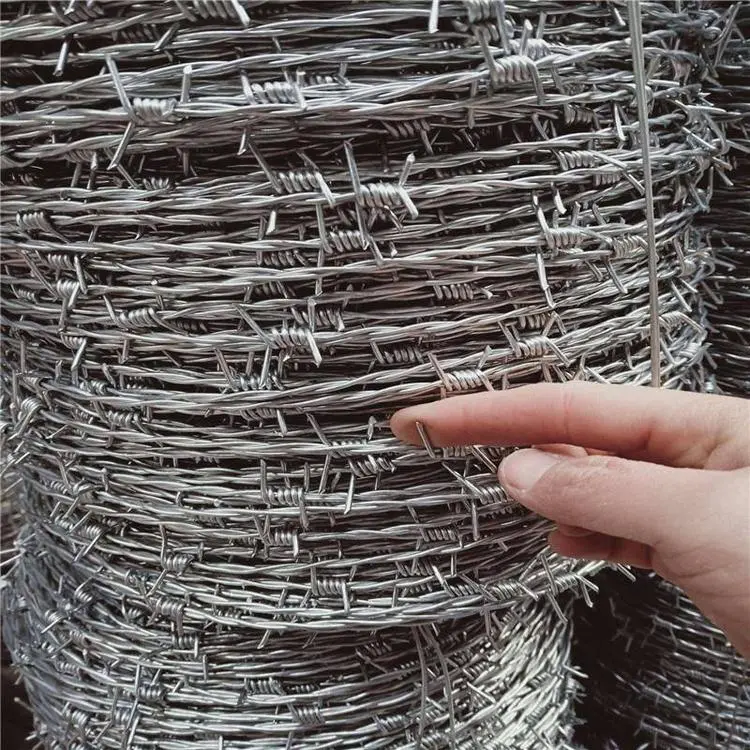
Odm Steel Barbed Fencing Concertina Wire For Prison
High-Quality ODM Steel Barbed Fencing Concertina Wire for Prison Security A barbed wire fence is a security barrier designed for perimeter protection, constructed from sharp barbed wire or concertina
Request a QuoteA barbed wire fence is a security barrier designed for perimeter protection, constructed from sharp barbed wire or concertina wire. It is commonly used to secure critical facilities such as buildings, factories, prisons, military bases, and government offices. The primary function of a barbed wire fence is to deter intruders from crossing into protected areas, while also preventing animal intrusion. These fences are known for their height, strength, durability, and anti-climb properties, making them an effective safety solution.
The main purpose of a barbed wire fence is to prevent intruders from crossing the fence into the protected area, but it also keeps animals out. Barbed wire fences usually have the characteristics of height, firmness, durability, and difficulty in climbing, and are an effective safety protection facility.
Material: PVC-coated iron wire, stainless steel wire, electro-galvanized wire
Wire Diameter: 1.7–2.8 mm
Barb Spacing: 10–15 cm
Strand Arrangement: single strand, multiple strands, three strands
Custom sizes available upon request
Three twisting methods of barbed wire: positive twist, reverse twist, and alternating twist.
Positive Twist: Two or more iron wires are twisted together into a double-strand cable, then the barbed wire is wound around this cable.
Reverse Twist: The barbed wire is first wound onto a single main wire, after which an additional wire is twisted and woven with it to form a double-strand barbed wire.
Alternating Twist (Positive and Reverse): The barbed wire is twisted in alternating directions at the points where it wraps around the main wire, rather than twisting consistently in one direction.
| Barbed Wire Type | Wire Gauge (Line × Barb) | Barb Spacing | Barb Length | |
| Electro-Galvanized Barbed Wire; Hot-Dip Galvanized Barbed Wire | 10# x 12# | 7.5–15 cm | 1.5–3 cm | |
| 12# x 12# | ||||
| 12# x 14# | ||||
| 14# x 14# | ||||
| 14# x 16# | ||||
| 16# x 16# | ||||
| 16# x 18# | ||||
| PVC-Coated Barbed Wire; PE-Coated Barbed Wire | Before Coating | After Coating | 7.5–15 cm | 1.5–3 cm |
| 1.0 mm–3.5 mm | 1.4 mm–4.0 mm | |||
| BWG 11#–20# | BWG 8#–17# | |||
| SWG 11#–20# | SWG 8#–17# | |||


Barbed wire has a broad range of applications. Originally developed for military purposes, it is now widely used for paddock enclosures, agriculture, animal husbandry, and residential security. Its use continues to expand. For security protection, barbed wire acts as an effective deterrent, but proper installation and safety precautions are essential. If you have any questions, please feel free to contact us.
If you have any questions, welcome to contact us.





