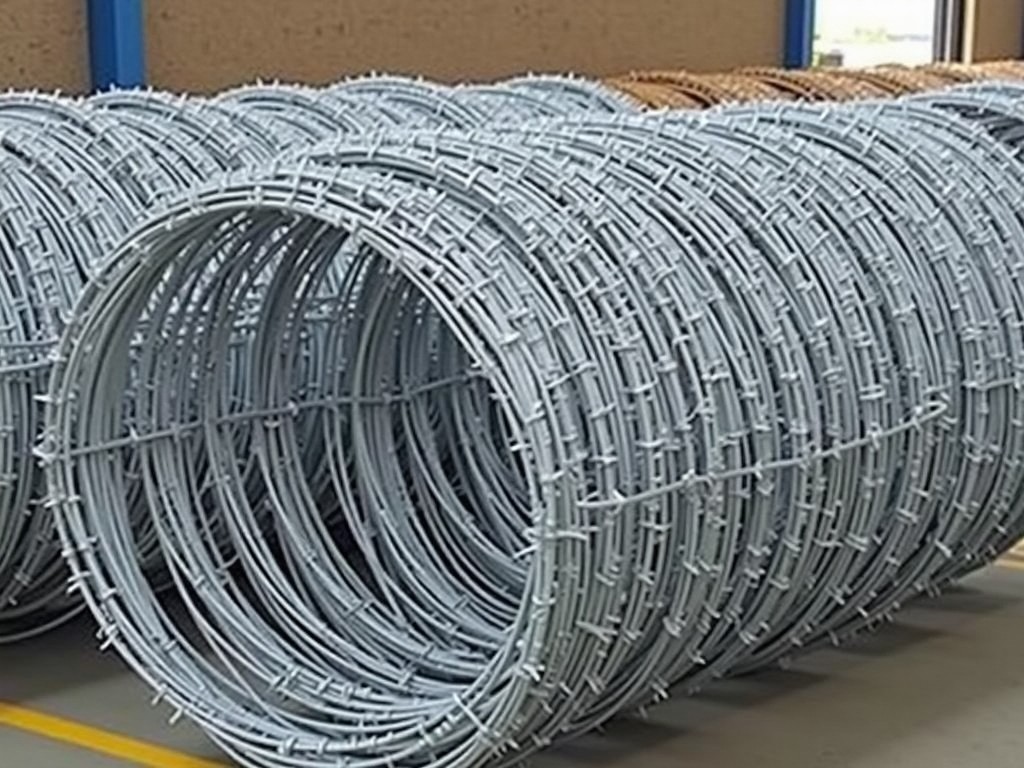
Factory Direct Hot Dipped Galvanized Razor Barbed Wire Exporter
Hot-dip galvanizing applies a metallurgically bonded zinc coating to steel wire by immersing it in molten zinc at approximately 450 °C. This process creates a uniform barrier that significantly
Request a QuoteFactory Direct Hot Dipped Galvanized Razor Barbed Wire Exporter
Hot-dip galvanizing applies a metallurgically bonded zinc coating to steel wire by immersing it in molten zinc at approximately 450 °C. This process creates a uniform barrier that significantly retards rust formation, especially in environments with high humidity, saline exposure, or industrial pollutants. For razor barbed wire, the coating protects both the core wire and the sharp barbs, extending service life while maintaining tensile integrity.
Technical Specifications
| Parameter | Typical Value | Notes |
|---|---|---|
| Core wire diameter | 2.5 mm | Cold‑drawn high‑carbon steel |
| Barb length | 15 mm | Formed from same wire |
| Barb spacing (pitch) | 100 mm | Center‑to‑center |
| Zinc coating weight | 60 g/m² (both sides) | ASTM A123 Class 1 |
| Tensile strength | 1 750 MPa (min) | Measured on bare wire before coating |
| Elongation at break | 8 % (min) | Ensures ductility during installation |
| Standard compliance | ASTM A123, ISO 1461 | Hot‑dip galvanizing specifications |
Manufacturing Process Overview
Production begins with high‑carbon steel rod that is drawn to the target diameter, improving grain structure and tensile capacity. The drawn wire is then twisted into a double‑helix strand; barbs are formed by cutting and bending the strand at precise intervals using rotary dies. After forming, the strand undergoes cleaning, fluxing, and immersion in a zinc bath where a metallurgical alloy layer develops. Finally, the galvanized wire is cooled, inspected, and coiled for shipment.
Applications in Perimeter Security
Razor barbed wire provides a physical deterrent that combines sharp protrusions with a tough, corrosion‑resistant coating. The hot‑dip zinc layer preserves cutting effectiveness even after years of exposure to rain, UV radiation, and industrial atmospheres, reducing the need for frequent replacement. This makes the product suitable for facilities where long‑term reliability and low maintenance are critical.
- Correctional institutions requiring continuous barrier integrity
- Military bases and border installations subject to harsh weather
- Petrochemical refineries where salt‑laden air accelerates corrosion
- Warehouse complexes protecting high‑value inventory
- Utility substations needing vandal‑resistant fencing
Quality Assurance Procedures
Each production lot undergoes systematic verification to confirm coating adherence and mechanical properties. Coating thickness is measured using magnetic‑induction probes at multiple points along the coil, with acceptance based on the average meeting the specified 60 g/m². Adhesion is assessed by a bend test where the wire is folded over a mandrel; no flaking or cracking indicates sufficient bond strength. Tensile samples are extracted from the wire before coating to verify baseline strength, while visual inspections detect surface defects such as drips, bare spots, or uneven barb formation.
Customization Options
Design parameters can be adjusted to match site‑specific security levels and installation constraints. Customers may select alternative wire gauges to alter tensile strength and weight, modify barb pitch to increase or decrease barrier density, or specify coil lengths that suit handling equipment. Additionally, the zinc coating weight can be increased for aggressive environments, or a duplex system (zinc‑rich paint over galvanize) can be applied for extra protection.
- Wire diameter: 2.0 mm – 3.2 mm
- Barb length: 12 mm – 20 mm
- Barb spacing: 50 mm – 150 mm
- Coil weight: 15 kg – 50 kg (standard)
- Packaging: PVC shrink wrap, woven polypropylene bags, or steel‑strapped pallets
Packaging and Export Logistics
Finished coils are wound onto reusable steel or plastic cores, then wrapped in UV‑stabilized polyethylene film to prevent abrasion and moisture ingress during transit. For containerized shipments, coils are stacked on pallets secured with corner protectors and steel strapping, facilitating efficient forklift handling at destination ports. Export documentation includes material test certificates, coating compliance reports, and fumigation records where required.
Frequently Asked Questions
- Can dimensions be customized? Yes, wire gauge, barb length, pitch, and coil length are adjustable per project specifications; contact us with your requirements for a tailored quotation.
- What information is needed before quotation? Provide the desired wire diameter, barb geometry, total linear meters or weight, coating class, and delivery location; this enables accurate pricing and lead‑time estimation.
- How is quality inspected? We perform coating thickness magnetic testing, adhesion bend tests, tensile strength sampling, and visual inspection on every batch, with records available upon request.
- What packaging methods are available? Options include UV‑stabilized film wrapping, woven polypropylene bags, and palletized steel‑strapped configurations; special requests such as corrosion‑inhibitor interleaves can be accommodated.
- How are export shipments protected? Coils are wrapped, palletized, and secured with corner braces and strapping; desiccant packets are added for high‑humidity routes to mitigate condensation.
Submit your specification sheet to receive a detailed technical proposal and lead‑time schedule.



