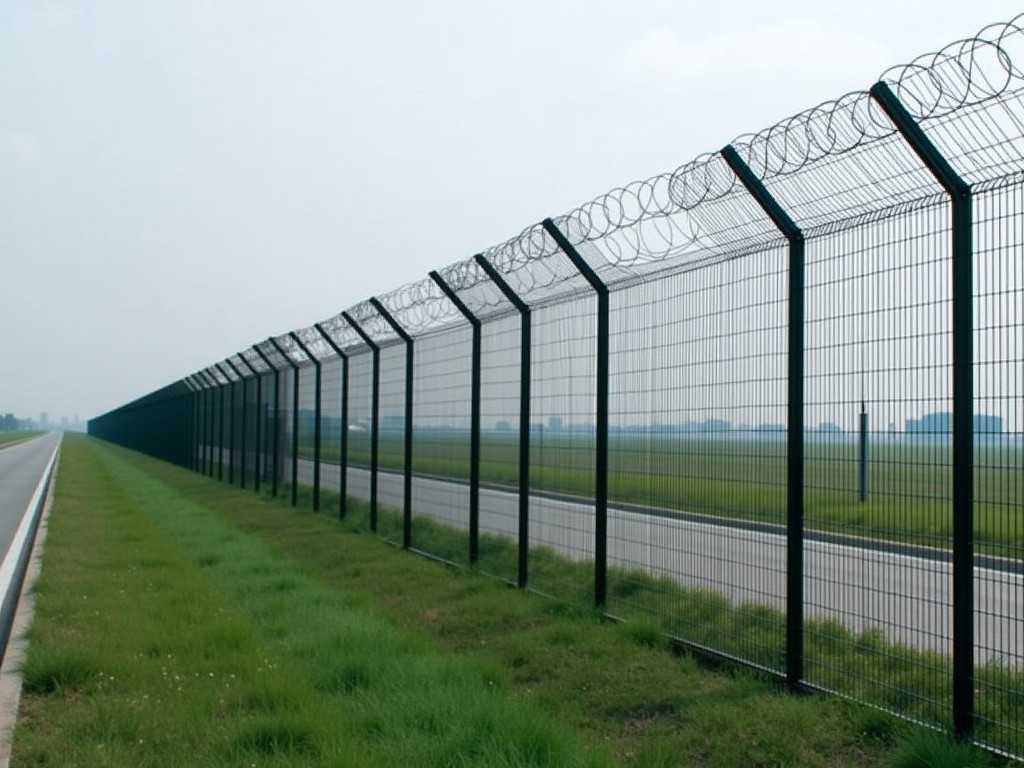
Custom Straight Line Razor Wire Fence Manufacturer
A straight line razor wire fence consists of a high‑tensile steel core wire formed into a continuous helical coil with uniformly spaced barbs. The coil is tensioned between structural posts to create
Request a QuoteCustom Straight Line Razor Wire Fence
A straight line razor wire fence consists of a high‑tensile steel core wire formed into a continuous helical coil with uniformly spaced barbs. The coil is tensioned between structural posts to create a linear barrier that presents a consistent profile along its length, unlike concertina types that rely on staggered loops.
Engineers select this configuration when a uniform visual deterrent and predictable mechanical performance are required. The straight geometry simplifies tensioning, reduces sag over long spans, and allows precise calculation of load‑bearing capacity for a given post spacing and foundation type.
Design Parameters
Core wire diameters typically range from 2.5 mm to 3.0 mm, providing tensile strengths of 1500 MPa or higher. Barb spacing is commonly set between 50 mm and 100 mm, which influences both climb‑deterrence and the overall weight per metre of fence.
Standard fence heights are 1.8 m, 2.0 m, and 2.4 m, with post centres usually placed at 3.0 m intervals for galvanized steel posts set in concrete footings. Tensioning is achieved using ratchet‑type turnbuckles or hydraulic tensioners, allowing the installer to maintain a pre‑load of 2 kN to 4 kN depending on site wind loads.
Material Options
The core wire is most often hot‑dip galvanized to a coating mass of 270 g/m² (Zn), delivering a service life of 15‑20 years in temperate climates. For aggressive environments, stainless steel grades 304 or 316 are available, offering corrosion resistance without additional coating.
Optional PVC overcoats (thickness 0.3 mm to 0.5 mm) can be applied in colours such as black, green, or grey to meet aesthetic or camouflage requirements while adding an extra barrier against UV degradation.
Customization Choices
- Coil diameter: adjustable from 45 mm to 70 mm to change barrier stiffness.
- Barb profile: standard pointed, reversed, or flattened tips for specific threat assessments.
- Length: supplied in continuous rolls up to 500 m or cut to exact panel lengths for modular installation.
- Integration: can be combined with barbed wire, electric fence strands, or sensor cables on the same post system.
Applications – Why This Fence Fits Specific Sectors
Correctional facilities choose straight line razor wire because the uniform height eliminates low‑spot gaps that could be exploited for climbing, while the consistent tension allows rapid visual inspection for tampering.
Industrial storage yards benefit from the fence’s high tensile load capacity, which resists vehicle impact better than lightweight mesh, and the low maintenance profile reduces lifecycle cost compared with painted steel palisades.
Data centres and power substations employ this barrier as a first‑line physical deterrent; the predictable performance simplifies risk assessments required for compliance with standards such as IEC 62443.
Quality Assurance
Incoming core wire is verified for diameter (±0.02 mm) and tensile strength using calibrated universal testing machines. Barb geometry is inspected via optical profilometry to ensure spacing uniformity within ±2 mm. Coating adhesion follows ASTM D3359 tape test, with a minimum rating of 4B required before shipping.
Finished coils undergo a 10 % visual inspection for defects such as nicked barbs or uneven winding. Each batch is accompanied by a material test report documenting the measured values for yield strength, elongation, and coating mass.
Typical Technical Specifications
| Parameter | Standard Range | Notes |
|---|---|---|
| Core wire diameter | 2.5 mm – 3.0 mm | Custom sizes available on request |
| Tensile strength | ≥1500 MPa | Measured at room temperature |
| Barb spacing | 50 mm – 100 mm | Affects weight per metre (~12‑18 kg/m) |
| Coating (Zn) | 270 g/m² | Hot‑dip galvanized; alternative coatings available |
| Standard height | 1.8 m, 2.0 m, 2.4 m | Other heights customizable |
Frequently Asked Questions
Can dimensions be customized?
Yes. Core wire diameter, coil diameter, barb spacing, fence height, and post spacing can all be tailored to project‑specific load and security requirements.
What information is needed for a quotation?
Required details include desired fence length, height, core wire specification, coating type, post material and spacing, and any additional features such as PVC colour or integration with electric strands.
How is quality inspected before shipment?
Each lot undergoes dimensional verification, tensile testing, coating adhesion assessment, and a visual audit. A material test report is supplied with every delivery.
What packaging methods are available?
Coils are wrapped in protective HDPE film, placed on wooden pallets, and secured with steel strapping. For overseas shipments, moisture‑absorbent desiccants and corner protectors are added.
What is the typical production lead time?
Lead times range from 3 to 6 weeks depending on order complexity and current capacity; exact schedules are confirmed at quote stage.
Contact Us for a Technical Quote
To discuss your project’s specific requirements, please use the inquiry form or send an email to our engineering team. Provide the parameters outlined above, and we will return a detailed quotation with lead times and material test reports.
Request a Quote


