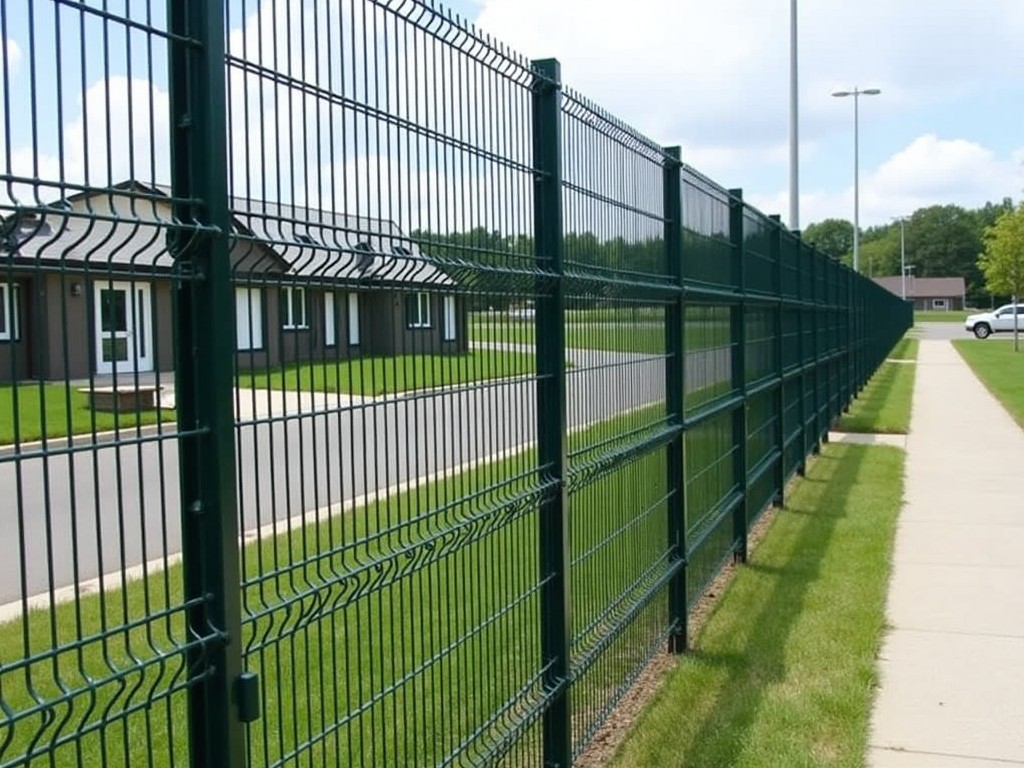
Custom Security Fencing Anti Climb Manufacturer
Security fencing designed to resist climbing incorporates geometric barriers that limit hand and foothold placement. By controlling opening sizes, adding overhangs, and selecting materials with
Request a QuoteCustom Security Fencing Anti Climb Manufacturer
Security fencing designed to resist climbing incorporates geometric barriers that limit hand and foothold placement. By controlling opening sizes, adding overhangs, and selecting materials with specific shear resistance, the system raises the effort required for unauthorized ascent. This approach reduces intrusion risk while maintaining visibility and airflow for site operations.
Product Overview
The fencing is produced from roll‑formed steel panels that are welded at intersections to create a rigid mesh. Panel dimensions are controlled to ±2 mm tolerance, ensuring consistent spacing across long runs. Posts are hot‑dip galvanized or powder‑coated to match the panel finish, providing a unified corrosion barrier.
Anti-Climb Design Features
- Maximum opening: 40 mm square mesh prevents finger and toe insertion.
- Overhang angle: 45° outward‑facing top rail increases climb height by ~150 mm.
- Picket shape: Rounded‑profile pickets reduce grip surfaces compared to square bars.
- Optional anti‑cut strip: 2 mm thick hardened steel bar welded to the top rail resists shear tools.
Material Selection
| Material | Tensile Strength (MPa) | Yield Strength (MPa) | Coating Thickness (µm) | Typical Use |
|---|---|---|---|---|
| Hot‑dip galvanized steel (SGCC) | 450 | 250 | 80‑120 | General perimeter, utility sites |
| Stainless steel 304 | 520 | 210 | Passivated (no coating) | Corrosive environments, chemical plants |
| Aluminum alloy 6063‑T5 | 210 | 140 | Anodized 15‑25 | Lightweight installations, temporary barriers |
Customization Options
- Height: 1.2 m to 3.0 m in 150 mm increments.
- Panel width: Standard 2.4 m, custom lengths up to 6.0 m available.
- Gate integration: Single‑leaf, double‑leaf, or sliding gates with matching mesh and overhang.
- Finish: Galvanized, powder‑coated (RAL options), or stainless steel passivation.
- Mounting: Concrete‑set posts, base‑plate with chemical anchors, or welded to structural steel.
Typical Applications
Facilities that require controlled access while maintaining visual monitoring benefit from the climb‑resistant mesh. Power substations use the fencing to deter tampering with live equipment, where any breach could cause safety hazards or service interruption. Data centers adopt the system to protect perimeter zones without obstructing camera sightlines, ensuring continuous surveillance. Correctional facilities rely on the anti‑climb geometry to increase the time required for escape attempts, supporting overall security protocols.
Quality Control & Testing
Each production lot undergoes dimensional verification using laser gauges to confirm mesh opening tolerances. Weld integrity is assessed via ultrasonic scanning, with acceptance criteria set at <5 % porosity per joint. Coating adhesion follows ASTM D4541, requiring a minimum pull‑off strength of 5 MPa. Final panels are subjected to a 48‑hour salt spray test (ASTM B117) to validate corrosion resistance before shipment.
Frequently Asked Questions
- Can dimensions be customized? Yes. Height, panel width, and gate configurations are adjusted per project specifications. Provide site drawings or required clearances for a detailed quote.
- What information is required before quotation? Needed details include total linear length, desired height, finish type, gate quantity and type, and any special mounting conditions (e.g., concrete depth, soil type).
- What materials are available? Hot‑dip galvanized steel, stainless steel 304, and aluminum alloy 6063‑T5 are standard. Other grades or coatings can be sourced upon request.
- How is quality inspected? Inspection includes dimensional checks, weld ultrasonic testing, coating adhesion measurements, and salt spray endurance. Reports are supplied with each shipment.
Contact for Inquiry
To discuss your project requirements or request a technical datasheet, contact our engineering team. Provide site specifics and we will return a detailed proposal within two business days.



