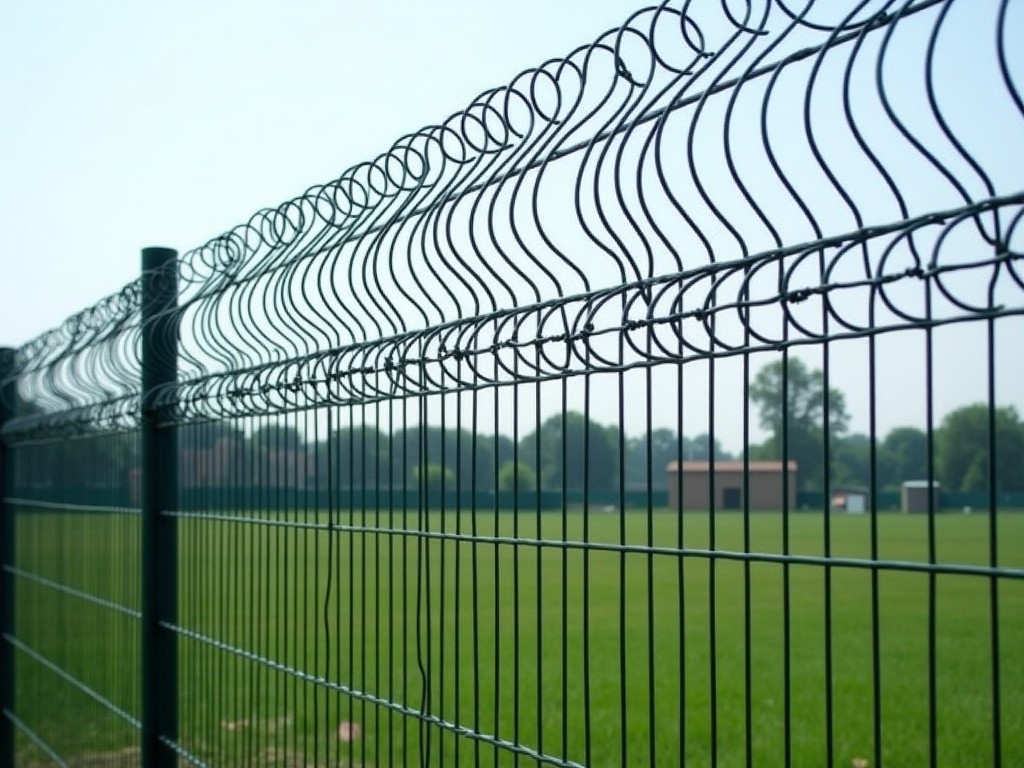
Custom Razor Wire On Top Of Fence Supplier
Razor wire installed on the top perimeter of a fence creates a continuous barrier that deters climbing and cutting attempts. The effectiveness depends on wire diameter, barb spacing, and the tension
Request a QuoteCustom Razor Wire On Top Of Fence Supplier
Overview
Razor wire installed on the top perimeter of a fence creates a continuous barrier that deters climbing and cutting attempts. The effectiveness depends on wire diameter, barb spacing, and the tension applied during installation.
Suppliers that offer custom lengths, coil configurations, and coating options enable engineers to match the barrier to specific site risks, fence height, and local regulations.
Material Selection
Core wire is typically cold‑drawn steel with a tensile strength ranging from 550 MPa to 650 MPa, providing resistance to manual cutting tools. The barbs are formed from the same wire stock, ensuring uniform hardness along the entire length.
Protective finishes include hot‑dip galvanized coating (minimum 55 µm zinc), PVC over‑coat (0.5 mm thickness), or stainless‑steel grade 304 for corrosive environments. Each finish adds a predictable service life: galvanized ≈ 15 years in moderate climates, PVC‑coated ≈ 20 years, stainless‑steel > 25 years.
Design & Customization
Customization begins with selecting the wire gauge (commonly 2.5 mm to 3.0 mm diameter) and barb length (typically 15 mm to 25 mm). The pitch—the distance between consecutive barbs—can be set from 25 mm up to 100 mm, influencing both deterrence and material usage.
Coil diameter is adjusted to suit the fence top rail width; standard coils range from 150 mm to 300 mm outer diameter. End treatments include looped ends for easy clipping or straightened ends for direct welding to support brackets.
- Wire gauge: 2.5 mm, 2.8 mm, 3.0 mm
- Barb length: 15 mm, 20 mm, 25 mm
- Barb pitch: 25 mm, 50 mm, 75 mm, 100 mm
- Coil outer diameter: 150 mm, 200 mm, 250 mm, 300 mm
- Finish: hot‑dip galvanized, PVC‑coated, stainless‑steel 304
Installation Guidelines
Proper tension is critical; the wire should be pre‑stressed to approximately 10 % of its breaking load before fixing to the fence top. This prevents sagging that could reduce barb effectiveness over time.
Fastening methods include stainless‑steel clips spaced every 300 mm, U‑shaped brackets welded to the rail, or proprietary tensioning bars that allow periodic re‑tensioning. All fasteners must be corrosion‑compatible with the chosen wire finish.
Safety during installation requires cut‑resistant gloves and eye protection, as the barbs can cause lacerations if mishandled.
Performance & Safety
Laboratory pull‑tests on 2.8 mm galvanized wire show an average ultimate tensile strength of 620 MPa, translating to a breaking force of roughly 3.8 kN per strand. When installed at 150 mm coil diameter with a 50 mm barb pitch, the system resists a lateral pull of up to 2.5 kN before permanent deformation.
The sharp barb geometry produces a cutting angle of approximately 45 °, which is sufficient to snag clothing or skin, thereby increasing the time required for an intruder to breach the perimeter.
Quality Assurance
Each production lot undergoes dimensional verification: wire diameter tolerance ± 0.02 mm, barb length tolerance ± 0.5 mm, and pitch tolerance ± 1 mm. Visual inspection confirms uniform coating adhesion using cross‑hatch tape tests (ASTM D3359).
Coating thickness is measured with a magnetic induction gauge; galvanized lots must exceed 50 µm zinc, PVC‑coated lots must show a minimum 0.45 mm polymer layer. Records are retained for traceability for a minimum of five years.
Applications
High‑security sites such as power substations, correctional facilities, and border installations use razor wire on fence tops to increase the time delay for unauthorized access. The added delay allows surveillance systems and response teams to intervene before a breach occurs.
In industrial storage yards, the barrier deters theft of valuable equipment by making the climb conspicuous and physically challenging, reducing loss incidents without requiring continuous manned guarding.
Comparison Table
| Attribute | Standard Offering | Custom Option |
|---|---|---|
| Wire Diameter | 2.8 mm | 2.5 mm – 3.0 mm (selectable) |
| Barb Length | 20 mm | 15 mm – 25 mm |
| Barb Pitch | 50 mm | 25 mm – 100 mm |
| Coil Outer Diameter | 200 mm | 150 mm – 300 mm |
| Finish | Hot‑dip Galvanized | Galvanized, PVC‑coated, SS 304 |
Frequently Asked Questions
Can dimensions be customized?
Yes, wire gauge, barb length, pitch, and coil diameter are all adjustable to match fence specifications and security requirements.
What information is required before quotation?
Fence height, top rail width, desired coating environment, and any local regulatory limits on protrusion length.
What materials are available?
Cold‑drawn steel core with hot‑dip galvanized, PVC over‑coat, or stainless‑steel grade 304 finishes.
How is quality inspected?
Dimensional checks, coating thickness measurements, and visual adhesion tests are performed on every lot.
What packaging methods are available?
Coils are wrapped in protective film, placed in corrugated cartons, and secured on pallets for transport; custom crating is available upon request.
Contact Us
To discuss your project specifics, request a quote, or obtain technical datasheets, please reach out via our contact form.
Request Quote


