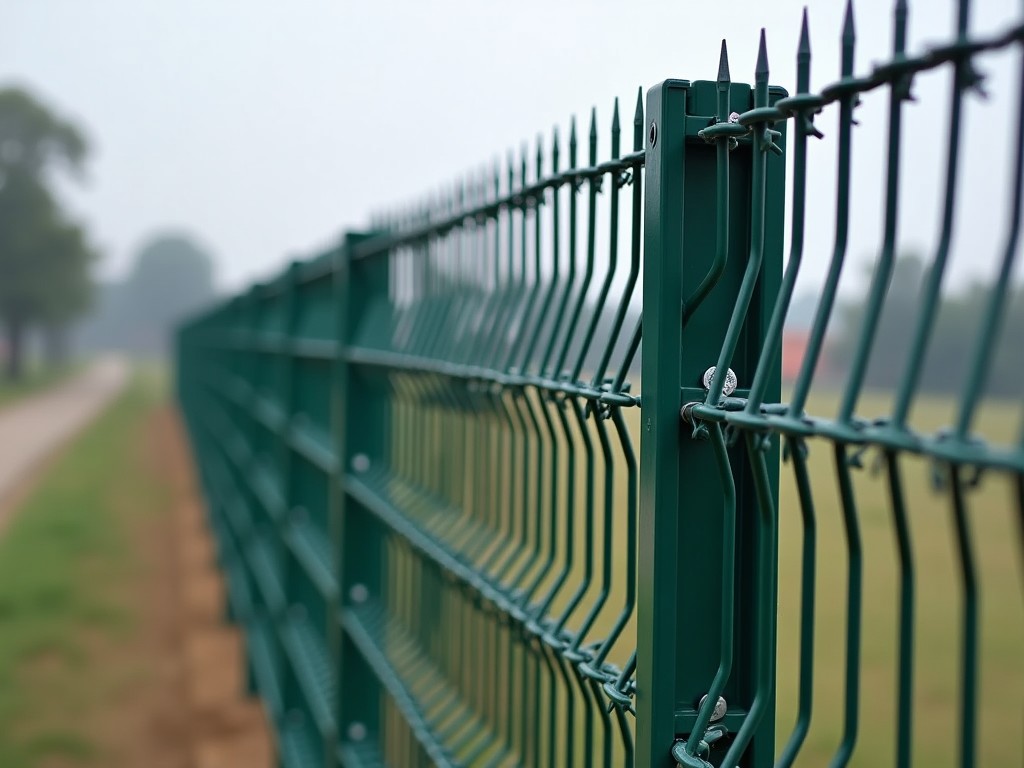
Custom Razor Spikes For Fence Factory
Razor spikes are pointed steel protrusions welded or mechanically fastened to fence panels to deter climbing and unauthorized access. Their effectiveness depends on geometry, material hardness, and
Request a QuoteCustom Razor Spikes For Fence Factory
Introduction
Razor spikes are pointed steel protrusions welded or mechanically fastened to fence panels to deter climbing and unauthorized access. Their effectiveness depends on geometry, material hardness, and anchoring strength.
Material Selection
Common base materials include low‑carbon steel (C1010) for formability and medium‑carbon steel (C1045) for higher tensile strength. The choice influences spike hardness after heat treatment and resistance to bending under impact.
Surface treatments such as hot‑dip galvanizing (minimum 60 g/m² zinc) or zinc‑rich paint provide corrosion protection in outdoor environments. Stainless‑steel grades (AISI 304 or 316) are available when chloride exposure is high.
Design Parameters
Key dimensions are overall length (L), tip angle (θ), and base diameter (D). Typical lengths range from 50 mm to 150 mm; tip angles between 30° and 45° provide a balance between penetration resistance and manufacturability.
Spacing between spikes along a rail affects the climb‑deterrent effect; a center‑to‑center distance of 25 mm to 40 mm is common for panel heights up to 2 mm thick. The base is often forged with a flange or hole for welding or bolt‑through mounting.
Customization Options
Customers can specify length, tip geometry (sharp, blunt, or barbed), base features (weld pad, threaded stud, or pre‑drilled hole), and coating type. These variables are adjusted to match panel thickness, expected load, and aesthetic requirements.
For high‑security fences, a double‑tip configuration or a helical twist can be added to increase torsional resistance. All custom dimensions are reviewed for manufacturability before tooling is produced.
Manufacturing Process
Production begins with coil feeding into a progressive die that cuts the spike blank and forms the base flange in a single stroke. The blanks then undergo austenitizing at 850 °C followed by oil quenching to achieve a surface hardness of 55‑60 HRC.
After quenching, parts are tempered at 200 °C to relieve internal stresses while retaining hardness. Galvanizing or painting is performed post‑treatment, and each batch is inspected for dimensional accuracy before packaging.
Quality Assurance
Every lot undergoes visual inspection for surface defects, followed by hardness testing on a sample using a Rockwell C scale. Dimensional checks are performed with calibrated gauges; length tolerance is typically ±0.5 mm and angle tolerance ±2°.
Traceability is maintained via laser‑etched lot numbers on the base flange, allowing correlation to material certificates and heat‑treat records. Non‑conforming parts are segregated and reworked or scrapped according to internal procedures.
Applications in Fence Factory
Razor spikes are installed on the top rail of perimeter fences to increase the effort required for an intruder to gain a foothold. The spikes act as a physical barrier that complements sensor‑based systems by increasing detection time.
In manufacturing environments, the spikes also protect equipment areas from unauthorized climbing, reducing the risk of accidents near moving machinery. Their low profile minimizes wind load while providing a measurable deterrent effect.
Technical Specifications
| Parameter | Typical Value / Range | Notes |
|---|---|---|
| Base Material | Low‑carbon steel (C1010) or Medium‑carbon steel (C1045) | Selected per project strength requirements |
| Length (L) | 50 mm – 150 mm | Custom lengths available |
| Tip Angle (θ) | 30° – 45° | Affects penetration resistance |
| Base Diameter (D) | 8 mm – 12 mm | Determines welding area |
| Surface Hardness after Quench | 55 HRC – 60 HRC | Measured on tip |
| Coating Thickness (Zn) | ≥ 60 g/m² (hot‑dip galvanizing) | Alternative: paint or stainless steel |
| Spacing (center‑to‑center) | 25 mm – 40 mm | Depends on panel height |
Frequently Asked Questions
- Can dimensions be customized? Yes, length, tip angle, and base features are adjusted per drawing.
- What information is required before quotation? Required data include fence panel thickness, material grade, desired coating, and order quantity.
- What materials are available? Low‑carbon steel, medium‑carbon steel, and stainless‑steel grades (304, 316) with optional galvanizing or paint.
- How is quality inspected? Each lot receives hardness, dimensional, and visual checks; traceability is maintained via lot numbers.
- What packaging methods are available? Spikes are packed in corrugated cartons with plastic inserts; palletization is available for bulk orders.
- How are export shipments protected? Cartons are lined with moisture‑barrier film and secured with steel straps to prevent corrosion during transit.
- What is the typical production lead time? Lead time ranges from 2 to 4 weeks depending on complexity and current shop load.
- How are samples arranged? Sample pieces can be produced after drawing approval; shipping costs are borne by the requester.
Contact for Technical Inquiry
To discuss your fence‑factory specifications, provide drawings or performance requirements via the inquiry form. Our engineering team will review the details and return a formal quotation with lead‑time confirmation.
Request a Quote


