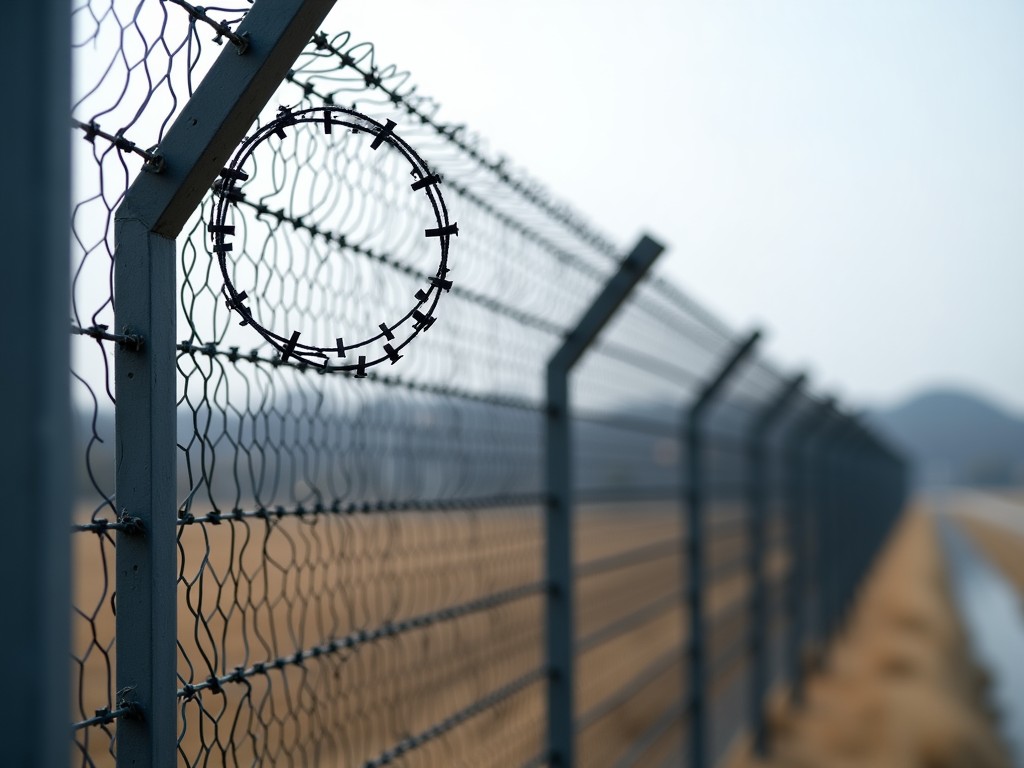
Custom Prison Razor Barbed Wire Fence
A prison razor barbed wire fence is a high‑security perimeter barrier formed by helically wound steel wire fitted with sharp, closely spaced barbs. The primary function is to delay and deter
Request a QuoteCustom Prison Razor Barbed Wire Fence
A prison razor barbed wire fence is a high‑security perimeter barrier formed by helically wound steel wire fitted with sharp, closely spaced barbs. The primary function is to delay and deter unauthorized climbing or cutting attempts, thereby increasing the time required for a breach and improving the effectiveness of auxiliary detection systems.
Customization allows the fence to match specific threat levels, site geometries, and regulatory requirements. Engineers select wire gauge, barb geometry, coil pitch, and protective coatings based on calculated tensile loads, corrosion exposure, and installation constraints.
Core Technical Specifications
| Parameter | Typical Value | Customizable Range |
|---|---|---|
| Wire diameter (core) | 2.5 mm | 1.8 mm – 4.0 mm |
| Barb length | 22 mm | 15 mm – 30 mm |
| Barb spacing (along wire) | 100 mm | 50 mm – 150 mm |
| Coil pitch (distance between loops) | 150 mm | 100 mm – 250 mm |
| Fence height (above ground) | 2.4 m | 1.8 m – 3.5 m |
| Tensile strength of wire | ≥ 550 MPa | 400 MPa – 800 MPa (grade dependent) |
Material Options
- Low‑carbon steel wire (ASTM A641) – economical, suitable for temporary or low‑corrosion environments.
- High‑tensile steel wire (ASTM A228) – increased resistance to cutting and stretching.
- Hot‑dip galvanized coating (Zn ≥ 60 g/m²) – standard corrosion protection for outdoor installations.
- PVC‑over‑galvanized coating – adds UV stability and color coding options.
- Stainless steel grades 304 or 316 – for highly corrosive or hygienic zones where coating maintenance is impractical.
Customization Parameters
- Wire diameter – adjusted to meet required tensile load and cutting resistance.
- Barb geometry – length, angle, and tip sharpness tailored to threat level.
- Barb spacing – influences climb‑delay time and material usage.
- Coil pitch – determines fence flexibility and ease of installation on uneven terrain.
- Overall fence height – set based on site risk assessment and local regulations.
- Post type – steel H‑posts, concrete‑filled tubes, or timber with corrosion‑protective sleeves.
- Mounting method – direct weld, bolt‑on brackets, or tension‑wire systems for rapid deployment.
Typical Applications in Correctional Facilities
In prisons, the fence acts as a physical delay mechanism that forces an intruder to spend additional time negotiating the barrier, increasing the probability of detection by patrols, motion sensors, or CCTV analytics. The psychological deterrent effect arises from the visible risk of injury, which reduces attempted climbs compared to smooth wire or mesh alternatives.
Integration with underground vibration sensors or taut‑wire detection systems is common because the razor wire maintains a consistent tension that transmits disturbance signals effectively. The modular coil design allows sections to be replaced individually after attempted breaches, minimizing downtime and lifecycle cost.
Manufacturing & Quality Assurance
Production begins with cold‑drawing steel wire to the specified diameter, followed by precision rolling to form the barb profile. The wire is then helically coiled around a core mandrel at the defined pitch, ensuring uniform loop geometry.
Quality control includes tensile testing of each batch (minimum 550 MPa), zinc‑coating thickness measurement via magnetic flux method, and visual inspection for barb uniformity and coil tightness. Statistical process control charts track dimensional variations to maintain tolerances within ±0.1 mm for wire diameter and ±2 mm for barb length.
Installation Considerations
Posts are typically set in concrete footings at 2.5 m to 3.0 m intervals, depending on soil conditions and wind load calculations. Tensioning is achieved with turnbuckles or ratchet devices to maintain a pre‑load of approximately 1.5 kN per wire, which prevents sagging and ensures consistent barb orientation.
Safety protocols require installers to wear cut‑resistant gloves and arm guards, as the barbs can cause deep lacerations. Proper grounding of the fence is recommended when located near power lines to mitigate induced voltage risks.
Frequently Asked Questions
- Can dimensions be customized?
- Yes. Wire diameter, barb length, spacing, coil pitch, and fence height are all adjustable per project specifications.
- What information is required before quotation?
- Required inputs include desired fence height, total length, post spacing, material preference (coating/grade), and any special environmental factors such as salinity or industrial pollutants.
- What materials are available?
- Options range from low‑carbon steel with hot‑dip galvanizing to high‑tensile steel with PVC overlay, and stainless steel grades 304 or 316 for aggressive environments.
- How is quality inspected?
- Each production lot undergoes tensile testing, coating thickness verification, and dimensional checks against approved tolerances before packaging.
- What packaging methods are available?
- Standard packaging uses water‑resistant poly‑wrapped coils on wooden pallets; custom crating or corrosion‑inhibitor treated wraps are available upon request.
- How are export shipments protected?
- Coils are sealed with VCI (volatile corrosion inhibitor) film and strapped to prevent movement; pallets are ISPM‑15 compliant for international transit.
- What is the typical production lead time?
- Lead time varies from 2 to 4 weeks depending on material availability and order volume; expedited schedules can be arranged for critical projects.
- How are samples arranged?
- Sample sections (typically 1 m length) can be shipped via courier after a technical review of the request; associated costs are credited against a subsequent order.
Get a Quote
To receive a detailed quotation, please provide the project specifics outlined above. Our engineering team will review the requirements and return a formal proposal with lead time, pricing, and compliance documentation.
Request a Quote


