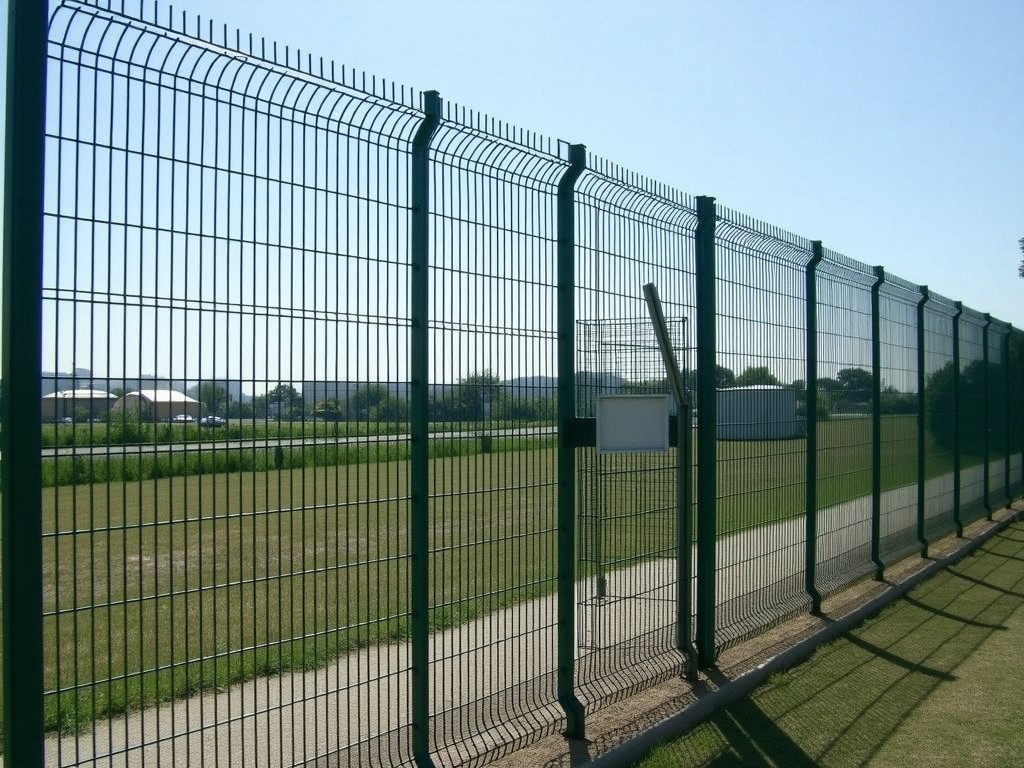
Custom Anti Climb Wireworks Security Fence Supplier
Security perimeters require barriers that deter intrusion without compromising visibility or structural integrity. Anti-climb wireworks fences achieve this by combining tight mesh geometry with
Request a QuoteCustom Anti-Climb Wireworks Security Fence Supplier
Security perimeters require barriers that deter intrusion without compromising visibility or structural integrity. Anti-climb wireworks fences achieve this by combining tight mesh geometry with high‑tensile steel to resist scaling and cutting.
Design and Engineering Principles
The fence mesh is typically configured with openings no larger than 50 mm × 50 mm, which prevents a foothold or handhold for climbers.
Vertical wires are pre‑tensioned to a minimum of 15 kN, reducing deflection under load and maintaining mesh integrity during attempted breaches.
Top edge options include a 30° outward‑angled overhang or a tight‑coiled barbed strip, both engineered to increase the effective climb height by at least 200 mm.
Material Selection and Corrosion Protection
Core wires are manufactured from cold‑drawn low‑carbon steel with a minimum tensile strength of 550 MPa.
Standard protection involves hot‑dip galvanizing to a coating weight of 270 g/m², providing a zinc layer that resists rust in temperate climates for over 25 years.
For aggressive environments, an optional duplex system adds a polyurethane powder coat over the galvanized layer, raising corrosion resistance to C5‑M classification per ISO 12944.
Customization Capabilities
Panel height can be specified from 1.8 m to 3.0 m in 100 mm increments, allowing alignment with site‑specific risk assessments.
Mesh aperture is adjustable; common choices are 40 mm × 40 mm for high‑security zones and 75 mm × 75 mm where visibility and airflow are priorities.
Integration features such as swing‑gate frames, sliding‑gate tracks, and anti‑lift brackets are fabricated to match the fence post spacing, typically 2.5 m centers.
Surface finish options include standard galvanized, black polyester powder coat, or custom color matched to corporate branding.
Typical Applications
Utility substations employ this fence to prevent unauthorized access to live equipment while maintaining clear lines of sight for CCTV.
Transportation hubs, such as rail yards and airport perimeters, use the system to deter trespassing without impeding emergency vehicle access.
Industrial storage facilities housing high‑value commodities select the anti‑climb design to reduce insurance premiums by demonstrating proven perimeter hardening.
Specification Table
| Parameter | Typical Value | Notes |
|---|---|---|
| Mesh Opening | 40 mm × 40 mm (standard) | Adjustable per project |
| Wire Diameter | 3.0 mm (core) | Cold‑drawn steel |
| Tensile Strength | ≥ 550 MPa | Minimum for core wire |
| Coating Weight (Galvanized) | 270 g/m² | Hot‑dip zinc |
| Panel Height Options | 1.8 m – 3.0 m | 100 mm increments |
| Post Spacing | 2.5 m centers | Standard, adjustable |
| Top Edge Options | 30° overhang or barbed coil | Adds ≥200 mm effective height |
| Surface Finish | Galvanized, powder coat, custom color | Optional duplex system |
Quality Assurance and Testing
Each batch undergoes tensile testing on a sampling basis, with results recorded to verify minimum 550 MPa strength.
Coating adhesion is assessed via ASTM D3359 tape test, requiring a minimum rating of 4B for acceptance.
Dimensional inspection confirms aperture tolerance within ±2 mm and panel straightness under 1 mm deviation over 2 m length.
Frequently Asked Questions
| Question | Answer |
|---|---|
| Can dimensions be customized? | Yes, panel height, mesh aperture, and post spacing can be tailored to project requirements. |
| What information is required before quotation? | Site layout, desired height, mesh size, finish preference, and any gate integration details. |
| What materials are available? | Cold‑drawn low‑carbon steel with hot‑dip galvanizing; optional polyurethane powder coat or duplex system. |
| How is quality inspected? | Tensile strength, coating adhesion (ASTM D3359), and dimensional tolerances are checked per lot. |
| What packaging methods are available? | Panels are bundled with protective edge guards and wrapped in stretch film; pallets are fitted with corner protectors. |
| How are export shipments protected? | Pallets are secured with steel straps and placed in weather‑resistant crates for long‑haul transport. |



