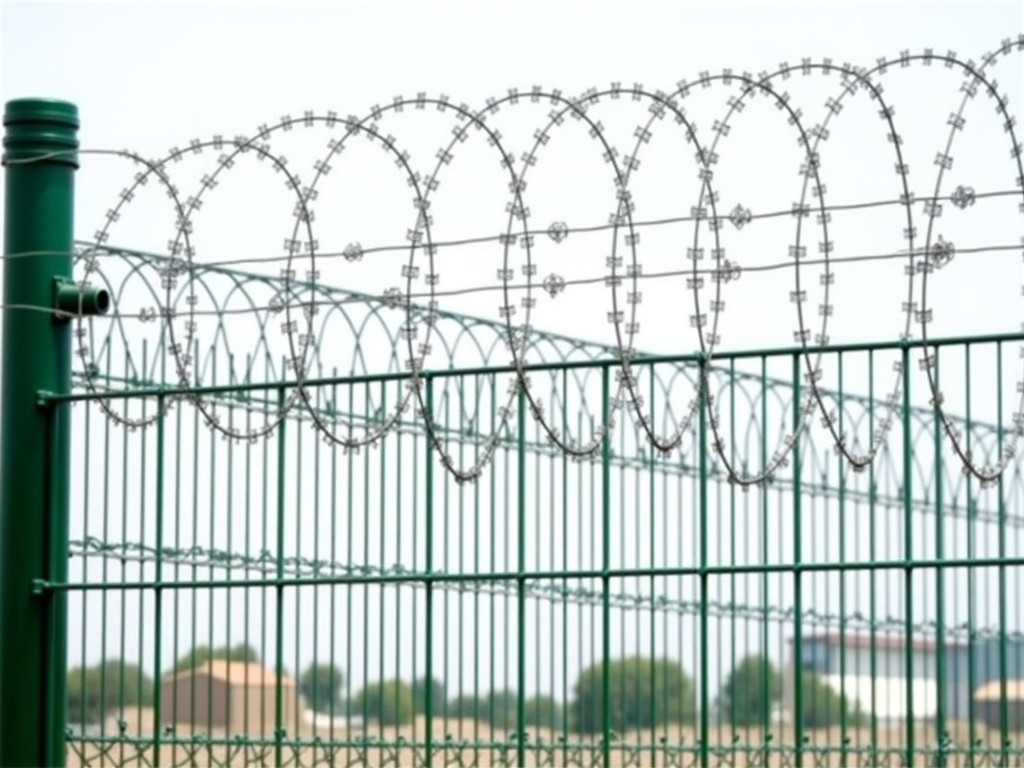
China Three Strand Barbed Wire Fence Top Supplier
A three‑strand barbed wire fence consists of three parallel high‑tensile steel wires, each uniformly spaced with barbs formed by twisting short protrusions around the wire core. The design provides a
Request a QuoteThree Strand Barbed Wire Fence – Technical Overview
A three‑strand barbed wire fence consists of three parallel high‑tensile steel wires, each uniformly spaced with barbs formed by twisting short protrusions around the wire core. The design provides a continuous deterrent barrier while maintaining flexibility for installation on posts or directly tensioned between anchors. Its performance is governed by wire diameter, tensile strength, barb geometry, and corrosion protection.
Construction and Materials
Typical core wire diameters range from 2.0 mm to 2.8 mm (12 – 10 AWG) with a minimum tensile strength of 550 MPa, allowing the fence to withstand tension loads exceeding 1.5 kN per strand without permanent deformation. Barbs are formed by winding a 1.5 mm diameter wire around the core at a pitch of 75 mm, producing a barb height of approximately 12 mm and a tip angle of 30°. The assembly is hot‑dip galvanized to a coating weight of 220 g/m² (≈15 µm zinc) or optionally coated with a zinc‑aluminum alloy for extended service life.
Key Technical Specifications
| Parameter | Typical Value | Unit |
|---|---|---|
| Core wire diameter | 2.0 – 2.8 | mm |
| Tensile strength (min) | 550 | MPa |
| Barb spacing (pitch) | 75 | mm |
| Barb height | 12 | mm |
| Zinc coating weight (hot‑dip) | 220 | g/m² |
| Elongation at break | ≥10 | % |
Performance Characteristics
The hot‑dip zinc coating provides a corrosion rate below 5 µm/year in rural atmospheres, translating to a service life of 20‑25 years before significant rust penetration. Under a uniform tensile load of 1.2 kN per strand, the fence exhibits elastic deformation with a Young’s modulus of approximately 200 GPa, returning to original length after load removal. Impact testing with a 5 kg pendulum at 2 m/s shows negligible permanent set, indicating good energy absorption for livestock containment. The alloy‑zinc option extends corrosion resistance to coastal environments with chloride exposure up to 5 g/m²/day.
Typical Applications
- Livestock perimeter fencing – the three‑strand geometry provides a visible barrier that discourages animal push‑through while allowing easy tensioning over long distances.
- Industrial site security – the barb height and spacing deter climbing attempts, and the high tensile strength resists cutting with conventional hand tools.
- Agricultural field boundaries – low maintenance galvanized coating withstands pesticide spray and soil abrasion, preserving functionality across seasonal cycles.
- Temporary construction site enclosures – lightweight rolls enable rapid deployment, and the wire can be reclaimed and reused after project completion.
Customization Options
- Wire diameter – selectable from 2.0 mm to 3.2 mm to match required load capacity.
- Barb pitch – adjustable between 50 mm and 100 mm to vary barrier density.
- Coating type – hot‑dip galvanized, Zn‑Al alloy, or PVC‑over‑zinc for color coding.
- Roll length – standard 200 m rolls, with custom lengths available upon request.
- Post‑attachment accessories – pre‑formed clips, tensioners, and corner brackets compatible with standard C‑ or U‑post profiles.
Quality Control and Testing
Each production lot undergoes inline diameter monitoring with laser gauges (±0.01 mm), tensile testing on a universal testing machine to verify minimum 550 MPa strength, and barb geometry inspection using optical comparators to ensure pitch and height tolerances within ±2 mm. Coating weight is measured by the strip‑weigh method per ASTM A123, and adhesion is assessed via the knife‑test (ASTM D3359). Finished rolls are subject to a 10 % visual inspection for surface defects, and a random sample is subjected to a 500‑hour salt‑spray chamber test (ASTM B117) to confirm corrosion resistance targets.
Packaging and Shipping
Rolls are wound on a steel core with an inner diameter of 50 mm, wrapped in UV‑stabilized polyethylene film, and placed in a corrugated cardboard box sized to prevent shifting. Each box carries a label with product code, wire diameter, coating type, length, and batch number for traceability. For export shipments, boxes are stacked on pallets, secured with stretch wrap, and protected with corner boards to withstand forklift handling and container vibration.
Frequently Asked Questions
Can the wire diameter and barb pitch be customized for a specific load requirement?
Yes. The manufacturing line allows diameter selection from 2.0 mm to 3.2 mm and barb pitch adjustment between 50 mm and 100 mm. Provide the desired tensile load or animal type, and engineering will recommend the optimal combination.
What information is needed to obtain a quotation?
Required details include: wire diameter (or target tensile strength), barb pitch, coating type (galvanized, Zn‑Al, PVC), roll length, quantity, and delivery destination. If the fence will be installed on specific post dimensions, sharing those helps us suggest compatible accessories.
How is quality verified before shipment?
Every batch passes dimensional, tensile, barb geometry, and coating weight tests as per internal QC protocol. A certificate of conformance (CoC) summarizing the test results is supplied with each shipment.
What packaging options are available for overseas transport?
Standard packaging is UV‑stabilized film wrapped rolls in cardboard boxes, palletized with stretch wrap and corner boards. Custom options include moisture‑barrier bags, wooden crates, or container‑direct loading for large volume orders.



