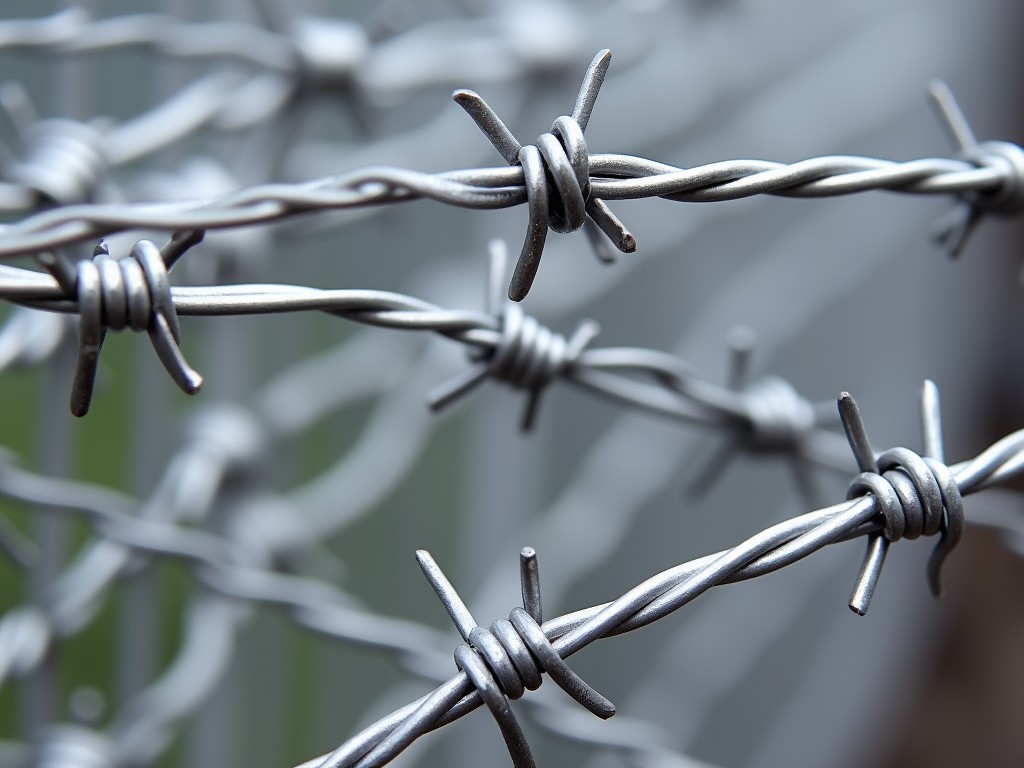
China Reverse Twist Barbed Wire Factory
Reverse twist barbed wire is a security fencing product formed by helically twisting two strands of steel wire around a central core, with barbs positioned at regular intervals. The reverse twist
Request a QuoteChina Reverse Twist Barbed Wire Factory
Reverse twist barbed wire is a security fencing product formed by helically twisting two strands of steel wire around a central core, with barbs positioned at regular intervals. The reverse twist configuration provides enhanced tensile stability and resistance to unraveling under load compared to conventional single‑twist designs.
Technical Specifications
| Parameter | Typical Value | Notes |
|---|---|---|
| Core Wire Diameter | 2.0 mm – 3.0 mm | High‑carbon steel, cold‑drawn |
| Barb Wire Diameter | 1.5 mm – 2.0 mm | Same material as core |
| Barb Spacing | 75 mm – 150 mm | Adjustable per project requirement |
| Twist Direction | Reverse (S‑twist) | Provides anti‑rotation lock |
| Tensile Strength (core) | ≥ 1550 MPa | Meets ASTM A121/ISO 10425 |
| Coating Options | Hot‑dip galvanized (Zn ≥ 200 g/m²) or PVC‑coated | Thickness customizable |
Materials and Corrosion Protection
The base wire is produced from high‑carbon steel rod, drawn to the required diameter and annealed to achieve a balance of ductility and strength. For outdoor exposure, the wire is typically hot‑dip galvanized, forming a metallurgical zinc‑iron alloy layer that inhibits rust formation. In environments with aggressive chemicals or high salinity, a PVC overcoat can be applied, adding a barrier thickness of 0.3 mm–0.5 mm and extending service life beyond 15 years under moderate UV exposure.
Manufacturing Process
Production begins with wire drawing to achieve precise core and barb diameters. The wires are then fed into a twin‑head twisting machine where the reverse helix is formed at a controlled pitch, ensuring uniform barb spacing. After twisting, the product passes through a cleaning station, followed by either a galvanizing bath or a PVC extrusion line, depending on the selected finish. Final spooling is performed under tension control to prevent deformation.
Applications
- Perimeter security for industrial facilities, where the reverse twist resists cutting attempts and maintains tension over long spans.
- Agricultural livestock enclosures, providing a durable barrier that withstands animal pressure without sagging.
- Temporary construction site fencing, offering quick installation and reliable performance under variable loads.
- Correctional and military perimeters, where the anti‑unraveling characteristic enhances delay against breach attempts.
Quality Control Philosophy
Each batch undergoes dimensional verification of wire diameter, barb spacing, and twist pitch using calibrated laser gauges. Tensile samples are tested to confirm minimum strength values, and coating thickness is measured with magnetic or eddy‑current probes. Visual inspection detects surface defects such as nicks or uneven zinc coverage. Only products meeting the predefined tolerances are cleared for shipment.
Customization Options
Clients may specify core diameter, barb length, barb spacing, and twist direction to match site‑specific mechanical requirements. Coating type (galvanized, PVC, or dual‑layer) and color can be adjusted for aesthetic or environmental considerations. Lengths are supplied in standard coils of 25 m or 50 m, with custom spool sizes available upon request.
Packaging and Shipping
Finished coils are wrapped in water‑resistant polyethylene film, placed on wooden pallets, and secured with steel straps. For export, pallets are fitted with corner protectors and stretch‑wrapped to prevent shifting during transit. Each package includes a label indicating product code, coil length, weight, and coating specification.
Frequently Asked Questions
- Can dimensions be customized? Yes, core diameter, barb spacing, and coil length can be tailored to project requirements.
- What information is needed for a quotation? Required details include wire diameter, barb length, spacing, coating type, total length, and delivery destination.
- How is quality inspected? Dimensional checks, tensile testing, and coating thickness measurements are performed on each batch.
- What packaging methods are available? Standard coil wrapping with palletization; custom spool sizes and protective crating are offered.
- What is the typical lead time? Production typically begins within 5–7 working days after order confirmation, with shipping dependent on destination.
To discuss your specific fencing needs or request a technical data sheet, please use the contact form below.
Submit Inquiry


