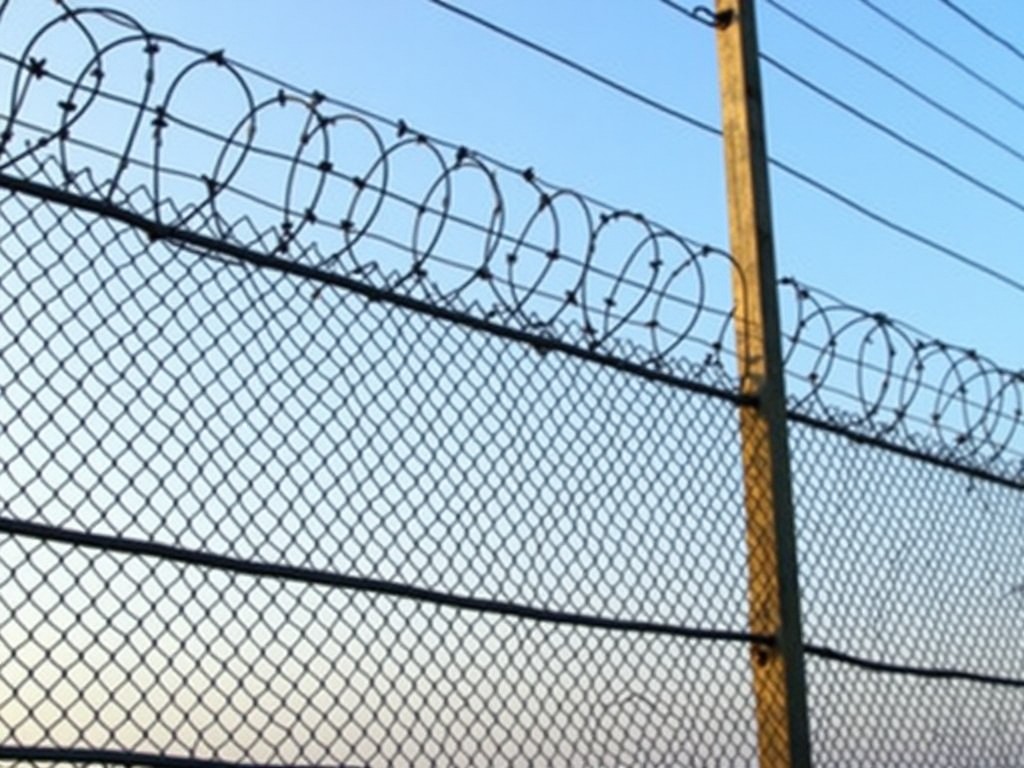
China Rbt Reinforced Barbed Wire Manufacturer
RBT reinforced barbed wire combines a high‑tensile steel core with a helical steel reinforcement that is welded or mechanically locked to the core before barbing. This configuration increases
Request a QuoteChina RBT Reinforced Barbed Wire
RBT reinforced barbed wire combines a high‑tensile steel core with a helical steel reinforcement that is welded or mechanically locked to the core before barbing. This configuration increases resistance to cutting and impact while maintaining the traditional deterrent effect of sharp barbs. The product is intended for perimeter security where mechanical durability and long service life are critical.
Key Technical Specifications
| Parameter | Typical Value | Unit | Notes |
|---|---|---|---|
| Core Wire Diameter | 2.5 | mm | Cold‑drawn high‑carbon steel |
| Reinforcement Diameter | 1.8 | mm | Helical steel welded at 50 mm intervals |
| Barb Length | 15 | mm | Sharp‑cut, double‑pointed |
| Barb Spacing | 100 | mm | Uniform along the length |
| Tensile Strength (Core) | ≥1700 | MPa | Measured per ISO 6935‑1 |
| Coating Type | Hot‑dip Galvanized (Zn) | – | Minimum 275 g/m² |
Material Composition
The core wire is produced from SAE 1080 high‑carbon steel, which after cold drawing achieves a carbon content of approximately 0.78 % and a manganese content of 0.6 % to 0.9 %. This composition provides the necessary hardness and tensile strength while retaining sufficient ductility for the subsequent forming processes. The helical reinforcement uses the same steel grade to ensure compatible elongation characteristics under load.
Barbed Wire Geometry
Barbs are formed by cutting a length of the reinforced wire, twisting it into a double‑pointed shape, and then helically wrapping it around the core at a 45 ° angle. The reinforcement wires are positioned centrally within each barb twist, which prevents the barb from being pulled away from the core under tensile load. The resulting profile provides a consistent cross‑sectional area that resists both axial pull‑out and lateral cutting.
Manufacturing Process Overview
Production begins with hot‑rolled rod that is drawn through a series of dies to reach the target core diameter. The drawn core is then cleaned and passed through a hot‑dip galvanizing bath to achieve the specified zinc coating weight. Simultaneously, reinforcement wire is fed, wound helically around the core, and spot‑welded at predetermined intervals. The combined strand proceeds to the barb‑forming station where cut lengths are twisted and wrapped. Finally, the finished product is spooled onto reels with protective interleaving and prepared for shipment.
Typical Applications
Because the reinforcement significantly raises the wire’s resistance to bolt cutters and abrasion, RBT reinforced barbed wire is chosen for high‑risk facilities such as military bases, correctional institutions, and critical infrastructure perimeters. It is also employed in agricultural settings where wildlife pressure demands a barrier that can withstand repeated impact without loss of integrity. The galvanized coating extends service life in humid or coastal environments, reducing maintenance cycles.
Quality Assurance & Testing
Each production lot undergoes tensile testing on the core wire to verify that the minimum strength meets or exceeds 1700 MPa. Coating adhesion is assessed by the bend test according to ASTM A123, ensuring no flaking when the wire is bent over a mandrel of three times its diameter. Barb retention is checked by applying a static load of 500 N to a sample barb and measuring any displacement; acceptable performance is defined as less than 2 mm movement. Visual inspection confirms uniform barb spacing and proper weld integrity of the reinforcement.
Customization Options
Customers can specify core wire diameters ranging from 2.0 mm to 3.2 mm, which directly influences tensile strength and flexibility. Barb length can be adjusted between 12 mm and 20 mm to meet specific deterrent requirements, while spacing can be varied from 75 mm to 150 mm. Coating options include standard hot‑dip galvanization, zinc‑aluminum alloy (Zn‑5Al‑MM) for enhanced corrosion resistance, or PVC over‑coat for colour coding. Reel lengths are available from 200 m to 800 m with custom labeling upon request.
Frequently Asked Questions
- Can dimensions be customized? Yes, wire diameter, barb length, spacing, and coating type can be tailored to project specifications.
- What information is required before quotation? Required details include desired core diameter, barb geometry, coating preference, total length, and any special packaging or labeling needs.
- What materials are available? The core and reinforcement are made from SAE 1080 high‑carbon steel; coatings include hot‑dip galvanized Zn, Zn‑5Al‑MM alloy, and optional PVC over‑coat.
- How is quality inspected? Each lot is tested for tensile strength, coating adhesion (ASTM A123 bend test), barb retention under load, and visual uniformity of barbs and welds.
- What packaging methods are available? Standard packaging uses waterproof‑treated reels with protective interleaving; custom palletizing, crating, or corrosion‑inhibitor treated wrapping can be arranged.
- How are export shipments protected? Reels are placed in sturdy cartons with edge protection, strapped to pallets, and sealed with stretch film; moisture‑absorbent desiccants are included for long transit.
- What is the typical production lead time? Lead time depends on order size and customization, generally ranging from 15 to 30 working days after receipt of confirmed specifications.
- How are samples arranged? Samples of up to 30 m can be provided free of charge; freight costs are borne by the requester unless otherwise agreed.
Contact for Technical Inquiry
For further technical details, customization requests, or a formal quotation, please reach out to our engineering team. We will review your application specifics and provide a prompt response with relevant data and pricing.



