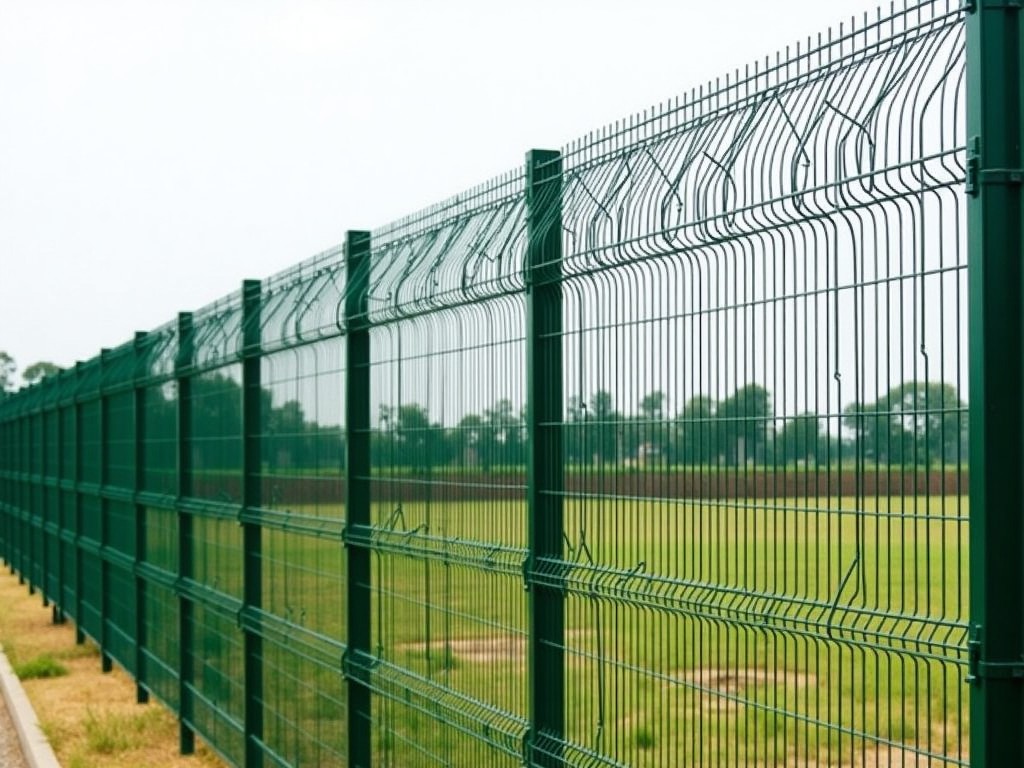
China Razor Wire Fence Manufacturer Exporter
Razor wire fence consists of high‑tensile steel wire formed into sharp barbs that are helically wound around a central core wire. This configuration creates a continuous barrier that resists cutting
Request a QuoteChina Razor Wire Fence Manufacturer Exporter
Razor wire fence consists of high‑tensile steel wire formed into sharp barbs that are helically wound around a central core wire. This configuration creates a continuous barrier that resists cutting and climbing attempts.
Manufacturers select wire grades based on required tensile strength, typically ranging from 550 MPa to 1 200 MPa, and apply protective coatings to suit environmental exposure.
Product Overview
The factory produces coil‑type razor wire in standard diameters of 2.5 mm, 3.0 mm, and 3.5 mm, with barb lengths varying from 15 mm to 30 mm. Coil pitch (distance between adjacent barbs) is adjustable to meet specific security levels.
Custom lengths are achievable by splicing coils using mechanical couplers that maintain the original tensile capacity of the wire.
Technical Specifications
| Parameter | Typical Value | Notes |
|---|---|---|
| Wire Diameter | 2.5 mm – 3.5 mm | Custom diameters available on request |
| Tensile Strength | 550 MPa – 1 200 MPa | Dependent on wire grade |
| Barb Length | 15 mm – 30 mm | Longer barbs increase deterrence |
| Coil Pitch | 40 mm – 80 mm | Adjustable per project requirement |
| Coating Type | Hot‑dip Galvanized, PVC‑Coated, or Stainless Steel | Coating thickness typically 55 µm (galvanized) or 0.2 mm (PVC) |
Material & Coating Options
- Low‑carbon steel wire (ASTM A641) for general purpose applications.
- High‑carbon steel wire (ASTM A228) where higher tensile strength is required.
- Stainless steel grade 304 or 316 for corrosive environments such as coastal or chemical plants.
- Hot‑dip galvanization per ISO 1461 provides a zinc layer of 55 µm average thickness.
- PVC coating available in colors black, green, or gray with a thickness of 0.2 mm for added UV resistance.
Design Variants
- Single‑coil razor wire – simplest form, suitable for low‑to‑medium security perimeters.
- Double‑coil (concertina) razor wire – two interlocking coils provide increased difficulty of penetration.
- Flat‑wrap razor wire – barbs are pressed flat against the core, reducing profile while maintaining deterrence.
- Barbed tape razor wire – integrates a polymer tape backing for easier handling and installation.
Applications
Correctional facilities deploy razor wire on perimeter walls because the sharp barbs create a psychological deterrent and increase the time required for an intruder to breach the barrier.
Military bases use concertina razor wire to protect forward operating bases; the tangled coils impede vehicle movement and foot traffic, buying critical response time.
Industrial sites such as power substations and data centers install flat‑wrap razor wire on fences to deter vandalism while maintaining a low visual profile that meets architectural guidelines.
Quality Assurance
Each batch undergoes tensile testing according to ASTM A370 to verify that the wire meets the specified strength range before forming.
Coating adhesion is assessed via ASTM D3359 tape test; a minimum rating of 4B is required for galvanized and PVC layers.
Dimensional inspections confirm wire diameter, barb length, and coil pitch within ±0.1 mm tolerance using calibrated calipers and laser gauges.
Final visual inspection checks for uniform barb orientation and absence of defects such as cracks or uneven coating.
Packaging & Shipping
- Coils are secured on wooden pallets with stretch film to prevent shifting during transit.
- Each pallet is labeled with product code, coil length, weight, and handling instructions.
- For export, pallets are placed in ISO‑standard containers with moisture‑absorbing desiccants to protect against corrosion.
- Shipping documents include material test certificates and coating thickness reports upon request.
Frequently Asked Questions
- Can dimensions be customized? Yes, wire diameter, barb length, coil pitch, and overall coil length can be adjusted to match project specifications.
- What information is required before quotation? Required details include desired wire grade, coating type, dimensions, quantity, and delivery destination.
- What materials are available? Low‑carbon steel, high‑carbon steel, and stainless steel (grades 304/316) with galvanized, PVC, or bare finishes.
- How is quality inspected? Through tensile strength tests, coating adhesion tests, dimensional checks, and visual inspections as described in the Quality Assurance section.
- What packaging methods are available? Standard palletized stretch‑wrapped coils; custom crating or container loading can be arranged.
- How are export shipments protected? Pallets are wrapped, desiccants are added, and containers are sealed to mitigate moisture and mechanical damage.
- What is the typical production lead time? Lead time ranges from 2 to 4 weeks depending on order complexity and current factory load.
- How are samples arranged? Sample coils (up to 5 m length) can be dispatched via express courier; shipping costs are borne by the requester.
Get in Touch
For technical discussions, quotation requests, or sample availability, please contact our export team.



